As your child moves up through Key Stage 2, they’ll start to learn about factors and prime numbers in maths lessons. If you’re looking to help your child learn at home but not sure where to start, we’re here to help!
Keep reading to:
- Learn about factors and prime numbers
- Understand what your child will be taught at school
- Plus, download free factors worksheets for Years 5 and 6!
What is a factor?
A factor of a number defines the integers (whole numbers) which divide exactly into that number with no remainder. 5 is a factor of 35 because 35 ÷ 5 = 7.
Every number can be represented as a product of 2 of its factors. For example, we can represent the number 12 in 6 different ways:
- 1 group of 12
- 2 groups of 6
- 3 groups of 4
- 4 groups of 3
- 6 groups of 2
- 12 groups of 1
The reason for this is that the number 12 has 6 different factors: 1, 2, 3, 4, 6 and 12.
What are common factors?
Common factors describe the factors which two different numbers can both be divided by. For example, take the factors of 16 and 18:
- Factors of 16: 1, 2, 4, 8, 16
- Factors of 18: 1, 2, 3, 6, 9, 18
The only common factor (other than 1) between these two numbers is the number 2. Since 16 isn't a factor of 18, both numbers also have factors which are unique to them. 12 and 16 do not share all their factors, but still have 3 common factors: 4, 2 and 1.
In Key Stage 2 maths tests, your child might see factor questions involving a Venn diagram. Here’s an example of one of these types of questions on Atom.
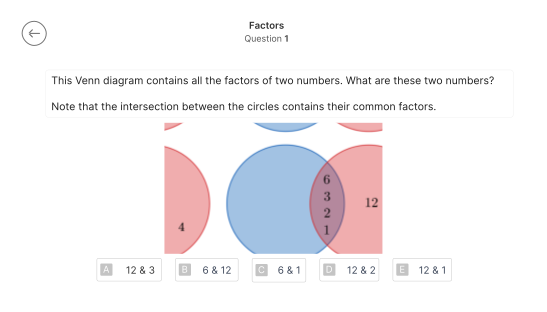
In the right (red) circle, we see all the factors of 12. These are 1, 2, 3, 4, 6 and 12.
All the numbers in the left (blue) circle are in the intersection, meaning there are no factors of the left number that are not factors of 12. This means that all the factors of the left number are also factors of 12 – so the number itself must be a factor of 12.
The factors in the intersection are all the factors of 6, so the left number is 6. The correct answer is 6 & 12.
Your child might also come across longer worded questions. Take a look at this example from Atom:
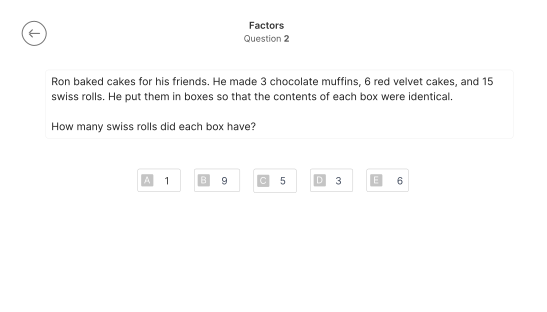
To solve this problem, we need to find a common factor of 3, 6 and 15. This will give us the number of boxes.
- The factors of 3 are 1 and 3
- The factors of 6 are 1, 2, 3 and 6
- The factors of 15 are 1, 3, 5 and 15
The only common factor of 3, 6 and 15 is 3. Ron can pack 3 identical boxes. To find out how many pastries are in each identical box, we divide their total by 3. Each box will have 1 chocolate muffin (3÷3), 2 red velvet cakes (6÷3), and 5 swiss rolls (15÷3).
So the answer is C – 5 swiss rolls.