Science is one of the compulsory subjects on the Key Stage 2 national curriculum. As a hands-on subject, many children enjoy learning about science by interacting with the world around them.
In this article, we’ll help you understand what your child will learn in Key Stage 2 science. Keep reading to find out:
Which topics are on the KS2 science curriculum
How to help your child build science skills at home
What is the national curriculum?
The national curriculum is a programme of study for primary and secondary schools in England. State schools teach the same subjects and standards so that children across the country all learn the same things.
The national curriculum is organised into ‘key stages’, which span different age groups. Tests at the end of each key stage assess your child’s performance and understanding of what they have learnt.
Early years: ages 3–5 (nursery and reception)
Key Stage 1: ages 5–7 (years 1–2)
Key Stage 2: ages 7–11 (years 3–6)
Key Stage 3: ages 11–14 (years 7–9)
Key Stage 4: ages 14–16 (years 10–11)
Join Atom’s free parent newsletter
Stay one step ahead of your child’s learning journey. Get expert advice on 11+ prep, Key Stage 2 support, and school admissions, plus practical tips and free resources, sent straight to your inbox.
Here’s a breakdown of the topics your child will learn on KS2 science national curriculum.
Year 3 science curriculum
Plants
Describe the functions of parts of flowering plants
Understand how the requirements for life and growth vary between plants
Investigate how water is transported within plants
Understand the role of flowers, including pollination, seed formation and seed dispersal
Animals including humans
Identify that animals, including humans, can’t make their own food and need specific nutrition
Understand the role of skeletons and muscles
Rocks
Group rocks based on their properties
Describe how fossils are formed
Recognise that soil is made from rocks and organic matter
Light
Understand the relationship between light and dark
Understand how reflections work
Understand the danger of direct light and the importance of protection
Recognise that shadows are formed when light is blocked by an opaque object
Forces and magnets
Compare how things move on different surfaces
Observe how magnets attract or repel each other
Compare and group materials based on their magnetic attraction
Working scientifically
Use scientific enquiry to answer questions
Set up simple practical enquiries, comparative and fair tests
Take accurate measurements using equipment such as thermometers and data loggers
Gather, record, classify and present data using drawings, labelled diagrams, keys, bar charts, and tables
Use results to draw simple conclusions, make predictions, and suggest improvements
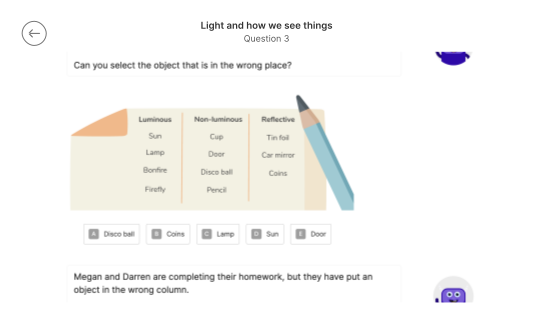
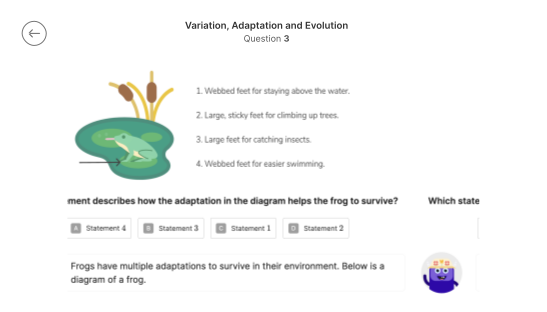
Here’s an example of a Year 3 science question on Atom – the online learning platform for ages 7–11.
Year 4 science curriculum
Living things and their habitats
Recognise and use classification to group, identify and name living things in the environment
Understand that environments can change and that this can sometimes pose dangers to living things
Animals including humans
Describe the simple functions of the digestive system
Identify different types of human teeth and their functions
Construct and interpret food chains and identify producers, predators and prey
States of matter
Group materials based on whether they are solids, liquids or gases
Measure the temperature change in degrees Celsius when materials change state
Understand evaporation and condensation in the water cycle
Sound
Identify how vibrations make sound
Find patterns between sound pitch and features of the object making the sound
Find patterns between volume and the strength of vibrations
Electricity
Identify common appliances that run on electricity
Construct a simple series electrical circuit using cells, wires, bulbs, switches and buzzers
Understand how a switch can open and close a circuit, and turn a lamp on or off
Recognise common insulators and conductors, including metals
Working scientifically
Use scientific enquiry to answer questions
Set up simple practical enquiries, comparative and fair tests
Take accurate measurements using equipment such as thermometers and data loggers
Gather and record data using drawings, labelled diagrams, keys, bar charts, and tables
Use results to draw simple conclusions, make predictions, and suggest improvements
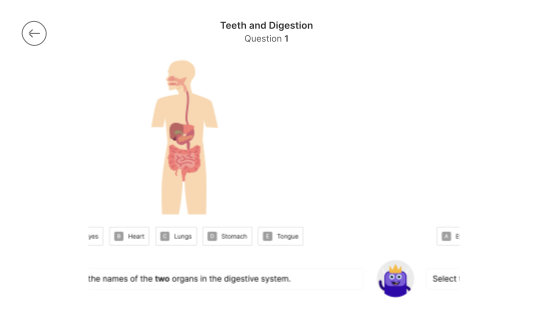
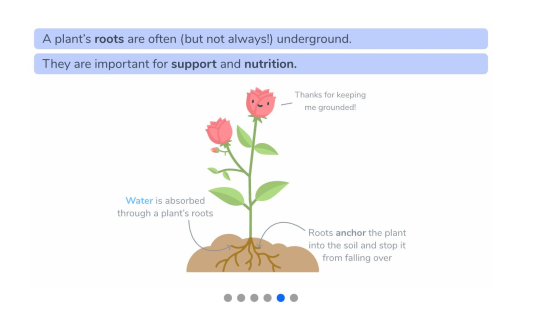
Take a look at an example Year 4 science question on Atom.
Year 5 science curriculum
Living things and their habitats
Describe the life cycles of mammals, amphibians, insects and birds
Describe the life process of reproduction in some plants and animals
Animals including humans
Describe the changes to the human body as it gets older
Properties and changes of materials
Compare and group everyday materials based on their properties
Understand how materials dissolve in liquids to form a solution
Use knowledge of solids, liquids and gases to decide how mixtures can be separated
Discuss the uses of everyday materials, including metal, wood and plastic
Understand which changes of state are reversible and irreversible
Earth and space
Describe how planets in the solar system are are relative to the Sun
Describe the movement of the Moon relative to the Earth
Understand how Earth’s rotation creates day and night
Forces
Understand the force of gravity
Identify the effects of air resistance, water resistance and friction
Recognise how mechanisms such as levers, pulleys and gears allow a smaller force to have a greater effect
Working scientifically
Recognise and control variables to answer scientific enquiries
Take measurements with increasing accuracy and precision
Gather and record data using drawings, labelled diagrams, keys, classification keys, tables, and scatter, bar and line graphs
Draw conclusions based on test results to make predictions
Present findings from enquiries, including conclusions
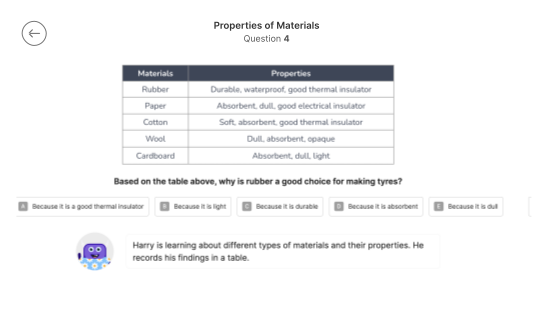
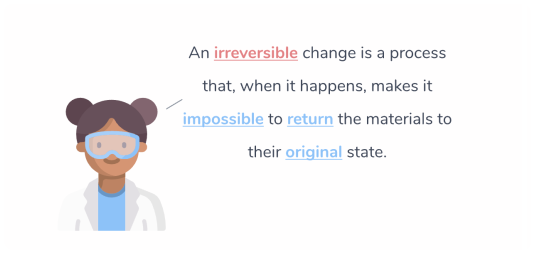
Here’s a science question appropriate for Year 5 on Atom.
Year 6 science curriculum
Living things and their habitats
Classify microorganisms, plants and animals based on similarities and differences
Give reasons for classifying plants and animals based on specific characteristics
Animals including humans
Name the main parts of the human circulatory system
Describe the functions of the heart, blood, and blood vessels
Recognise the impact of diet, exercise, drugs and lifestyle on the human body
Describe how nutrients and water are transported within animals, including humans
Evolution and inheritance
Recognise that living things have changed over time
Recognise how fossils provide historical information
Recognise that living things produce offspring, but they vary and are not identical to their parents
Identify how animals and plants are adapted to their environment
Understand that adaptation may lead to evolution
Light
Recognise that light appears to travel in straight lines and use this ideal to explain how we see objects
Explain why shadows have the same shape as the objects that cast them
Electricity
Associate lamp brightness or buzzer volume with the number and voltage of cells in a circuit
Use recognised symbols in a diagram of a circuit
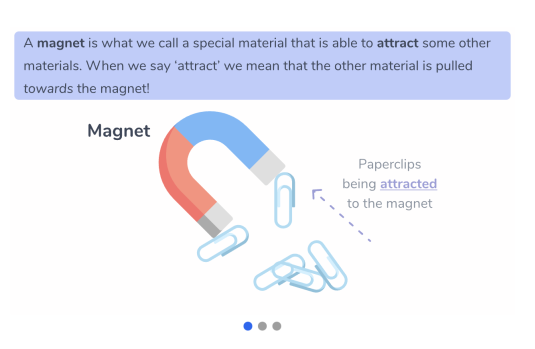
Take a look at a Year 6 science question on Atom below.
No items found.
How is KS2 science tested?
Key Stage 2 science is no longer formally tested. Only English and maths are tested in Year 6 SATs.
Instead, your child’s scientific knowledge and skills will be assessed by their class teacher. They will look at whether your child is working at the expected standard in each topic. This information is usually available in your child’s school report.
KS2 science experiments to try at home
Here are some practical activities you and your child can try at home!
1. Plants: experimenting with flowers
In this activity, your child will need to identify and describe the functions of different parts of flowering plants. They will see how the relationship works between structure and function. They will observe the way that water is transported in plants.
Materials
White flowers (white carnations work well)
Food colouring (a variety of colours)
Drinking glasses
Water
A spoon
A pair of scissors
A kitchen knife
Instructions
Using the scissors, trim about one inch off the ends of the flowers.
Fill the drinking glasses with water. Add around 10 drops of different food colouring into each glass of water and stir with the spoon.
Place a couple of flowers into each glass. Save some remaining flowers for dissection.
Write down what you think will happen to each plant in the coloured water!
Use the kitchen knife to dissect the spare flowers. Name and label all the different parts of the flower and explain what purpose each part has.
Observe how the flowers change every day and think about how it compares to your hypothesis.
2. Changing materials: make bath bombs
In this activity, your child will learn how some changes are irreversible and result in the formation of new materials. They will observe what a chemical change looks like.
Materials
Food colouring
Flower petals or biodegradable body glitter
Sweet almond oil
A scented oil of your choice (e.g. lavender)
A small glass jar
A muffin tin
Bicarbonate of soda
Citric acid
Two large bowls
Rubber gloves
A tablespoon
Instructions
Mix three tablespoons of citric acid and ten tablespoons of bicarbonate of soda in the bowl.
Mix in the flower petals or the biodegradable body glitter.
In the small jar, combine six drops of the scented oil, five teaspoons of sweet almond oil, and ten drops of food colouring.
Slowly pour the oil mixture into the bowl. Mix it together until it’s not too crumbly.
Grease the muffin tray with some sweet almond oil and scoop the mixture into the tray.
Set the mixture aside to set (this might take a few days). When it’s set, run yourself a bath and watch what happens when you put a bath bomb into the water!
3. Gravity-defying magnets
In this experiment, your child will learn how magnetic forces can act at a distance and how they attract or repel each other.
Materials
A stick
String
Paperclips
A pair of scissors
Tale
Strong magnets
A metal ruler
A few books
Instructions
Tie a paperclip to a piece of string. Tie the other end of the string to the stick.
Lift the stick so that the paperclip is hanging from it. Note the effect of earth’s gravity on the paperclip. No matter how you tilt the stick, the paperclip is always pulled towards the earth by gravity.
Place a magnet on a metal ruler.
Create two stacks of books with a gap between them, and place the ruler on top so that it crosses the gap like a bridge. Make sure the magnet is facing down.
Untie the string from the stick (keeping the paperclip attached) and tape the string to the table directly under the magnet.
Slowly lift the paperclip to the magnet until it’s suspended and looks as if it is floating in the air underneath. Lift up the ruler to see how the paperclip drops to the ground again. What do you think is happening?
No items found.
No items found.
No items found.
Build strong English, maths and science skills.
Want to support what your child is learning at school, or help them stretch beyond it? Atom gives them the right blend of challenge and support. Help them strengthen foundations, deepen understanding, and grow confident in the subjects that matter most for Key Stage 2 and beyond.
Follow personalised weekly learning plans that adapt to your child’s level and keep them progressing in English, maths and science.
Learn through interactive lessons that stretch their thinking and reinforce key skills.
Track progress topic by topic. See their strengths and pinpoint where they need to improve.
Strengthen foundations and build confidence.
Start your free trial and help your child make real school progress today.