How can I help my child manage text anxiety?
1. Emphasise a growth mindset
- A fixed mindset is the belief that abilities can't be changed – that natural intelligence is the only way to success.
- A growth mindset is the belief that abilities are developed over time through hard work, strategies, and input from others.
Helping your child to establish a growth mindset, rather than a fixed mindset, will help them to approach exams in a balanced and realistic way.
One way to support a growth mindset in your child is to think about the type of praise you are giving them. Studies have found that children's mindset is influenced by the type of praise they get.
- Personal praise that focuses on innate qualities or labels (such as "you're clever" or "you're good at this subject") is likely to promote a fixed mindset.
- Process praise that focuses on their effort and approach (such as "you studied really well for this and your hard work paid off") is likely to encourage a growth mindset.
Try to avoid the temptation to over-focus on rewarding good results – instead, praise their resilience in making mistakes and learning from them, their attention to detail and improvements they've made. Ask them to reflect on what they're proud of during the revision process.
2. Establish the right environment
'Tidy desk, tidy mind'. We’ve all heard it – for a reason. Revising for exams involves absorbing lots of information and too many external stimuli can cause difficulty concentrating.
Help your child set up the right environment by establishing a dedicated study space free from distraction. Consider somewhere with plenty of natural light, far away from TV screens and noisy siblings.
3. Learn and practise together
Preparing for exams can be an isolating experience, but research shows that children whose parents are involved in their schoolwork reap benefits such as improved wellbeing and better academic performance.
Revising exam content together and working on test-taking strategies is an opportunity for you to bond with your child in a shared activity, while demonstrating that parents don’t know everything (which is perfectly OK!) and reinforcing that growth mindset.
4. Reinforce healthy routines
Whether your child is sporty or not, there’s no denying that exercise has a hugely positive impact on brain health - notably by aiding memory. Ensure your child gets daily activity, such as walking, cycling, dancing or playing team sports, to sharpen their brain and alleviate stress while improving physical health. Implementing a well-balanced diet to boost energy also helps.
A good night's sleep is underrated when it comes to reducing test anxiety and setting a firm bedtime can improve concentration. Ensure your child is getting enough sleep for their age. Research shows that children aged between six and 12 should be sleeping for nine to twelve hours a night, while teenagers need at least eight hours.
5. Try calming strategies
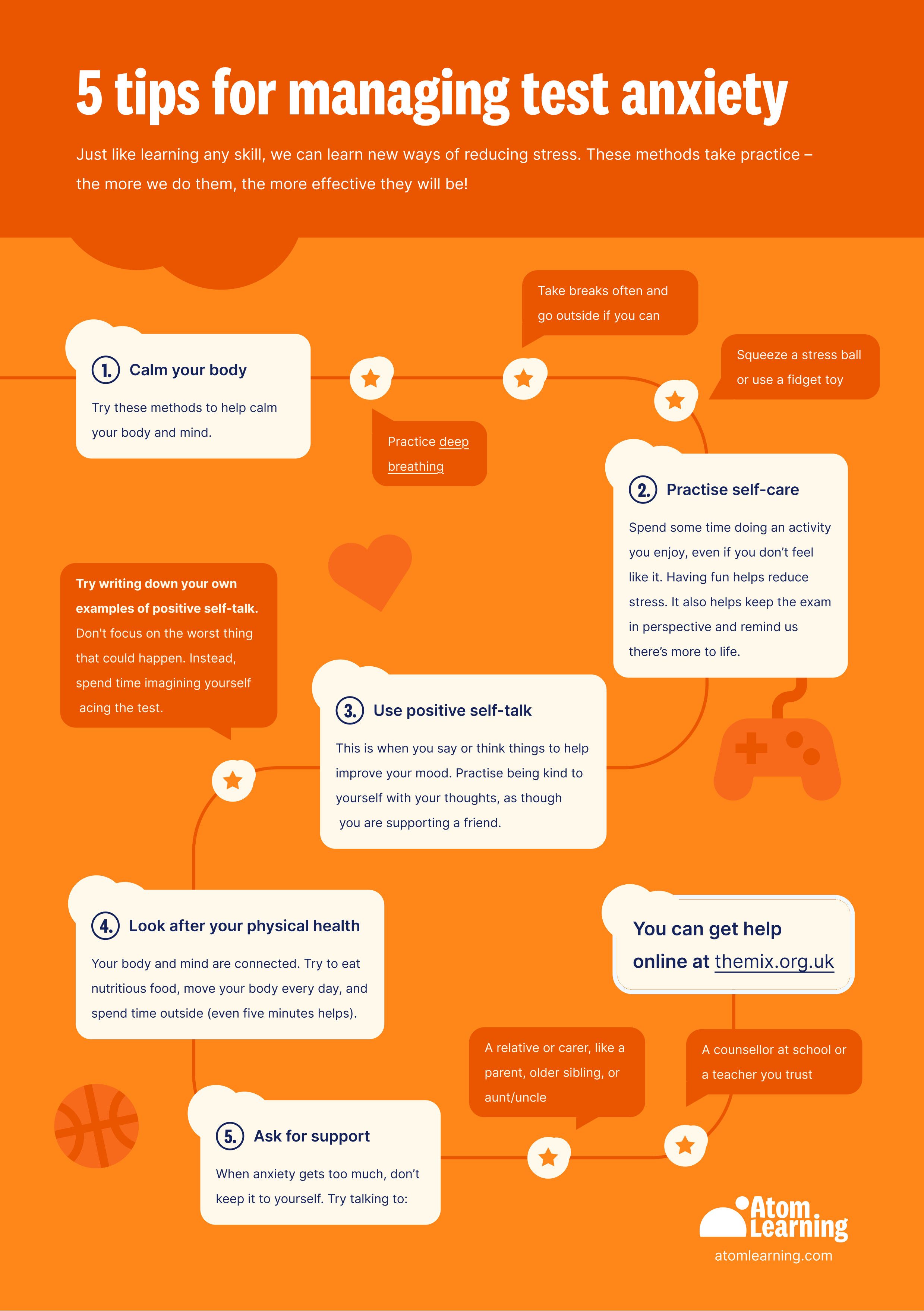
While some children are blessed with natural confidence, others may find themselves overcome with panic in the exam room. Teach your child techniques for deep breathing, such as box breathing, to help them manage the physical symptoms of test anxiety.
It may also be worth helping your child develop a strategy for difficult questions, such as making a note of the question to return to later.
6. Maintain perspective
We all want our children to succeed, but too many young people worry about disappointing their parents and develop a fear of failure.
Children don’t yet have the ability to maintain perspective, so make sure to remind your child that not performing as expected is not the end of the world. Don't add to your child's stress – stay calm and reassure your child that trying their best is the most you ask.