Maths is an essential life skill and one of the core subjects taught on the Key Stage 2 national curriculum. If your child is in primary school, they'll have regular maths lessons every week, if not every day.
If you're looking to understand what your child will learn in KS2 maths, we've got you covered. Keep reading to:
find out which topics your child will learn in Years 3–6
learn how your child's maths knowledge will be tested
get tips to support your child's learning at home
What is the national curriculum?
The national curriculum is a programme of study for primary and secondary schools in England. State schools teach the same subjects and standards so that children across the country all learn the same things.
The national curriculum is organised into ‘key stages’, which span different age groups. Tests at the end of each key stage assess your child’s performance and understanding of what they have learnt.
Early years: ages 3–5 (nursery and reception)
Key Stage 1: ages 5–7 (Years 1–2)
Key Stage 2: ages 7–11 (Years 3–6)
Key Stage 3: ages 11–14 (Years 7–9)
Key Stage 4: ages 14–16 (Years 10–11)
Join Atom’s free parent newsletter
Stay one step ahead of your child’s learning journey. Get expert advice on 11+ prep, Key Stage 2 support, and school admissions, plus practical tips and free resources, sent straight to your inbox.
Take a detailed look at what your child will learn on the Key Stage 2 maths curriculum below.
Year 3 maths
The aim of the Year 3 maths curriculum is to ensure that your child becomes more confident with increasingly large numbers. They’ll learn how to use all four operations, and times tables are a big focus of this. They’ll also develop their ability to solve a range of problems using simple fractions and decimals.
Number and place value
Count in multiples of 4, 8, 50, and 100
Find 10 or 100 more or less than a given number
Recognise the place value of each digit in a three-digit number
Compare and order numbers up to 1,000 and write them in numerals and words
Addition and subtraction
Use mental maths to add and subtract numbers
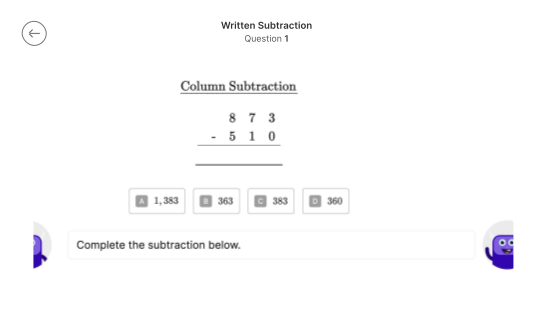
Use column addition and subtraction to add and subtract three-digit numbers
Estimate an answer to a calculation and use inverse operations to check if it’s correct
Multiplication and division
Know multiplication facts for the 3, 4 and 8 times tables
Multiply two-digit numbers by one-digit numbers
Use mental maths to solve multiplication and division problems, and start using formal written methods
Fractions
Count up and down in tenths
Find fractions of quantities and write them as numbers
Understand equivalent fractions with small denominators
Add and subtract fractions with the same denominator
Measurement
Measure the perimeter of 2D shapes
Measure, compare, add, and subtract lengths, mass and volume
Add and subtract amounts of money using both £ and pence
Work out the time using an analogue clock. This includes using Roman numerals from I to XII, 12-hour clocks and 24-hour clocks
Record and compare time in seconds, minutes and hours
Know how many days are in a month, a year and a leap year
Geometry
Draw 2D shapes and make 3D shapes
Identify right angles and work out whether angles are greater or smaller than a right angle
Identify horizontal and vertical lines, and pairs of perpendicular and parallel lines
Statistics
Use bar charts, pictograms and tables to interpret and present data
Answer one-step and two-step questions about this data
Here's an example Year 3 maths question on Atom – the online learning platform for ages 7–11.
Year 4 maths
On the Year 4 maths curriculum, your child will be introduced to negative numbers. They’ll start to solve two-step problems in context – such as using different methods to find the answer in a real-life scenario. By the end of Year 4, they should have memorised their times tables up to and including 12 x 12.
Number and place value
Count in multiples of 6, 7, 9, 25, and 100
Count backwards through 0 to include negative numbers
Round numbers to the nearest 10, 100, or 1,000
Recognise the place value of each digit in a four-digit number
Read Roman numerals up to 100 (I to C)
Addition and subtraction
Use column addition and subtraction to add and subtract numbers with up to four digits
Estimate an answer to a calculation and use inverse operations to check if it’s correct
Decide which operations and methods to use to solve two-step problems
Multiplication and division
Know multiplication facts for all times tables up to 12 x 12
Multiply three-digit numbers by one-digit numbers
Understand and use factor pairs
Fractions and decimals
Count up and down in hundredths
Find fractions of quantities and write them as numbers
Understand equivalence between fractions and decimals
Add and subtract fractions with the same denominator
Divide one-digit and two-digit numbers by 10 and 100
Round decimals with 1 decimal place to the nearest whole number
Measurement
Work out the perimeter and area of shapes
Convert between different units of measurement
Estimate, compare and calculate measures, including money in £ and pence
Read, write and convert time between analogue and digital 12-hour and 24-hour clocks
Convert from hours to minutes, minutes to seconds, years to months, and weeks to days
Geometry
Classify triangles and quadrilaterals
Identify acute and obtuse angles
Identify lines of symmetry in 3D shapes
Plot coordinates in the first quadrant of a grid
Translate shapes from up to down, and left to right
Statistics
Use bar charts and line graphs to interpret and present data
Use bar charts, pictograms, and tables to solve comparison, sum and difference problems
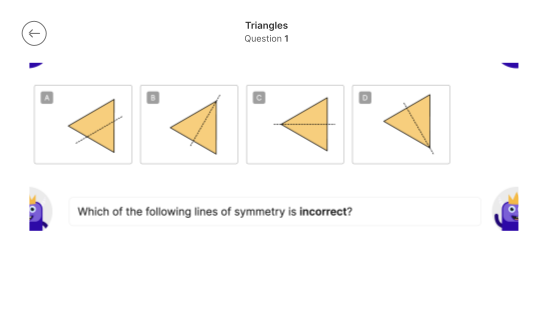
The picture below shows a triangles question appropriate for Year 4 on Atom.
Year 5 maths
The Year 5 maths curriculum introduces percentages and the relationship between percentages, decimals and fractions. Children are taught to solve problems using increasingly large numbers, negative numbers, and numbers with up to four digits. They’ll also start using the formal written methods of long multiplication and short division.
Number and place value
Count backwards and forwards with positive and negative numbers
Read, write, order and compare numbers to at least 1 million
Round any number up to 1 million to the nearest 10,100, 1,000, 10,000 and 100,000
Read Roman numerals up to 1,000 (M)
Addition and subtraction
Use column addition and subtraction to add and subtract numbers with up to 4 digits
Use rounding to check answers
Use addition and subtraction to solve multi-step problems in context
Multiplication and division
Multiply whole numbers and decimals by 10, 100 and 1,000
Multiply four-digit numbers by two-digit numbers using long multiplication
Divide four-digit numbers by one-digit numbers using short division
Identity prime numbers and establish whether a number up to 100 is prime
Identify factors and multiples of different numbers
Recognise and use square numbers and cube numbers
Solve problems involving all four operations
Fractions, decimals and percentages
Convert from mixed numbers to improper fractions
Compare, order, add, and subtract fractions whose denominators are multiples of the same number
Multiply proper fractions and mixed numbers by whole numbers
Round decimals with two decimal places to the nearest whole number and to one decimal place
Read, write, order, and compare numbers with up to three decimal places
Read and write decimals as fractions
Understand the per cent symbol (%) and write percentages as a fraction with a denominator of 100 and as a decimal fraction
Solve problems knowing the percentage and decimal equivalents of 1/2, 1/4, 1/5, 2/5, and 4/5
Measurement
Work out the perimeter and area of irregular shapes
Estimate volume
Convert between different units of measurement
Solve problems using money and measures
Convert between different units of metric measure and time
Geometry
Identify 3D shapes from 2D representations
Estimate and compare acute, obtuse, and reflex angles
Draw angles and measure them in degrees
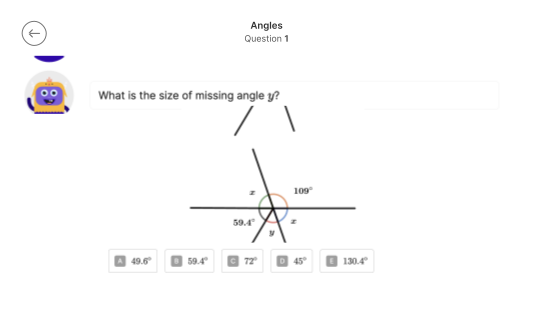
Find angles around a point, on a straight line, and within a right angle
Statistics
Use the information in a line graph to solve comparison, sum and difference problems
Complete, read and interpret information in tables (including timetables)
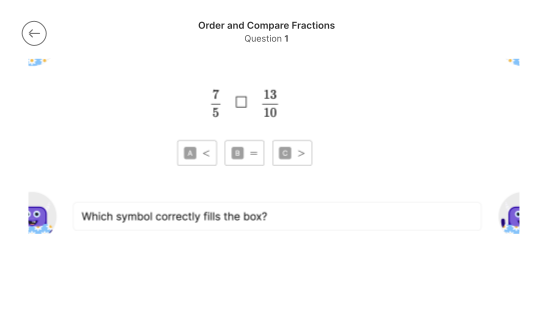
Take a look at a Year 5 fractions question from Atom below.
Year 6 maths
By the end of the Year 6 maths curriculum, your child should be able to solve multi-step problems using formal written methods and the four operations. They’ll be introduced to shape and scale factors and will start to use simple algebraic formulae. They’ll also learn how to draw and interpret pie charts and find the mean as an average.
Number and place value
Read, write, order and compare numbers up to 10 million
Round any whole number to a degree of accuracy
Use negative numbers in context and calculate intervals across zero
Addition, subtraction, multiplication and division
Use long multiplication to multiply four-digit numbers by two-digit numbers
Use long division to divide four-digit numbers by two-digit numbers
Use mental maths to solve problems with mixed operations and large numbers
At the end of Year 6, children in England primary schools take Key Stage 2 Standard Assessment Tests, known as Key Stage 2 SATs. These tests are used to assess your child's knowledge of the KS2 curriculum and for the government to understand the quality of education across schools in the country.
Pupils take three maths SATs tests across two days in May:
While your child will have structured maths lessons at school, there are lots of ways to stretch and challenge them at home.
Why not get the whole family involved in a board game night? Monopoly (suitable for ages 8+) involves counting money and calculating deals. This is a great way to build confidence using the four operations and solve problems using money.
Battleships (suitable for ages 7+) can help your child understand geometry. This game of strategy and logic requires users to get familiar with grids, graphs, coordinates and quadrants.
You can also help your child practise maths concepts through everyday activities around the home. Daily tasks such as shopping and cooking involve skills such as multiplication and division, percentages, fractions, and converting between units. Get more details and top tips in our guide to helping your child with maths at home.
No items found.
No items found.
No items found.
Build strong English, maths and science skills.
Want to support what your child is learning at school, or help them stretch beyond it? Atom gives them the right blend of challenge and support. Help them strengthen foundations, deepen understanding, and grow confident in the subjects that matter most for Key Stage 2 and beyond.
Follow personalised weekly learning plans that adapt to your child’s level and keep them progressing in English, maths and science.
Learn through interactive lessons that stretch their thinking and reinforce key skills.
Track progress topic by topic. See their strengths and pinpoint where they need to improve.
Strengthen foundations and build confidence.
Start your free trial and help your child make real school progress today.