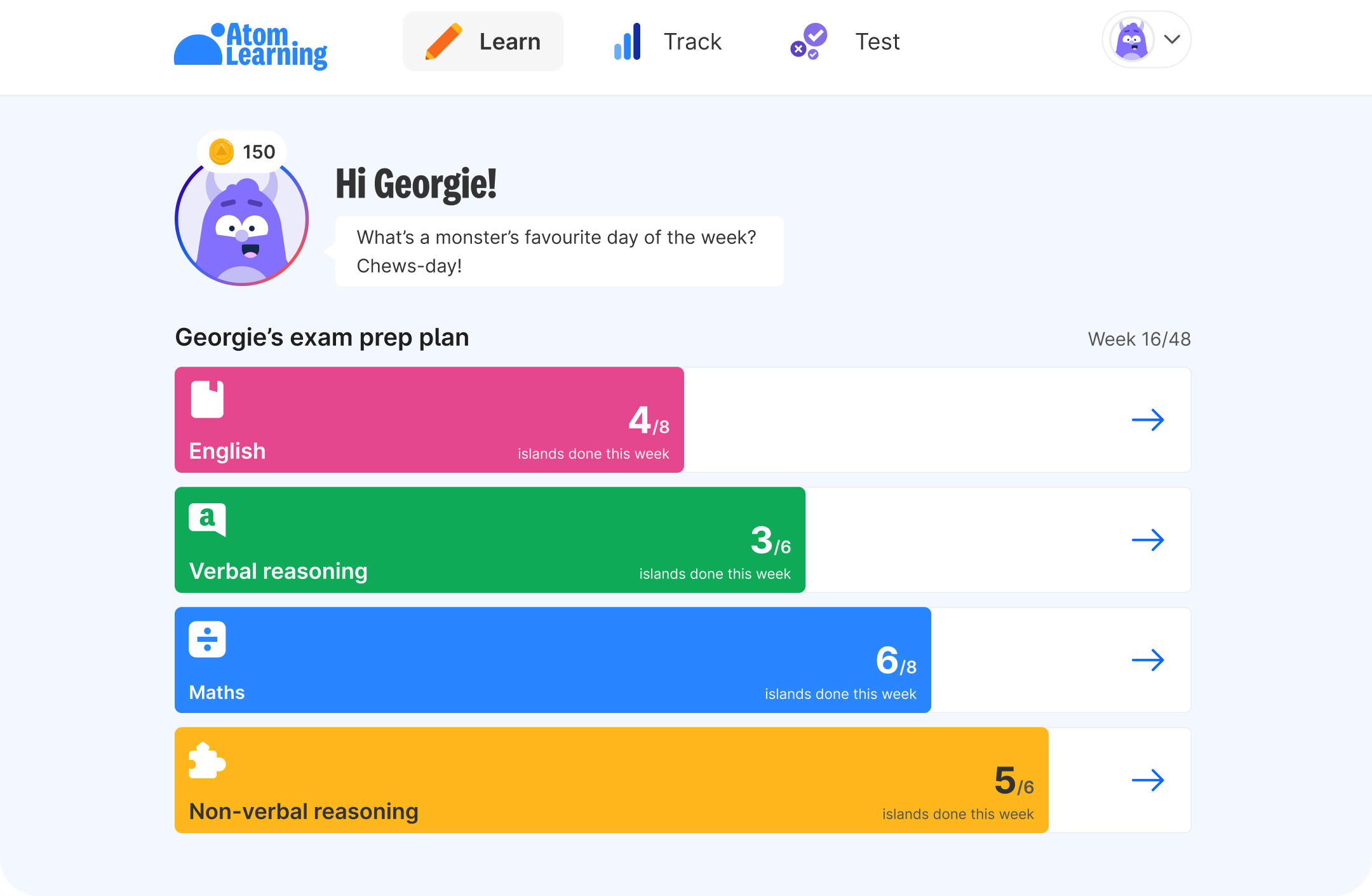
Is your child applying for a private senior school? In this 6-month study plan, Jade explains how to best use this time to boost your child's confidence, excel in entrance exams and increase their chances of getting into their target school.

No items found.
Resources for entrance exam preparation
Private school entrance exams: an overview
All school entrance exams are based on the same curriculum. No matter whether the exam provider is ISEB or the school's own, your child will be assessed on:
- English and maths based on the Key Stage 2 national curriculum
- Verbal reasoning and non-verbal reasoning based on the same question types as the 11 plus
The first stage of preparation should be building your child's confidence and understanding of the Key Stage 2 curriculum, before delving into specific exam technique practise.
Most independent schools use the ISEB as either their sole entrance exam, or the first stage of their selective process. The ISEB takes place in late October or November of Year 6.
Second stage exams typically take place in January. These are generally based on the same curriculum, but are designed and administered by the school themselves. They tend to be written exams, with longer reading comprehension and creative writing questions.
Is your child ready for the ISEB Pre-test?
See where they stand in minutes. Atom’s free ISEB baseline tests give you an instant breakdown of their strengths and gaps. Know exactly what to focus on next and start preparing with direction, not uncertainty.
Take the free test
.png)
Structuring your exam prep
Starting preparations in mid-Year 5 will allow your child to take a balanced approach to revision, minimise pressure, and ensure they feel confident on exam day.
We recommend that exam prep is structured as follows:
- Children should spend 2–2.5 hours on Atom Nucleus each week, broken into smaller chunks
- 90% of this time should be spent working through the learning journeys to ensure a firm understanding of the curriculum
Alongside this, we recommend:
- Setting two or three custom practices each week in the subtopics that the algorithm identifies as most challenging for your child
- Completing one or two mock tests each month
1. Building subject mastery
Consistent, short bursts of practice is the best approach to build a thorough mastery of each topic. Atom's algorithm will ensure your child is exposed to all the different question types they will encounter in the exam, to the level of difficulty required, and will adapt to their unique pace of learning.
The 2–2.5 hours spent on Atom each week should be broken down into 20–30 minutes a day. This has been shown to improve focus and knowledge retention, as well as help to incorporate study into part of a daily routine. If your child starts to lose focus, a quick break can do wonders for getting them back on track.
It's also good practice to focus on different subjects on different days. At most, work on two subjects in one day, as long as they are related (such as maths and non-verbal reasoning, or English and verbal reasoning).
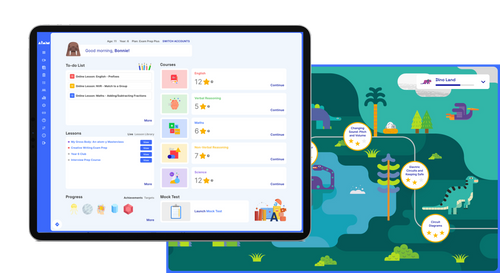
Your child's personalised learning journey progress:
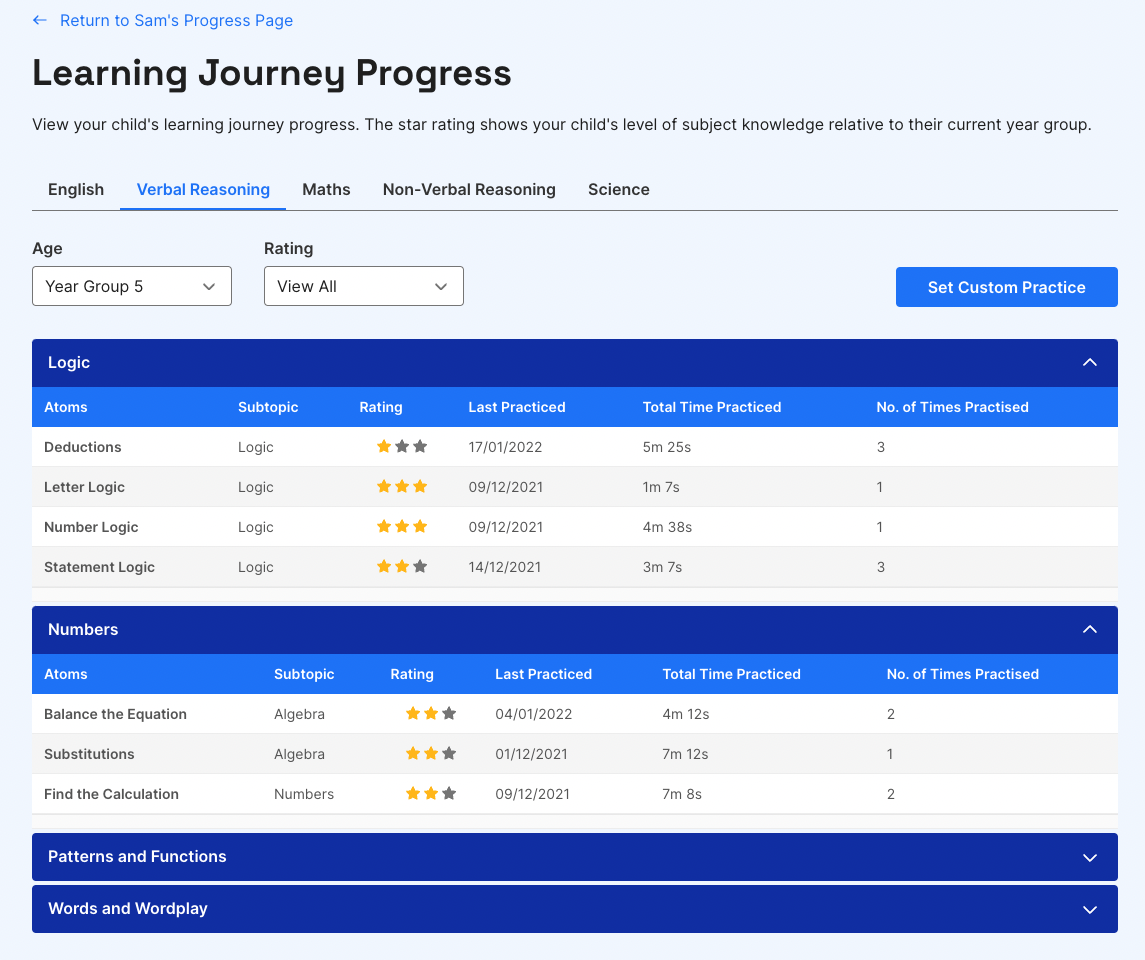
Despite the star score your child achieves, keep moving forward onto new islands to ensure you cover the breadth of the curriculum. Avoid jumping straight to the most challenging content, as it's impossible to master the most challenging topics without getting a firm grasp of the basics.
2. Combatting the forgetting curve
We forget over 50% of the information we learn within an hour of learning it. Over 70% of it is forgotten within 24 hours!
Ebbinghaus found that the forgetting curve can be interrupted and memory can be strengthened through two key methods:
- Better memory representation (e.g. with mnemonic techniques)
- Repetition based on active recall (especially when repetition is spaced)
Atom's friendly help sheets and explanations will interrupt the forgetting curve by engaging active recall and consolidating knowledge.
3. Mastering the depth of content and challenging areas
Once your child has covered all question types, you'll be able to identify the subtopics that require further revision. We recommend using a balance of overall progress data and mock test data to identify these areas for development.
You can use the attainment graph to see overall subject and subtopic performance compared to the average student in their year:
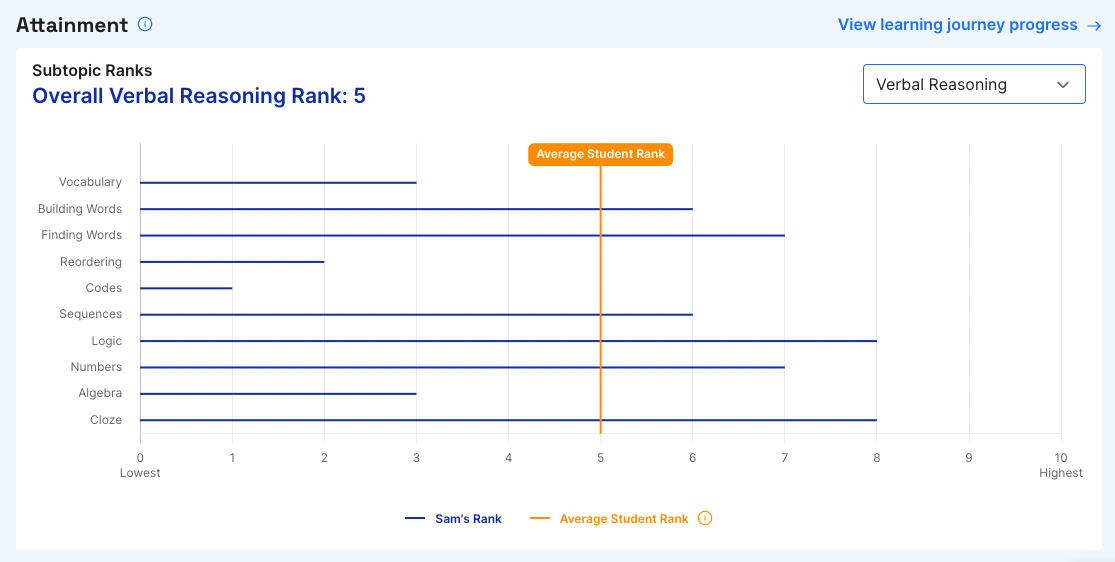
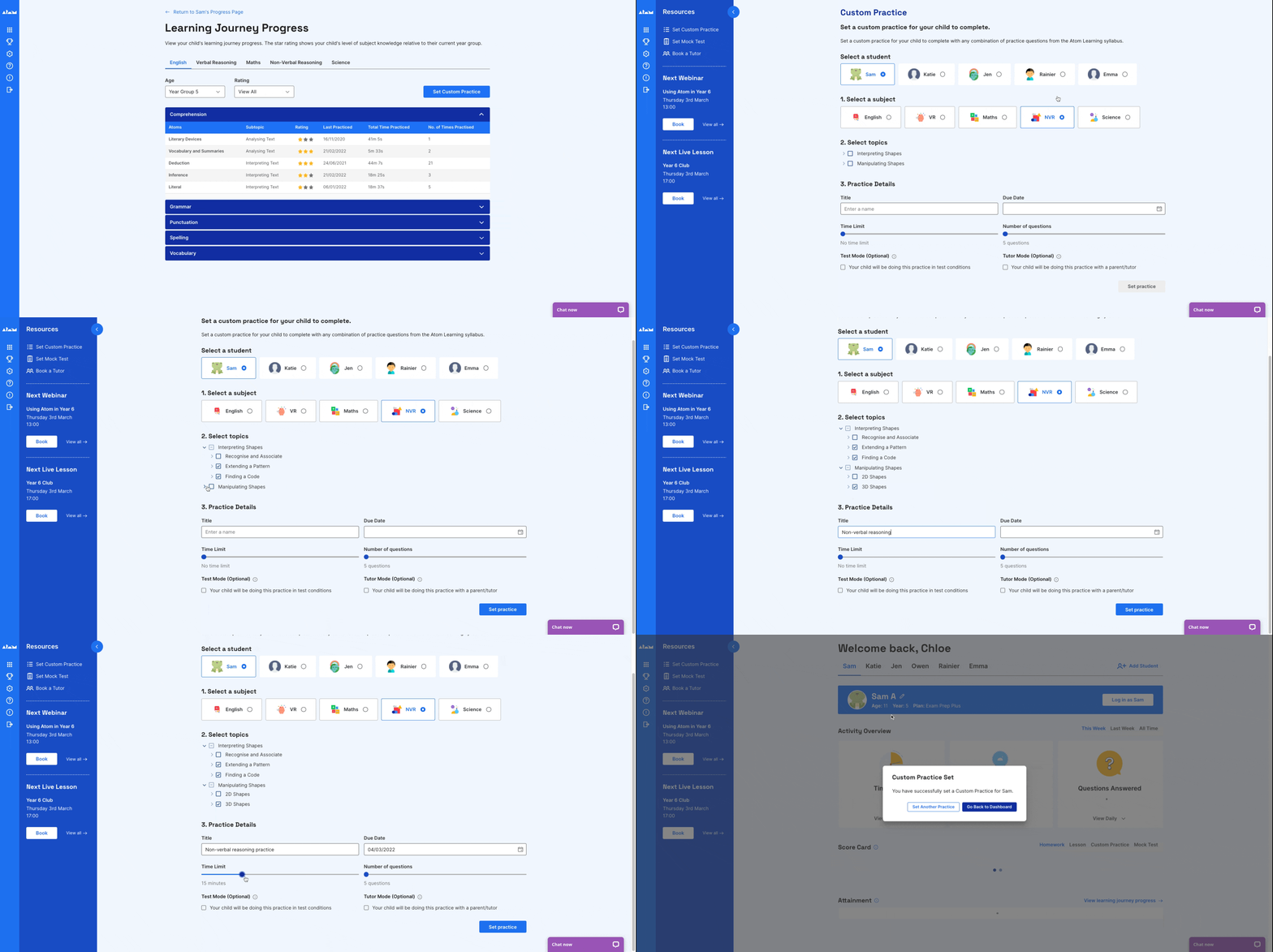
Set custom practices to target your child's most challenging subtopics, with functions to personalise timings and question types. Start by setting no more than three activities per week. During the summer term we recommend increasing this up to five per week.
4. When and how to use mock tests
A common misconception is that repeating mock tests or practice papers is the most effective way to revise for an exam. However, it's far more effective to build knowledge of the curriculum first.
Although mock tests are a fantastic tool to practise exam technique, they're not the best way to teach – or to learn. Mock tests are taken in exam conditions, which means that your child won't have access to help sheets or explanations to consolidate their understanding of a topic. They also won't be able to see their score as they go, so won't have the chance to self-correct any misunderstandings.
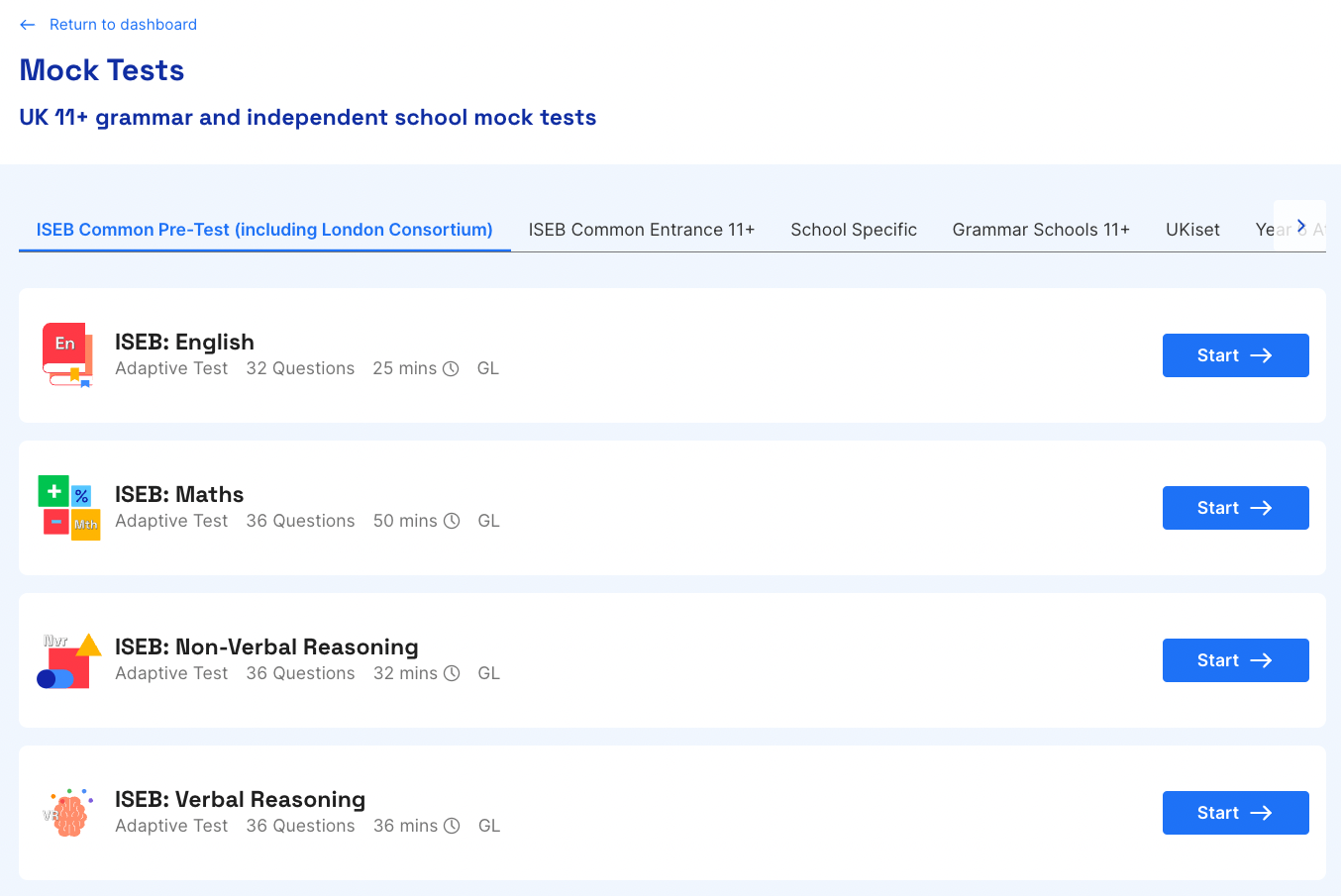
Instead, we recommend practicing one or two mock tests each month, as a supplement to the time spent in learning journeys. You can increase this to one per week in the final six weeks before an exam.
Always make time to sit down with your child after a mock test to review the transcript together and talk through any corrections. You will be given a standardised age score after the mock test. This is the same scoring system used in the real entrance exams, so it's an important tool to keep track of during your child's exam preparation.
If you haven't already begun your child's personalised exam preparation journey, start your 5-day free trial of Nucleus today:
No items found.
No items found.
No items found.
Take control of your child’s independent school prep.
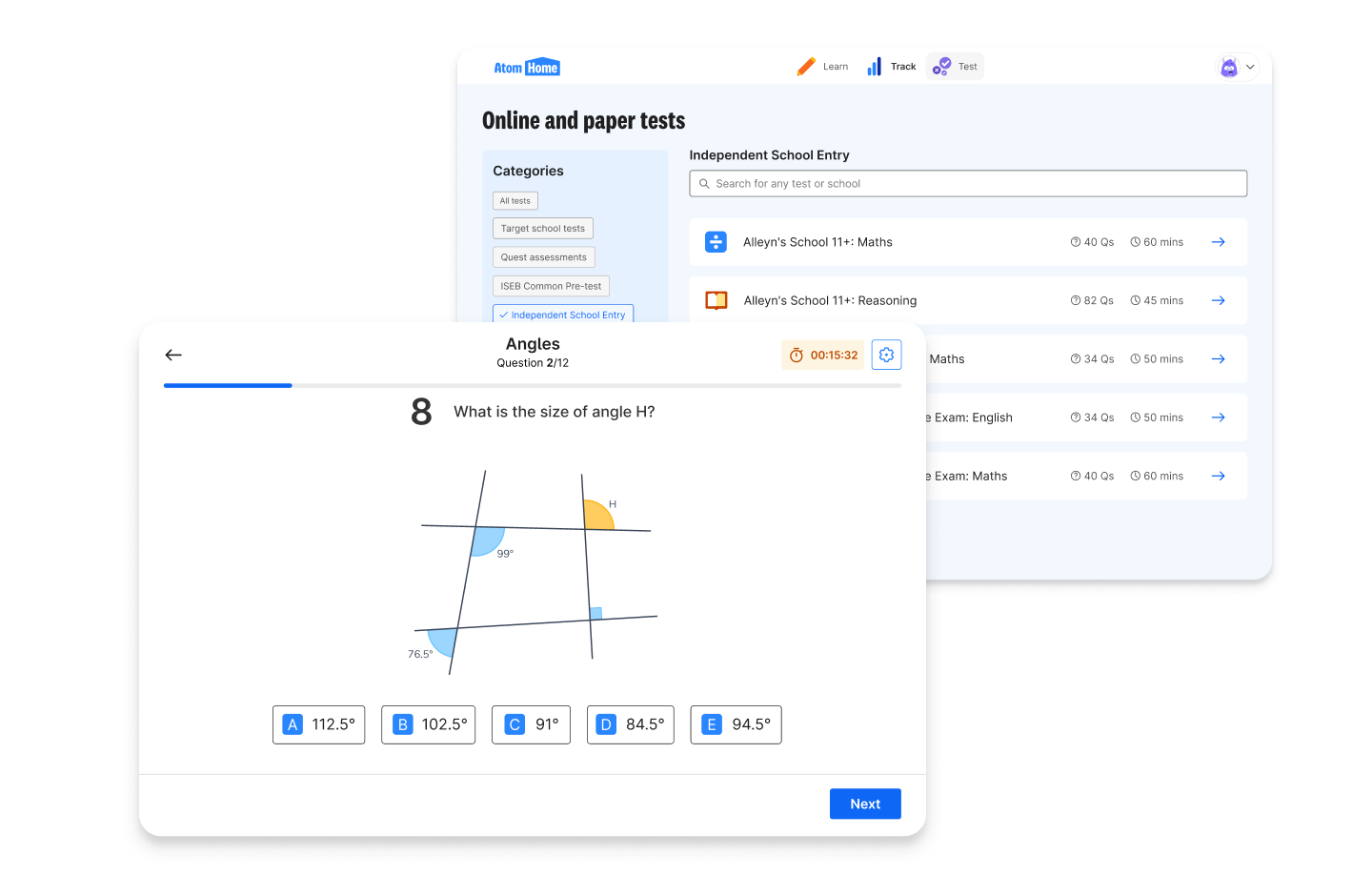
Worried about keeping pace with the competition? Independent school exams can feel unpredictable, but your child’s preparation doesn’t have to be. Atom shows you exactly what to practise and how they’re performing, so you can stay ahead throughout the admissions process.
- Follow personalised weekly exam plans that show them what to learn next.
- Practise with mock tests that replicate their exam and generate new questions every time, so they build real exam skills.
- Track progress and see how they compare to others preparing for the same schools.
Partnered with leading independent schools, trusted by families.
Start your free trial and help your child get ready for senior school entry.
Try Atom for free