Applying to Sir Henry Floyd Grammar School for September 2028? This guide covers the Buckinghamshire Secondary Transfer Test in September 2027, the qualifying score, how the 180 Year 7 places are allocated and the key dates for September 2028 entry.
Number of places in Year 7: 180 (2027-entry figure — Sir Henry Floyd Grammar School confirms each year's admission number in its determined arrangements, published the spring before entry.)
Qualifying score: 121 on the Secondary Transfer Test, the Buckinghamshire qualifying score for 2027 entry
11+ test: Buckinghamshire Secondary Transfer Test (two multiple-choice papers, each about 45 minutes of questions)
Source: Buckinghamshire Council school admissions page for Sir Henry Floyd Grammar School (September 2027 entry). Last checked October 2026.
Key dates for September 2028 entry
Buckinghamshire Council has published these windows for 2028 entry. Exact dates are confirmed in the spring before each cycle. For 2027 entry, registration ran from Friday 1 May 2026 to Tuesday 2 June 2026, the test took place on Thursday 10 September 2026 (practice test Tuesday 8 September) and results came out on Friday 9 October 2026. We'll update this page as soon as the 2028-entry dates are published.
Key dates for Sir Henry Floyd Grammar School 11+ entry in September 2028, with expected windows where the school has not yet confirmed exact dates.
Date
What happens
May to June 2027
Test registration window
1 September 2027
Home address on this date is used for catchment in the main allocation
Early September 2027
Practice test, then the Secondary Transfer Test
Mid-October 2027
Test results expected
Sunday 31 October 2027
Deadline to apply for secondary school places through your home local authority. This date falls on a Sunday.
Wednesday 1 March 2028
National offer day for secondary school places
Worried about missing an important 11+ deadline?
Get grammar school reminders with the key dates for your target school delivered straight to your inbox.
Sir Henry Floyd Grammar School is selective, so your child needs to sit the 11+ test to be considered for a place.
You register your child for the Secondary Transfer Test through Buckinghamshire Council during the registration window.
Once you have your child's result, you apply by naming Sir Henry Floyd Grammar School on your common application form, which goes to your home local authority. For September 2028 entry the deadline is Sunday 31 October 2027. As it falls on a Sunday, you may find it easier to submit your form in the days before.
Reaching the qualifying score makes your child eligible, but it doesn't guarantee a place. If more qualifying children apply than there are places, the school uses its oversubscription criteria, set out further down this page.
What will my child be tested on?
The Secondary Transfer Test is produced by GL Assessment and run by The Buckinghamshire Grammar Schools. Your child sits two papers on the same day, with a break between them. A shorter practice test usually takes place two days before.
Each paper has about 45 minutes of questions, so it takes roughly an hour in the room once the introduction and practice examples are included. All questions are multiple choice.
The table below shows what each paper covers.
The Buckinghamshire Secondary Transfer Test papers for September 2028 entry: length and content of each paper.
Paper
Length
What it covers
Paper 1
About 45 minutes of questions (around an hour including introduction and practice examples)
Comprehension, technical English and verbal reasoning
Paper 2
About 45 minutes of questions (around an hour including introduction and practice examples)
Non-verbal reasoning, spatial reasoning and maths
How are places allocated at Sir Henry Floyd Grammar School?
If more children reach the qualifying standard than there are 180 Year 7 places, Sir Henry Floyd Grammar School offers places in the order below. This order comes from the school's admissions policy for September 2026. The school sets its 2028-entry policy separately, and we'll update this table if anything changes.
Sir Henry Floyd Grammar School oversubscription criteria, September 2026 arrangements.
Priority
Who it covers
1
Looked after and previously looked after children, and children who qualify for Free School Meals (on the autumn census in Year 6)
2
Children who qualify for Pupil Premium (on the autumn census in Year 6)
3
Brothers and sisters of students who are on roll and will still be on roll when the child starts
4
Children of Insignis Academy Trust staff employed at the school for two or more years, or recruited to a post with a demonstrable skill shortage
5
Children living in the school's catchment area, continuously from 1 September of the year before entry
6
All other children, in order of distance from home to the school
No items found.
In the September 2026 policy, up to six places above the admission number are available to children who qualify for Free School Meals or Pupil Premium and score at least 110 (but below 121) in the Secondary Transfer Test. These places are offered in order of distance from the school, and families apply for them through the usual application plus a letter with evidence to the Head of School.
Does Sir Henry Floyd Grammar School have a catchment area?
The school publishes a catchment map on its admissions page, and you can check an address with Buckinghamshire Council's postcode checker. We haven't listed towns because we couldn't check them against the map.
Distance is measured in a straight line from the front door of the family's normal home address to the nearest of the school's three main entrances, using Buckinghamshire Council's measurements. Where two children live exactly the same distance away, for example in the same block of flats, a random draw decides. This is how the September 2026 policy sets it out; the school confirms its 2028-entry arrangements separately.
If you don't live close to the school, it's worth thinking about how your child will get there every day. How long will the journey take? What transport options are available? Will they be travelling independently or with support?
A longer or more complex journey can affect your child's daily routine, including how much time they have for homework, rest and after-school activities. It's a good idea to think about how manageable the school run will be and whether it will work for your family day to day.
How can I help my child prepare for the test?
The Buckinghamshire Secondary Transfer Test can feel like a big milestone, but preparation doesn't have to be overwhelming. Here's how you can help your child prepare for test day.
Stay on track with a clear plan
One of the hardest parts of 11+ preparation is knowing what to focus on, when, and how to make steady progress without it taking over family life.
A clear, structured plan helps your child feel less overwhelmed and more in control. It ensures they build skills in the right order, cover everything they need, and avoid last-minute cramming.
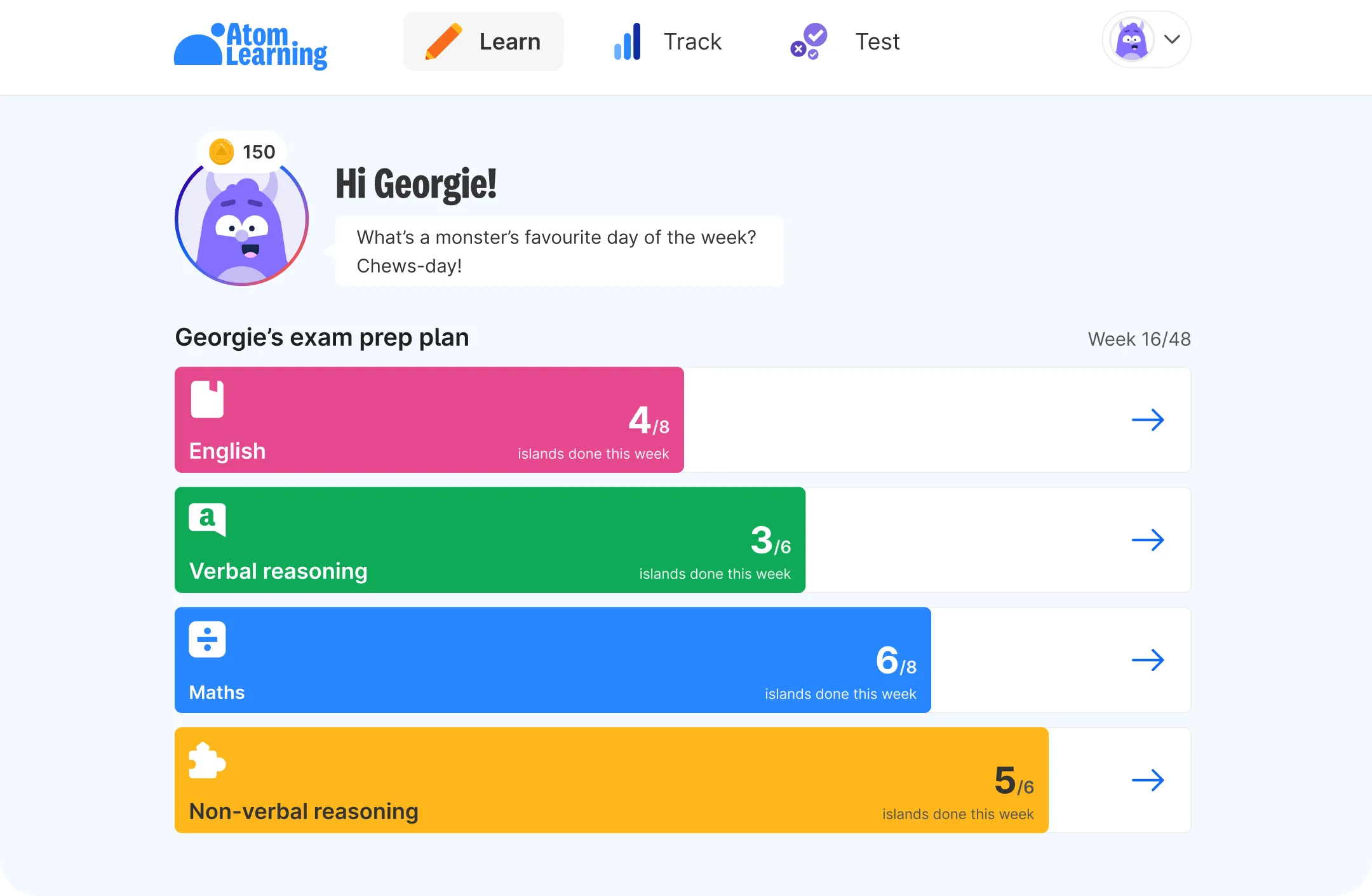
Atom's exam plan makes this easier. Enter your child's target schools and exam dates, and we'll create a personalised weekly plan tailored to the topics they'll be tested on. It shows them what to work on and when, adapts as they improve, and helps them build progress in a calm, manageable way — little and often.
That means less guesswork for you, less stress for them, and a clearer path all the way to exam day.
Build smart exam technique
As your child's knowledge grows, practice tests can help them feel more comfortable with the real exam format.
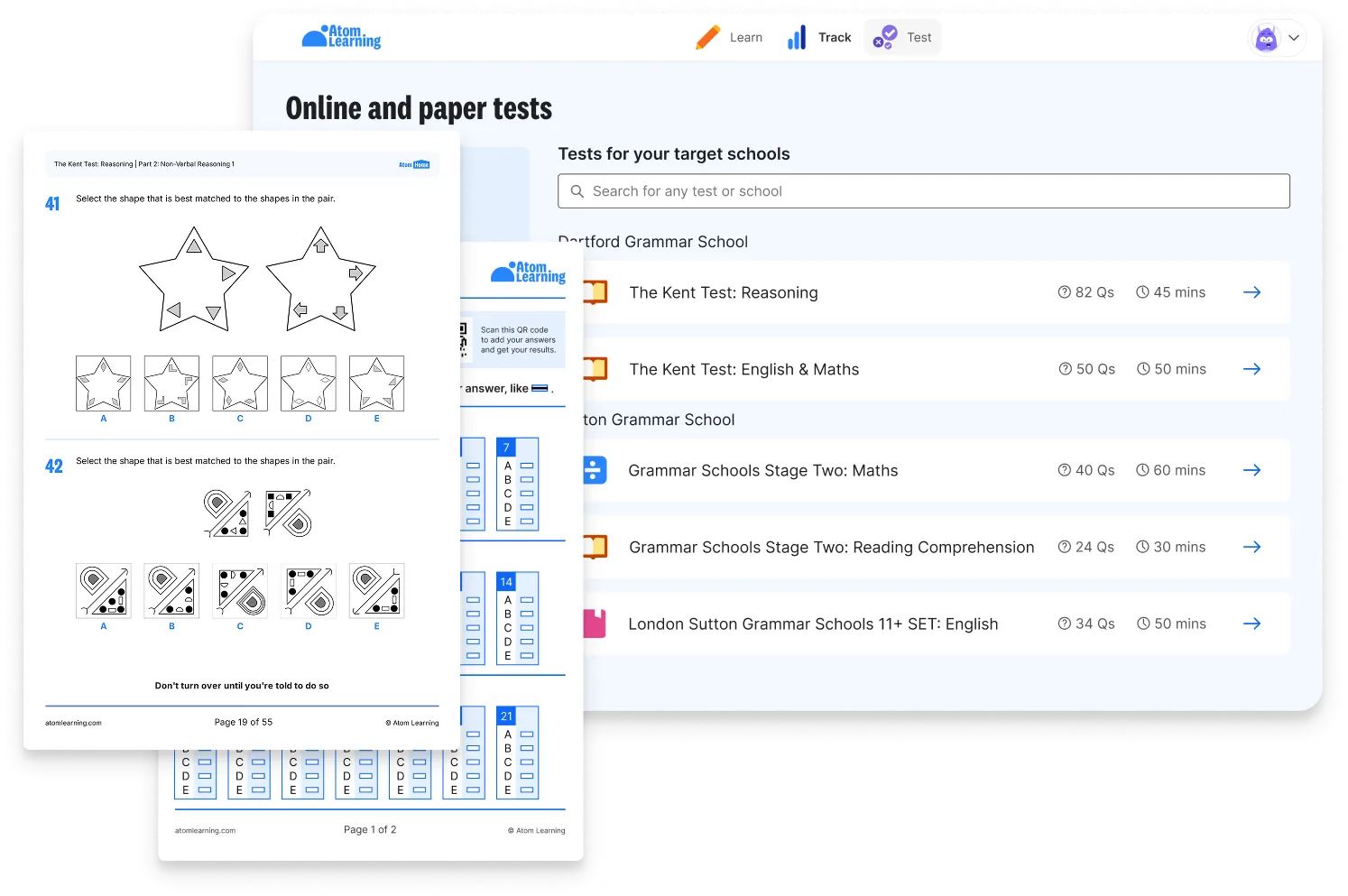
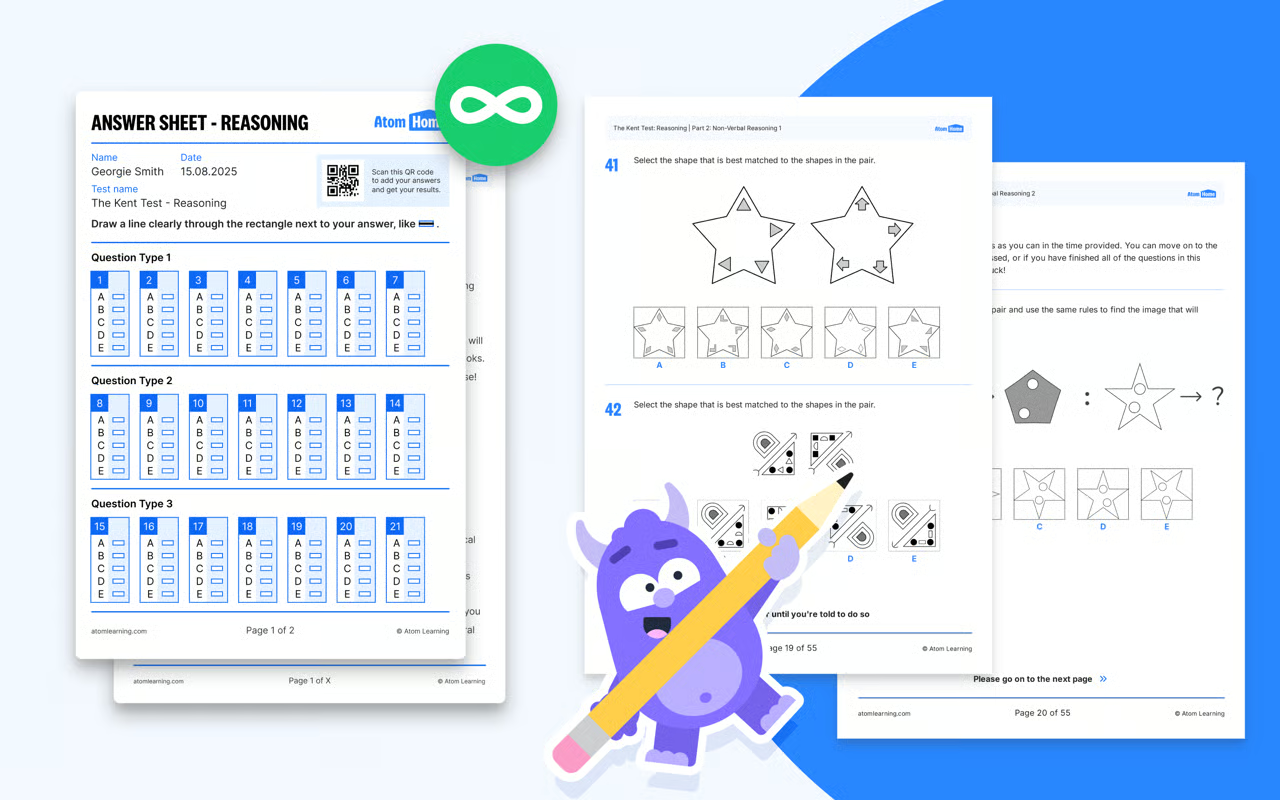
Atom's 11+ practice papers are built to match the format, timing and question styles of real 11+ exams. They're also unlimited — you can download the same paper again and again, and your child will get new questions each time. This helps them practise without repeating the same content.
We've made marking easy for you, too. Simply photograph your child's answer sheets and upload them to Atom. The papers are marked instantly, showing your child's standardised age score (SAS), where they're doing well, and what they should focus on next. You'll also learn how they compare to other children applying to the same school.
Encourage regular reading
Strong reading skills play a big role in 11+ preparation.
Encourage your child to read every day, even for just 10–15 minutes. The key is variety. Mix fiction and non-fiction, different genres, and a range of authors. This helps them become more confident in understanding tone, purpose, and meaning across different texts.
Over time, regular reading will broaden their vocabulary, improve comprehension and inference, and build confidence in tackling unseen texts.
Looking for inspiration? Atom's recommended reading lists have suggestions spanning fiction and non-fiction for Years 3–6.
Celebrate progress, not just scores
When you're supporting your child through 11+ preparation, what really matters is knowing they're moving in the right direction — not just how they scored on a single test.
Atom's progress tracking gives you a clear, simple picture of how your child is doing in each topic and the direction they're moving in. You can see where they're on track, where they might need more practice, and spot progress as it happens.
That makes it easier to give meaningful encouragement, keep motivation steady, and focus on what matters most: consistent improvement, not just one-off results.
No items found.
Take control of your child’s 11+ preparation.
Not sure if your child is on track for the grammar school 11+? You don’t need to guess what to cover or whether they’re ready. Atom shows you exactly what to practise each week and how they’re performing, so you can stay ahead of the process without the stress.