Non-verbal reasoning is often one of the least understood topics for 11 plus tests and entrance exams.
Keep reading to:
Learn what non-verbal reasoning means – and the skills it involves
Understand how to answer eleven plus non-verbal reasoning question types
Get free non-verbal reasoning worksheets to support your child's exam prep
What is non-verbal reasoning?
Non-verbal reasoning involves analysing visual information and solving problems using shapes, diagrams and pictures. This is a different kind of reasoning to verbal reasoning, which involves analysing written information.
Non-verbal reasoning tests several skills, including logic and problem-solving, spatial awareness, and the ability to identify patterns and rules.
Non-verbal reasoning questions can be confusing to those who have never come across them before. Getting familiar with basic problem-solving and question types will help your child tackle non-verbal reasoning successfully.
Which exams test non-verbal reasoning?
Non-verbal reasoning is a common topic tested in school entrance exams. These exam boards all have non-verbal reasoning papers, or questions, within their tests:
GL Assessment Most UK grammar schools use GL Assessment 11+ papers. Schools choose which subjects to test at 11 plus entry. If non-verbal reasoning is tested, it may be through a specific paper, or in a paper combined with other subjects (such as maths). This test is taken on paper.
ISEB Common Pre-Test The ISEB Common Pre-Test is a common exam used to select pupils for 11+ or 13+ entry to independent schools. The Pre-Test has a 25-minute non-verbal reasoning section. This test is taken on a computer and is adaptive – meaning the questions become more challenging depending on how the pupil is performing.
CAT4 The CAT4 test is often used either as an independent school entrance exam or to 'stream' pupils into key subjects in Year 7 (at both state and independent schools). Pupils are tested in non-verbal reasoning with questions on figure classification, analysis, recognition, and matrices. It's usually taken on a computer, although it's also available on paper. Questions are not adaptive.
Cambridge Select Insight Some independent schools use Cambridge Select Insight to shortlist children for places. Cambridge Select Insight used to be known as CEM Select. Non-verbal reasoning is tested in the final section. Each question contains 8 pictures and one missing picture. Children need to select the picture, from four options, which completes the set. The test is taken on a computer and is non-adaptive.
Is your child ready for the 11+?
See where they stand in minutes. Atom’s free 11+ baseline tests give you an instant breakdown of their strengths and gaps. Know exactly what to focus on next and start preparing with direction, not uncertainty.
Non-verbal reasoning questions fall into two main categories: interpreting shapes and manipulating 2D and 3D shapes.
Interpreting shapes
Pairing shapes In pairing shapes questions, you will be shown two pairs of images – one complete and one incomplete. In each pair, the first image is changed into the second image using a rule. You need to figure out the rule and select the image which correctly completes the pair.
Sequences In sequence questions, you will be shown an incomplete sequence of images. You will have to choose the answer option that completes the gap(s) in the sequence.
Matrices In matrices questions, you will be shown a matrix, or grid, with one piece missing. You will have to select the image that would correctly complete the matrix. Each piece in a matrix is positioned according to a pattern. Patterns can run in lots of different directions and may even be combined.
Find a code In find a code questions, you will see a set of images that are each linked to a two-letter or three-letter code. Each letter in the code represents one feature of the image. You will have to work out what each letter represents, and then choose the letters which correctly represent the final image.
Odd one out In odd one out questions, you will be shown a group of images and asked to find the one image that doesn't fit with the rest of the group.
Match to a group/pair In match to a group or pair questions, you will have to choose the answer option which has the most in common with a group, or pair, of images.
Manipulating 2D shapes
Parts within a shape In parts within a shape questions, you will have to find an image that is hidden within a more complex shape. There are three types of questions:
Which shape is hidden in the group?
Which shape is not in the group?
Which group of shapes contains the hidden shape?
Shape logic There are three types of shape logic question:
Combining shapes
Forming a shape
Forming a silhouette
Rotations and reflections In rotations and reflections questions, you will be given a shape or image and will need to work out what it would look like if it was rotated or reflected. You will need to check that all the different elements of the image or shape have been rotated or reflected in the same way.
Following folds In following folds questions, you will be shown a diagram of a piece of paper that has been folded and had shapes cut out of it. You will have to choose the option that shows what the paper will look like when it is unfolded.
Manipulating 3D shapes
Nets and cubes In nets and cubes questions, you will be shown a 2D net and asked to work out what it would look like when it is folded up into a cube.
Rotating 3D shapes In rotating 3D shapes questions, you will be asked to choose, from multiple options, which image is the rotation of a particular 3D shape.
Combining 3D shapes In combining 3D shapes questions, you will need to select the group of blocks that can be combined to make a particular 3D shape. There are three types of block: fully visible, partially hidden, and obscured.
3D shapes from above In 3D shapes from above questions, you will be shown a 3D shape. You will need to choose the 2D plan that shows what the shape would look like when viewed from above.
Non-verbal reasoning example questions Here are some examples of common non-verbal reasoning question formats. You can use these together with your child as practice questions.
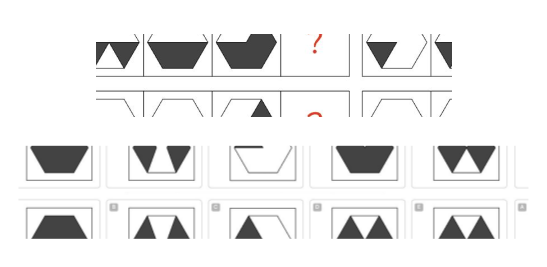
Sequences In sequence questions, you will be shown an incomplete sequence of images. You will have to choose the answer option that completes the gap(s) in the sequence.
Tip: the images or shapes in a sequence may be linked by more than one feature. Focus on one feature at a time!
Question: Select the option that will complete this sequence.
Answer: D is the correct answer! With each step through the sequence, the hexagon becomes more shaded – increasing one sixth at a time. The hexagon in our answer must be five sixths shaded, so we can rule out A, B, C and E.
Following folds example
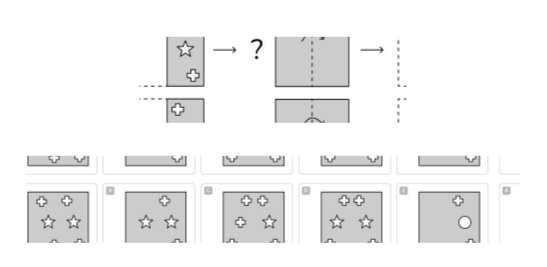
Following folds are a common area of difficulty on non-verbal reasoning tests. This type of question requires your child to visualise how some shapes will look when they are reflected.
Tip: pay attention to the distance between a shape and a fold. This will help you figure out where it should be positioned on the unfolded paper. And make sure to look out for irregular shapes – their unusual features can help you figure out the orientation of cut-out shapes.
Question: Imagine that the piece of paper has been folded along the dashed line, and then had shapes cut out of it. Which image shows how the paper would look if it was unfolded?
Answer: D is the right answer! The left half of the paper is a reflection of the right half of the paper across the vertical fold.
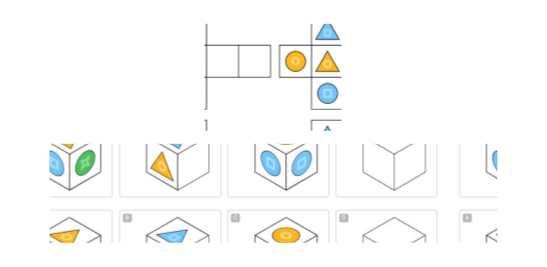
Tip: helping your child begin to visualise the nets and cubes as real-world entities will aid tremendously in their ability to answer the questions. You may wish to give your child a real-life object like a dice or Rubik's Cube to support this visualisation.
Question: Which of these cubes can be made by the following net?
Answer: B is the correct answer! D, C and A are dud cubes: they show shapes that aren't on the net.
Top tips for non-verbal reasoning
Here are our top tips for tackling non-verbal reasoning questions!
1. Know the process
To tackle most non-verbal reasoning questions you can follow this process:
Type: What type of question is it?
Analyse: Look at the shapes in the question. What are the most obvious qualities (e.g. shape, colour, pattern) of the shapes and patterns?
Similarities/differences: Find similarities and differences between the shapes and patterns. Remember this also includes patterns and changes in frequency when looking at a series of shapes!
Rule: Find a rule from these obvious qualities.
Eliminate: Eliminate those that don’t fall into this rule.
2. Drawing
Drawing can simplify everything. When we try to picture many shapes in our heads, these images can become jumbled and it’s easy to get confused. Encourage your child to draw the shapes out as this can help them visualise the answer more clearly.
3. Practise, practise, practise!
Encourage your child to practise different types of non-verbal reasoning questions. Has your child attempted all of the question types in the list above?
Identify which types they find most difficult, and spend more time working on these. Like most things in life, practice makes perfect and the more questions your child completes, the faster they will be in the test, allowing them to work confidently within time limits. Increasing their general answering speed is important as it can give them more time to focus on the questions they struggle with.
4. Make it fun and play a game
Find fun and interactive ways to improve your child’s non-verbal reasoning skills by playing games such as Sudoku, which improve logic and attention to detail. Playing Lego is also a great way for children to practise shape building and visualisation, standing them in good stead for these types of test.
5. Consistency and repetition
Consistency is crucial for non-verbal reasoning. A little bit every day will go a long way, as repetition will make these exercises second nature to your child. This is also much easier than trying to cram all this learning into long last-minute sessions, which can lead to frustration for everyone involved!
6. Study breaks and rewards
Taking a break every 30 minutes will improve the productivity of your child's study sessions. Your child is more likely to come back feeling refreshed and ready to be challenged. After you finish a study session, why not reward your child for their hard work (e.g. a bit of time playing their favourite game)?
Don’t be disheartened if it takes your child a long time to get to grips with non-verbal reasoning. This subject is not taught as part of the national curriculum, so they’ll be learning completely new skills.
Did you know?Atom makes it easy to see your child’s progress at the click of a button, so you can celebrate progress and reward them with something they love!
No items found.
No items found.
No items found.
No items found.
Take control of your child’s 11+ preparation.
Not sure if your child is on track for the grammar school 11+? You don’t need to guess what to cover or whether they’re ready. Atom shows you exactly what to practise each week and how they’re performing, so you can stay ahead of the process without the stress.