Back to blog

Eton College: 13 plus entry guide

By
Atom
|
November 17, 2025

Chances are that you have heard of Eton College – one of the top private schools in the UK and famous for educating world leaders, award-winning actors and prime ministers.

The boys-only boarding school was founded in 1440 by King Henry VI and places are extremely competitive. Each year, around 120 children will be offered a place.

We've collated everything you need to know about the admissions process for Eton. Keep reading to find out:

  • What to expect at each stage of the 13+ entry process
  • The format and content of the entrance exam
  • How to help your child prepare (with free resources to boost exam prep!)

Key information for Eton College

  • Headteacher: Simon Henderson
  • Address: Eton College, Windsor, SL4 6DW
  • County: Berkshire
  • Age range and gender: 13–18, boys only
  • Number of pupils: 1,300+

13+ admissions

  • Admissions contact: [email protected], 01753 370611
  • Open day: private tours – contact the admissions team to book
  • Overview of entry process: ISEB Common Pre-Test, second-stage online assessment, interview, and Year 8 assessments
  • Registration closes: 30th June in Year 5
  • Assessment date: October–November in Year 6 (ISEB), spring/summer in Year 6 (second stage), spring in Year 8 (Common Entrance/Eton Entrance)

Eton College financial assistance and scholarships

Financial assistance

Eton College is able to offer means-tested financial assistance (bursaries). Boys who pass the entrance process but whose families wouldn't otherwise be able to afford the fees may be eligible for a bursary. Around 20% of Eton students are currently on a bursary, and many students pay no fees at all.

If you would like your child to be considered for a bursary, you will need to complete a bursary application form. An independent company will visit you at home to assess your family circumstances.

Scholarships

Eton College also offers a variety of awards and scholarships to boys entering the school in Year 9:

King’s Scholarships

Each year, 14 boys are awarded a King’s Scholarship. King’s Scholars live together in the same boarding house.

The King’s Scholarship exam takes place in late April in Year 8. The papers are based on the Common Entrance syllabus, but students need to provide more advanced analytical responses.

King's Scholars can receive up to 100% fee assistance based on financial need.

Music scholarships and exhibitions

Up to 8 music scholarships are awarded each year in February in Year 8.

Music scholars can receive up to 135 minutes of free music tuition each week. Music scholars can also receive financial assistance based on their family's financial needs.

Rokos scholarships

Up to 4 Rokos scholarships are available for bright boys applying to Eton from primary schools. Eligible children would need financial assistance to otherwise study at Eton. Boys who receive this award are guided on the best possible route to Eton through Years 7–8.

There is no separate application for this scholarship. All boys who are registered by the 30th June deadline are automatically considered.

No items found.

Eton College 13+ entry process

Each year, Eton College welcomes around 120 boys into the school. Children come from a range of state and independent schools.

The admissions process begins in Year 5. However, many families begin considering Eton College and book a personal visit much earlier.

1. Research the school

If you’re considering registering your son for Eton, it’s a good idea to do your research first. Eton is academically selective and all children board full-time. It's important to get a feel for the school first to make sure it's somewhere your child will thrive.

You can book a personal tour of the school site, facilities, and boarding houses with the admissions team. Make sure to take a look at the school website and read through the prospectus too. You'll be able to find out more about teaching and learning, daily life, and the sorts of activities your son can get involved in.

2. Register for 13+ entry

To register your son for entry to Eton, you'll need to complete the online application form before the 30th June in Year 5. Make sure to have a copy of your child's birth certificate on hand. When you're ready to submit the form, you'll be asked to pay a registration fee of £400.

If you think your son will need a bursary to study at Eton, make sure to contact the fees and bursaries team before completing the application form. They will be able to provide more guidance about your child’s application and might be able to waive the registration fee.

3. Stage 1: ISEB Common Pre-Test

The first stage for 13+ entry to Eton is the ISEB Common Pre-Test. This is taken in October or November in Year 6.

If your child currently goes to a prep school, he will likely take this at his current school. If your child's school can't facilitate the test, he might be able to take it at an approved testing centre.

The ISEB Common Pre-Test is taken on a computer. It's adaptive, meaning the questions become more challenging depending on how your child is performing. The questions cover four subjects:

  • English: reading comprehension, spelling, punctuation and grammar
  • Maths: number, measurement, data, algebra and geometry
  • Verbal reasoning: logic and problem-solving with written information (e.g. letters, words and numbers)
  • Non-verbal reasoning: logic and problem-solving with visual information (e.g. shapes, diagrams and pictures)

The admissions team will also be in touch with your son's current school. They will be asked to provide a report on his academic strengths, interests, and personal character.

How is the ISEB Common Pre-Test marked?

Your child's scores in each test are added together and then converted into a Standardised Age Score (SAS). This takes into account the number of correct answers, the level of difficulty in each question, and your child's age in years and months.

Age-standardisation is common practice in entrance exams. It prevents younger children from being disadvantaged.

Competitive selective schools like Eton are usually looking for high scores in the ISEB Common Pre-Test. However, there's no specific score to get into Eton. There are other elements in the admissions process to help consider the whole child.

Is your child ready for the ISEB Pre-test?

See where they stand in minutes. Atom’s free ISEB baseline tests give you an instant breakdown of their strengths and gaps. Know exactly what to focus on next and start preparing with direction, not uncertainty. 

Take the free test

. Stage 2: second assessment and interview

You'll find out whether your son has passed Stage 1 by mid-December in Year 6. Children who have performed well in the Pre-Test and who have a positive school reference are shortlisted for Stage 2.

The second stage assessments take place throughout the spring and summer terms in Year 6. Your son will take the test with other children born at a similar time in the year:

  • Boys born between September and the first half of December take the test in late January or early February
  • Boys born between the second half of December and March take the test in late February or early March
  • Boys born between April and August take the test in late April or early May

If you have applied for financial assistance, your child will be tested in late January regardless of when he was born. However, his age will still be taken into consideration.

Assessment

The Stage 2 assessment is often referred to as the Eton List Test. It's an online test designed by Cambridge University and looks at both ability and potential. Your child will be tested on English, maths, verbal and non-verbal reasoning.

Like the ISEB test, the Stage 2 test is adaptive. Your child will not need extensive IT skills to complete it.

Interview

Your son will also have an interview with a member of Eton College staff. This step in the process is designed to look at the whole child, rather than just exam performance.

Your child might be asked questions about his hobbies outside of school, his awareness of current affairs, and his interest in Eton College. The interviewer will want to see that your child loves learning and is interested in the world around him.

This is an opportunity for your son to be himself, so his responses should be authentic. Get top tips to help your child build key skills for his interview and download a free interview handbook in our guide to private school interviews.

No items found.

5. Offers and boarding house visits

You'll be informed of the outcome of Stage 2 by July in Year 6. There are three potential outcomes – a conditional place, a place on the waiting list, or no offer. If your child is offered a place on the waiting list, he will be invited to a reassessment in the summer term in Year 7.

Children who are offered a conditional place are invited to visit their potential boarding house in the autumn or spring term in Year 7. Eton aims to find a house for each child where there is a mutual good fit with his family.

6. Year 8 exams

Children who are offered a conditional place are invited to final exams in the spring term of Year 8. Your child will need to pass these exams to qualify for an unconditional place.

There are three types of exams:

Common Entrance

The Common Entrance exam is usually taken by boys applying to Eton from independent schools. The exam is set by the ISEB (Independent Schools Examination Board).

Children who sit the Common Entrance for entry to Eton have compulsory and optional papers. The compulsory papers are English, maths (higher level), science, and one language (French, German or Spanish). Boys can also take optional papers in other subjects, but there's no set number that your child needs to take.

Eton Entrance

Boys applying to Eton from state schools do not need to take the Common Entrance. Instead, they take papers set by the school. These are based on the Key Stage 3 national curriculum for English, maths and science.

King's Scholarship

Boys applying for a King's Scholarship take a separate exam in April in Year 8. They take compulsory papers and three optional papers from a list of subjects:

  • Compulsory papers: English, General I, Creative Writing, Maths A, and Science
  • Optional papers: 3 from French, Latin, Greek, General II, Maths B, and History-Geography-Divinity

Past papers for the King's Scholarship exam are available on the Eton College website.

Top tips to prepare for entry to Eton College

If your son's academic ability is at the top of his year group, he may be a suitable candidate for Eton College. Before starting an application, it's a good idea to speak to his current teachers to find out more about his potential.

In the meantime, here are our top tips to help your child prepare for the selection process.

Build knowledge

It can be tempting to jump straight into practice papers to prepare for school exams. However, this is not an effective way to learn and can cause children to feel demotivated.

Your child should feel comfortable with the Key Stage 2 curriculum before using practice papers. When your child is recapping content, make sure to use a 'little and often' approach. Our brains encode new information more effectively through smaller chunks of information. Experts recommend daily study sessions of no longer than 30 minutes for children aged 10–11.

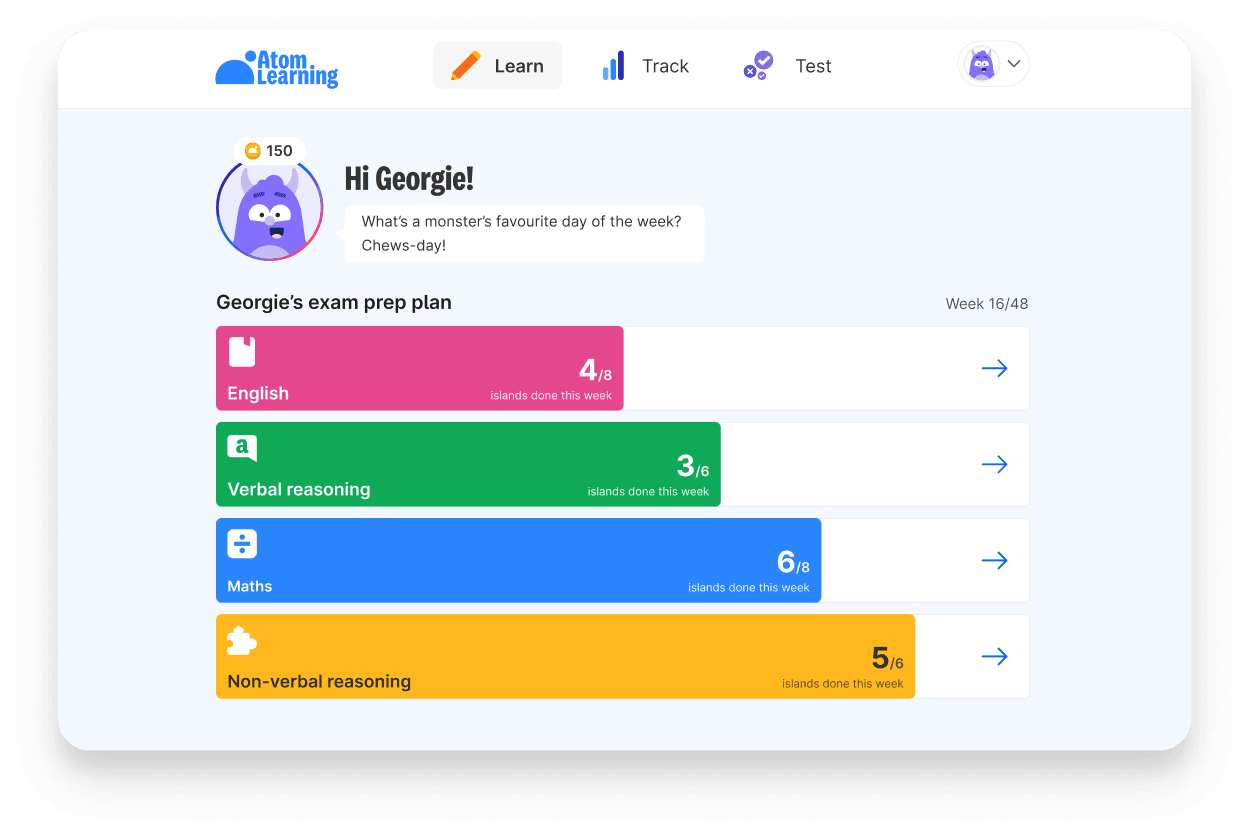
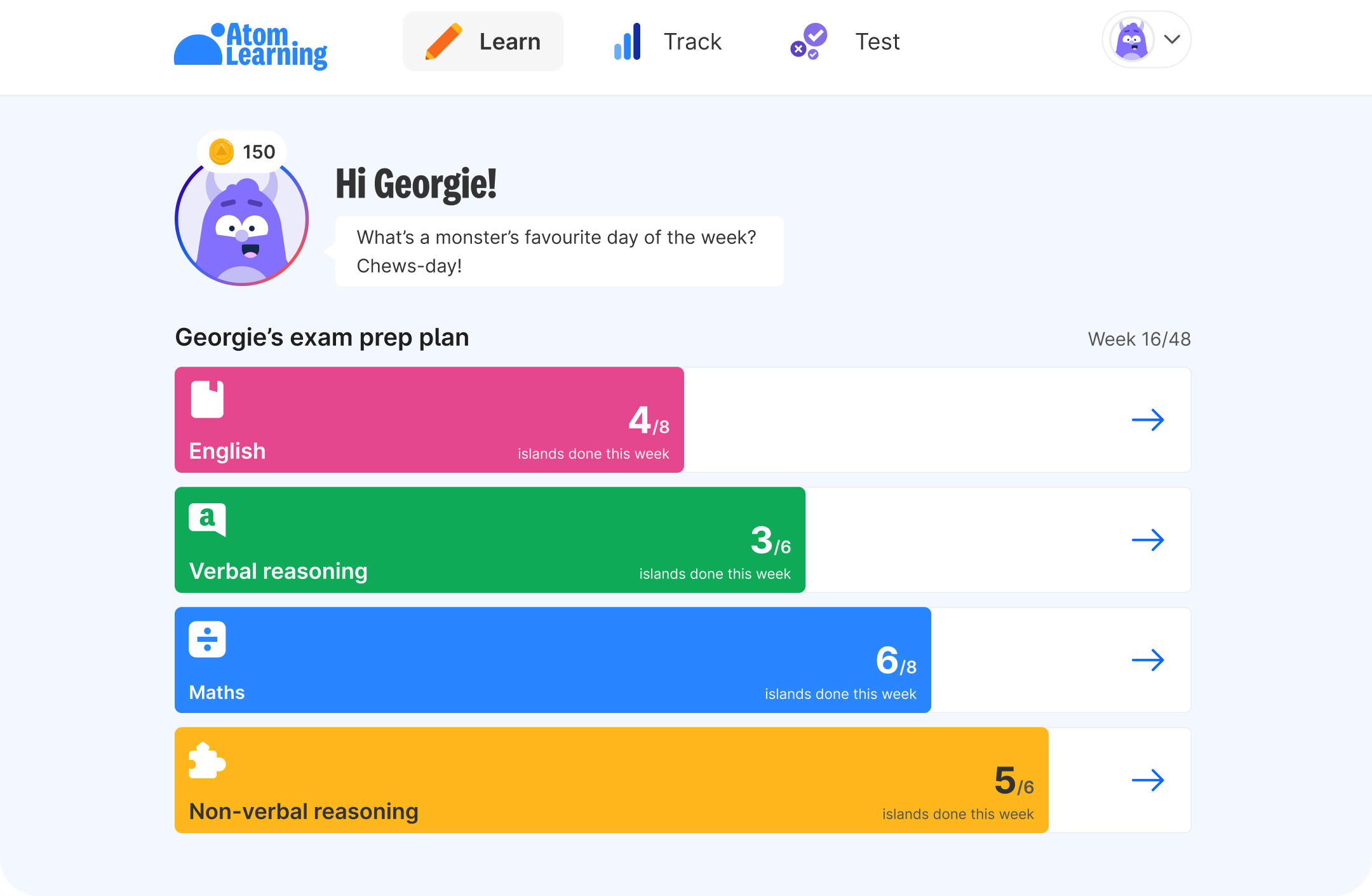
Atom Home makes learning a more enjoyable process for your child. They'll explore exciting worlds full of interactive questions, earning coins to spend in the Atom shop. Atom adapts to your child, showing them questions at just the right level of difficulty to keep them motivated.

Georgie's exam prep plan on Atom Home, showing the number of topics completed this week in English, maths, verbal reasoning and non-verbal reasoning

Read widely

In Eton College English assessments, your child will need to analyse text and interpret written information. Regular reading at home is a great way to help your child build these skills.

Encourage your child to read books from different genres and by a diverse range of authors. Reading widely helps your child understand different styles, tones and purposes. Regular reading is important to help your child widen their vocabulary, improve analytical thinking, and enhance their imagination.

Looking for reading inspiration? Take a look at our recommended reading list for children aged 7-11.

Develop curiosity

Eton College is an academically selective school. The admissions team are looking for children who can show a commitment to learning and finding out more about the world.

It's important to support your child's broader learning and intellectual curiosity. Talk to them about their interests, opinions and what they think about current affairs. It's also a good idea to make sure they benefit from a rich variety of experiences, such as visiting free museums and galleries.

Practice tests

When your child feels confident with Year 5 topics, they’ll be ready to put their knowledge to the test.

Practice tests can help your child improve their problem-solving skills and exam technique. They’re a great way to consolidate learning and highlight knowledge gaps.

It’s best to schedule mock tests for the weekend when your child is feeling more refreshed. Try to simulate an exam environment by removing distractions, reading the instructions to your child as an invigilator would, and setting a strict time limit. This will help make the real experience feel less daunting.

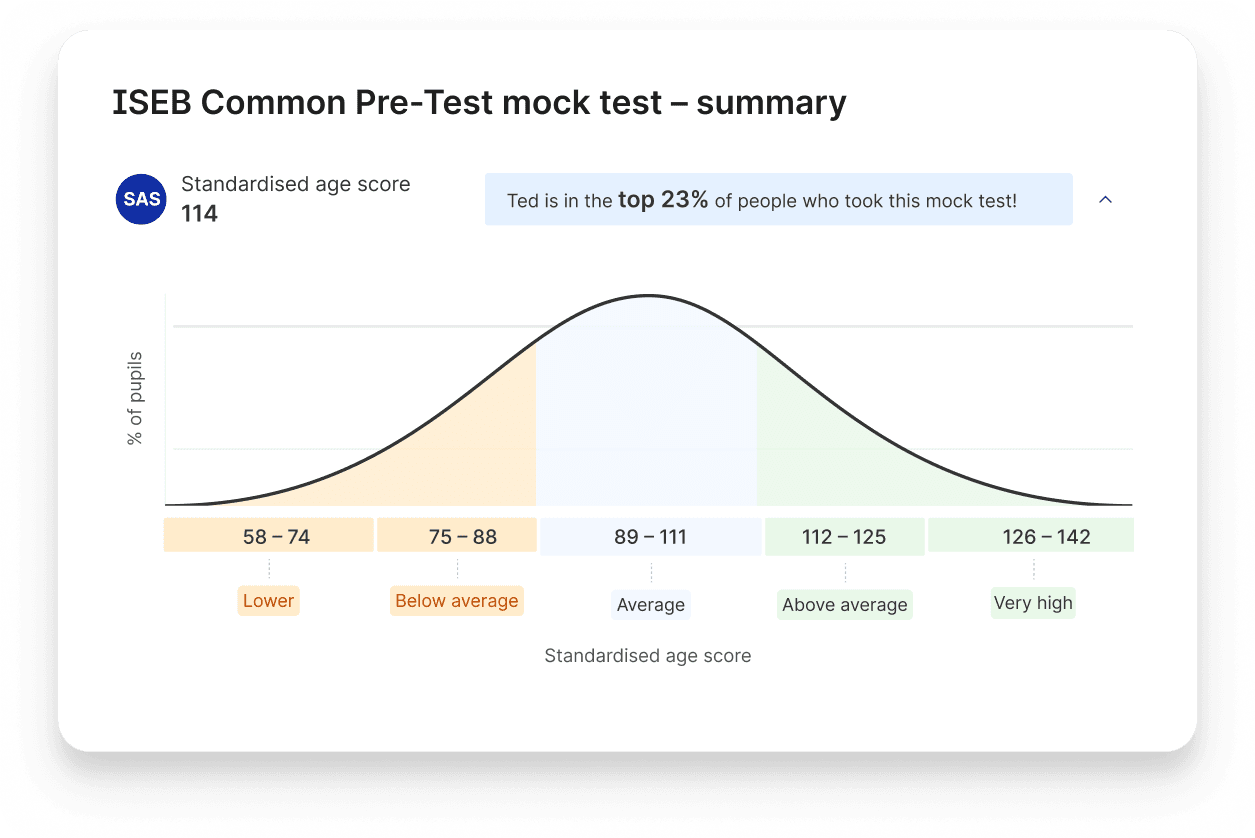
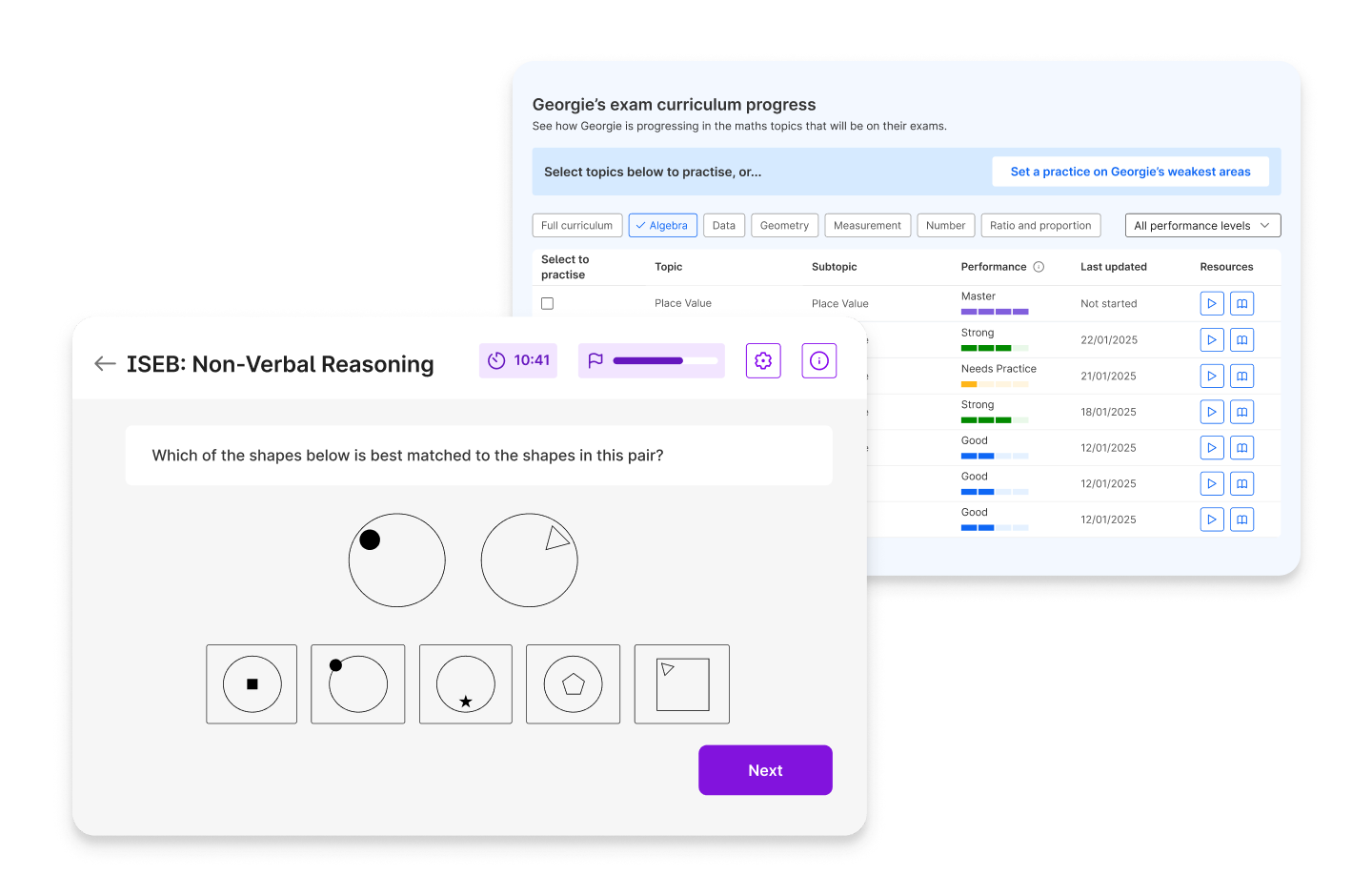
With Atom, you can unlock unlimited mock tests for the ISEB Common Pre-Test and Eton List Test. See your child's results instantly, including their standardised age score and topics they might need more work on.

Child's standardised age score on Atom Home after taking a mock test for the ISEB Common Pre-Test

Celebrate progress

Setting regular, achievable goals and celebrating your child’s progress keeps them motivated. It's important to encourage a growth mindset and celebrate effort as much as achievement.

When your child makes mistakes or finds something difficult, help them understand that they can improve through practice. Regular praise will help them improve their resilience when tackling challenging topics.

No items found.
No items found.

Remove the guesswork from ISEB prep.

Worried about how your child will perform in the ISEB Common Pre-Test? The adaptive format can feel unpredictable, but their preparation doesn’t have to. 

Atom adapts to your child’s level as they work. We show you exactly what they need to practise and how they’re progressing. 

Partnered with leading independent schools, trusted by families.

Start your free trial and watch your child master every ISEB subject. 

Try Atom for free