Considering Highgate School for your child? We’ve collated everything you need to know about 11+ entry. Learn how to apply, what’s on the entrance exam, and how to help your child prepare for success.
Key information for Highgate School
- Address: Highgate School, North Road, London N6 4AY
- Age range and gender: boys and girls aged 4–18
- Type of school: independent day
- Number of students: 1,900+
- Admissions contact: [email protected]
- 11+ open days: October
- 11+ selection criteria: entrance exam, interview, taster lesson and headteacher’s reference
- Financial assistance: means-tested bursaries
- 11+ scholarships: music
About Highgate School
Highgate School is a private day school for boys and girls in the leafy suburb of Highgate in north London. It was founded in 1565 by Sir Roger Cholmeley, a ‘well-beloved and faithful subject’ of Queen Elizabeth I. The school comprises a prep-prep, junior and senior school and educates over 1,900 children.
Pupil wellbeing is at the heart of Highgate School’s ethos. A dedicated wellbeing team aims to ensure pupils feel safe, happy, supported and welcomed in the community. Beyond the classroom, there are extensive extracurricular activities. These include over 150 clubs, access to 30 specialist sports coaches, and a programme of national and international trips.
Highgate School has won several awards over the years. These include Independent School of the Year (2019 and 2020) and Sunday Times London Independent School of the Decade (2020).
Dates for your diary
- Registration closes: November in Year 6
- Entrance exam: December in Year 6
- Interviews and activities: January in Year 6
- Offers of places: February in Year 6
- Acceptance deadline: March in Year 6
Highgate School 11+ entrance exam
All children applying for 11 plus entry to Highgate School take an entrance exam in December in Year 6. This consists of three paper tests: English, maths and non-verbal reasoning.
English
The English test lasts 45 minutes. There are two main sections in total.
In Section 1, your child will need to read a passage of text, which will be a short extract from a story or novel. They will then answer three questions which demonstrate their skills in:
- reading comprehension – showing how well they understand what they have read
- analysis – explaining the effect the writer has created in the passage
The questions will require written responses. Each of the three questions might have more than one part in it. Your child will see how many marks are available for each question in their exam booklet. Your child should spend 30 minutes answering these questions (including time taken to read the passage of text).
Section 2 consists of one question (Question 4). This is a creative writing task. They might be asked to write the opening of a story or a description. They will see prompts to help guide their answer. 10 marks will be available for the content of their writing (such as how original and creative it is). 5 marks will be awarded for spelling, punctuation and grammar.
Your child should spend 15 minutes answering this question. It’s important that they give themselves enough time to check their work to ensure their spelling, grammar and punctuation are accurate.
Maths
The maths test lasts around 45 minutes. This paper tests your child’s knowledge and understanding of the Key Stage 2 maths curriculum. However, your child won’t know exactly which topic they are being tested on as they answer the questions. They need to decide which is the best strategy to solve the problems for each question.
There are four questions in the maths paper. Each question is split into four parts (A, B, C and D). The level of difficulty increases within the question, so your child might find part D more difficult than part A. 10 minutes is allowed for each question. After 10 minutes have passed, all children move onto the next question at the same time. Time is allocated at the end of the test to give children time to go back and check their answers.
Non-verbal reasoning
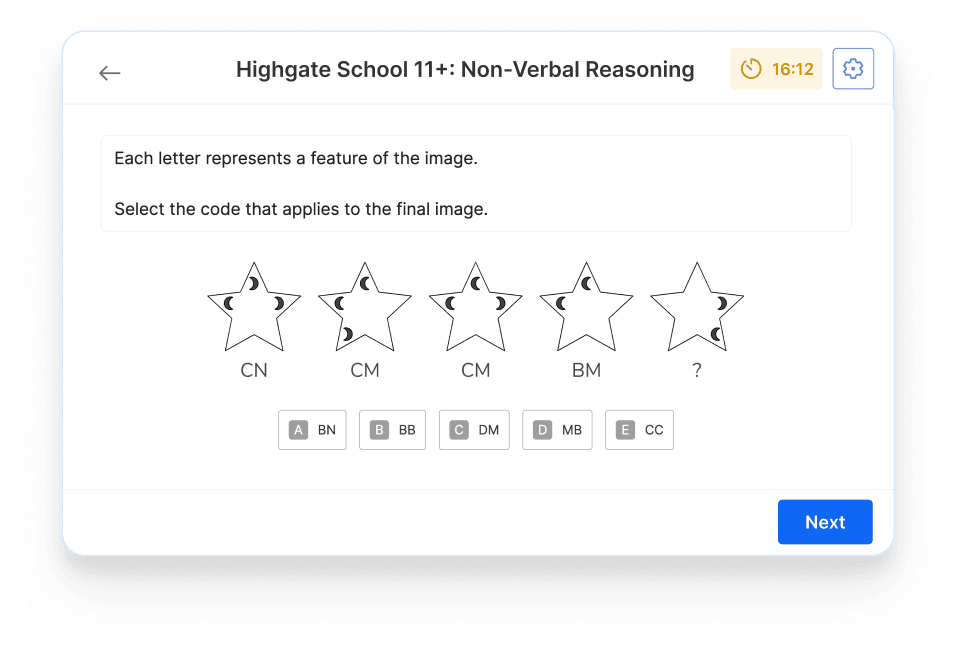
The third paper tests non-verbal reasoning. This assesses your child’s ability to use logic and reasoning to solve problems with visual information, such as shapes and diagrams. Highgate School uses GL Assessment papers for this test.
This paper is divided into four sections which last around 40 minutes in total. Your child will not be allowed to move forwards or backwards between the sections until they are told to do so.
All the questions in the non-verbal reasoning paper are multiple-choice. Your child will have a separate answer sheet for this test. They need to mark the answer they think is correct by shading in the corresponding answer option on the answer sheet.
Around the same time as the entrance exam, Highgate School will write to your child’s current headteacher to request a confidential reference. Based on this reference and performance in the entrance exam, many children are then invited back to the school in January for the next stage.
The second stage of the assessment consists of group interviews and taster lesson(s). Learn more about interviews, find out top tips, and download a free interview resource in our guide to private school interviews.