Considering St Paul's Girls' School for your child? We’ve collated everything you need to know about 11+ entry. Learn how to apply, what’s on the entrance exam, and how to help your child prepare for success.
Key information for St Paul's Girls' School
- Address: St Paul's Girls' School, Brook Green, Hammersmith, London W6 7BS
- Age range and gender: girls aged 11–18
- Type of school: independent day school
- Number of students: 750+
- Admissions contact: [email protected]
- 11+ open days: September and October in Year 6
- 11+ selection criteria: Cambridge Select Insight test, written tests, interview and school reference
- Financial assistance: means-tested bursaries
- 11+ scholarships: music
About St Paul's Girls' School
St Paul’s Girls’ School (SPGS) is a private day school in Hammersmith, West London, for girls aged 11 to 18. It was founded in 1904 by John Colet as a sister school to St Paul’s School.
SPGS consistently ranks within the top schools in the UK, often coming first based on exam success. While academic results are important, the school has a liberal ideology. There's no school uniform, few rules, and discussion and debate are encouraged. A forward-thinking curriculum includes a 'real world' creative research programme and Friday lectures from eminent speakers.
Students at SPGS have extensive co-curricular opportunities. Music and drama are performed to a very high standard, and there are plenty of sports and STEM activities on offer. Students are also encouraged to engage in partnerships, volunteering and service programmes.
Dates for your diary
- Registration closes: early November in Year 6
- Stage 1 entrance exam (Cambridge Select Insight): late November in Year 6
- Stage 2 entrance exam (written tests): early January in Year 6
- Stage 3 (interviews): January in Year 6
- Offers of places: February in Year 6
- Acceptance deadline: March in Year 6
St Paul's Girls' School 11+ entrance exam
Stage 1
All children applying for 11+ entry to St Paul's Girls' School take the Cambridge Select Insight exam. This is a computer assessment previously known as CEM Select. Schools use the exam to get an idea of a child’s academic potential and ability.
Cambridge Select Insight has a time limit of one hour and is split into six sections. This is a non-adaptive test, so all children see the same questions in the same order. Question types include multiple-choice, drag and drop, and auto-complete.
The core sections in the test are comprehension, missing words, numerical ability and pictures. These sections are often supplemented with one or two more sections which test verbal reasoning.
- Comprehension: the reading comprehension section is one of the longest in the test. Your child will need to read a passage of fiction or non-fiction text, and answer questions to assess their understanding of the text and the extent of their vocabulary.
- Missing words: your child will see two passages of text, one after the other. Both contain missing words. They will need to work out the missing words in each passage.
- Numerical ability: this section of the test assesses your child’s maths skills and knowledge. These questions are aligned to the Key Stage 2 maths curriculum.
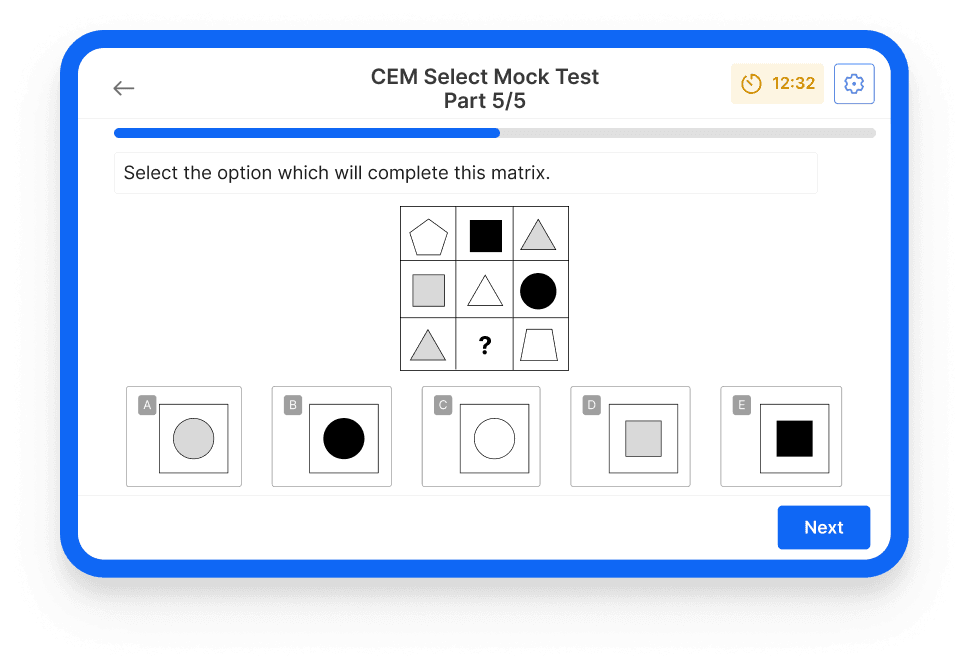
- Pictures: the pictures section assesses non-verbal reasoning. For each question, your child will need to choose a picture to complete a set.
You will be informed of the outcome of Stage 1 in mid-December. St Paul’s Girls’ School will also ask your child’s current school for a confidential report around this time.
Stage 2
Children who have performed well in the Cambridge Select Insight test are invited back to St Paul’s Girls’ School in January for Stage 2 tests. There are three papers in total:
English
The English paper has a time limit of 1 hour and 15 minutes.
Your child will need to read a passage of text and answer questions to demonstrate their understanding and analysis of what they have read. Some of the questions may be extended creative writing tasks based on the passage.
Questions will assess your child’s ability to:
- accurately extract information from the text
- comment on the meaning and effect of individual words and phrases
- show inference and sensitivity to linguistic effects
- apply a wide vocabulary, where appropriate
Maths
The maths paper has a time limit of 1 hour and 15 minutes. This is split into two sections:
- Section A: questions based on fundamental maths concepts taught at Key Stage 2, followed by questions which are more problem-solving in style. 35 minutes are allocated for this section.
- Section B: multi-part questions which will assess your child’s ability to understand new ideas and put them into practice. 40 minutes are allocated for this section.
Your child is encouraged to show their working out in all sections. Wrong answers may be given credit if they are supported by detailed working out.
Comprehension
The comprehension paper has a time limit of 1 hour and 15 minutes and is based on a theme. Your child will need to respond to a range of materials (e.g. visual, numerical, or written) and draw conclusions about them.
This paper tests skills such as:
- deduction and inference
- extraction and organisation of information
- evaluation and comparison
- identification of patterns and links
- logic and problem-solving
Your child will not need any prior knowledge to complete this paper. However, scientific enquiry skills (such as those developed in Key Stage 2 science) might be helpful.
Stage 3
The final stage in the SPGS 11+ admissions process is an interview. Children who are successful in the written entrance exams are invited back to the school for an interview during a weekend in January.
The interview lasts around 20 minutes. The interviewer will use the opportunity to get an idea of your child’s academic potential, using stimulus material to guide the conversation. SPGS is looking for evidence of your child’s creativity, engagement, and capacity for independent thought.
Learn more and get top tips in Atom’s guide to private school interviews.