Westminster School 13+ entry guide
Are you thinking about applying to Westminster School for 13+ entry? Find out everything you need to know about the admissions process and how to prepare for the entrance exam.
Key information for Westminster School
- School type: co-educational independent school (day and boarding), becoming fully co-educational at 13+ from 2028 entry
- Location: Westminster, Central London
- Admissions contact: registrar@westminster.org.uk
- 13+ exam: ISEB Common Pre-Tests, plus further Maths and English tests and an interview
- Financial assistance: means-tested bursaries
- Scholarships: King's Scholarships (academic) and Music Awards
Important dates for Year 9 (13+) entry
Westminster's 13+ registration is currently open for 2029 entry. Because the timeline runs two years ahead of entry and is set relative to your child's school year rather than fixed calendar dates, here's how the process unfolds:
- 1 October of Year 5: registration opens
- 30 September of Year 6: registration closes
- October to November of Year 6: pre-interview tests taken at your child's current school
- Mid-December of Year 6: interview invitations sent to shortlisted candidates
- Early January of Year 6: further Maths and English tests
- January to February of Year 6: interviews take place
- End of February of Year 6: offer results communicated
- March of Year 8: unconditional offers confirmed, subject to a supportive reference from your child's current school
Check the school's website nearer the time to confirm exact dates, since Westminster has not yet published day-specific dates for the 2029 entry cycle.
How to apply to Westminster School
Westminster School is selective, with around 125 children joining Year 9 (the Fifth Form) each year. The school receives around 500 applications for 13+ entry and invites approximately 250 applicants to interview.
You must register your child online when they're in Year 5, in the academic year of their tenth birthday. Registration opens on 1 October of Year 5 and closes on 30 September of Year 6. A non-refundable registration fee applies.
If you're applying for a bursary, you'll need to indicate this at the point of registration. If your child is later offered a place, you'll be invited to complete an in-depth financial assessment.
Children who attend a primary school finishing at the end of Year 6 should apply for 11+ entry to Westminster Under School instead, as pupils accepted there move up to Westminster School in Year 9 without needing to reapply or sit further tests. 13+ entry is for children who can remain at their current school until they are 13.
What will my child be tested on?
Westminster's 13+ entrance process has two stages: pre-interview tests taken at your child's current school, followed by further tests and an interview at Westminster for shortlisted candidates.
Stage 1: Pre-interview tests
While your child is in Year 6, they'll sit pre-interview tests in Maths, English and Reasoning, taken online at their own school during October or November. Westminster uses the ISEB Common Pre-Tests, an adaptive, computer-based assessment used by many senior schools, which adjusts questions in real time based on how a child is performing. Raw scores are adjusted according to each child's age, so younger candidates in the year group aren't disadvantaged. Overseas candidates can take these tests at their own school too.
Westminster also requests a report from your child's current school for all pupils sitting the pre-interview tests.
Stage 2: Further tests and interview
Children who perform well in the pre-interview tests are invited back for further testing and an interview. This takes place in January, when your child is in Year 6. It includes:
- Further Mathematics and English tests, each 40 minutes long
- A separate interview
Overseas candidates attend Westminster in person for this stage.
Is your child ready for the ISEB Pre-test?
See where they stand in minutes. Atom’s free ISEB baseline tests give you an instant breakdown of their strengths and gaps. Know exactly what to focus on next and start preparing with direction, not uncertainty.
.png)
How are places decided?
After the further tests and interview, Westminster considers all the information gathered about a candidate before deciding whether to offer an unconditional place. This means the school believes your child will be able to comfortably meet the standard expected for entry at 13, while also making the most of a broad and varied education.
Parents are told whether their child has been offered a place by the end of February, when their child is in Year 6.
An unconditional offer is made on the expectation of continued good conduct and academic progress at your child's current school, including an unreserved supporting reference in March of Year 8. If a place isn't offered straightaway, your child's name may be added to a waiting list, from which they could be offered a place at any point up to the end of June in Year 8.
Financial information
Westminster School is a fee-paying school. Take a look at the school website for a full breakdown of fees for day and boarding pupils.
Financial assistance
When exploring independent schools for your child, scholarships and bursaries are worth considering. They can ease the pressure of school fees and open doors to opportunities that might otherwise feel out of reach.
Scholarships
Scholarships are awarded for a child's talent or achievement. Westminster offers King's Scholarships, its long-established academic award, alongside Music Awards for outstanding instrumentalists.
King's Scholarships are not means-tested and are awarded through a separate examination known as The Challenge, sat by candidates in Year 8. Music Awards are offered to candidates who audition and subsequently qualify for a place through the usual entrance process.
Visit Westminster School's website to see the scholarships available and how to apply.
For more information, read: Your guide to independent school scholarships.
Bursaries
Bursaries are means-tested awards (based on a family's financial situation) designed to make independent education more accessible. At Westminster, means-tested bursaries of up to 100% of day fees are available for day places at 13+, and can also cover extras like uniform, travel, equipment and school trips.
Families provide financial information to qualify, and awards are reassessed each year. For many families, bursaries make an excellent education possible that might otherwise seem out of reach.
Visit Westminster School's website to find out what bursaries are available and how to apply.
For more information, read: Bursaries: a parents' guide
Your guide to scholarships & bursaries
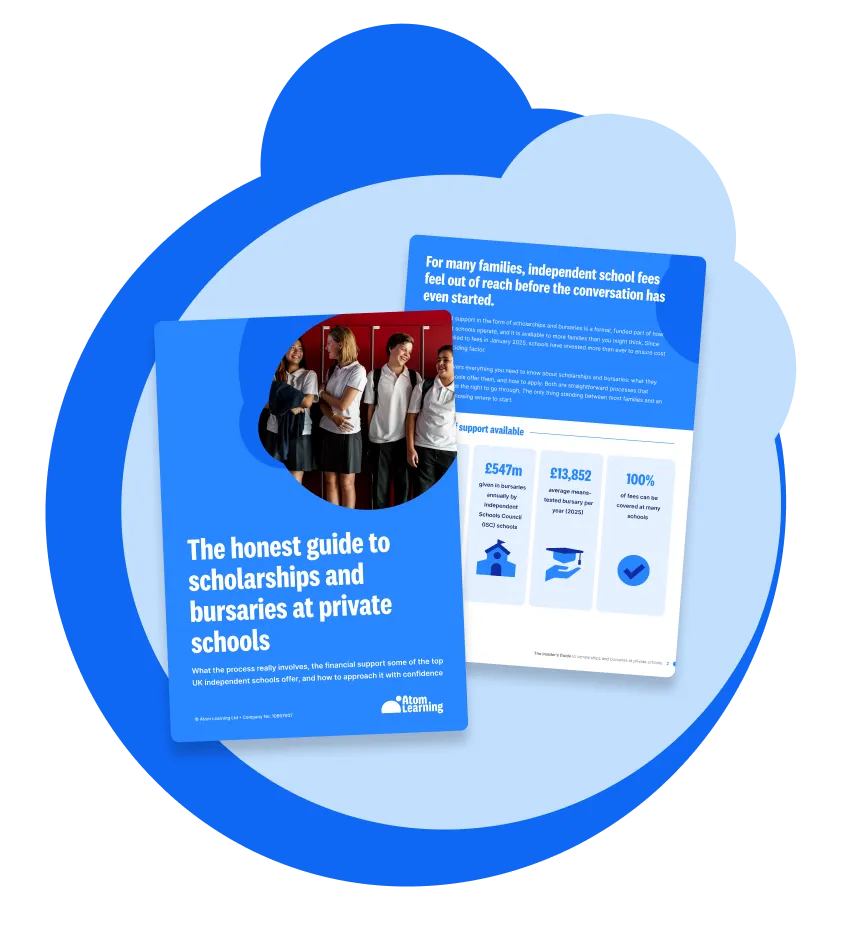
Financial support for independent school fees is more available than most families realise.
This free guide is an honest look at how scholarships and bursaries work in practice: what they cover, how the timeline unfolds from Year 4 to Year 6 and how to approach admissions with confidence.
.png)
How can I help my child prepare for the test?
Applying to senior school can feel like a big milestone, but preparation doesn't have to be overwhelming. Here's how you can help your child prepare for test day.
Stay on track with a clear plan
One of the hardest parts of exam preparation is knowing what to focus on, when, and how to make steady progress without it taking over family life.
A clear, structured plan helps your child feel less overwhelmed and more in control. It ensures they build skills in the right order, cover everything they need, and avoid last-minute cramming.
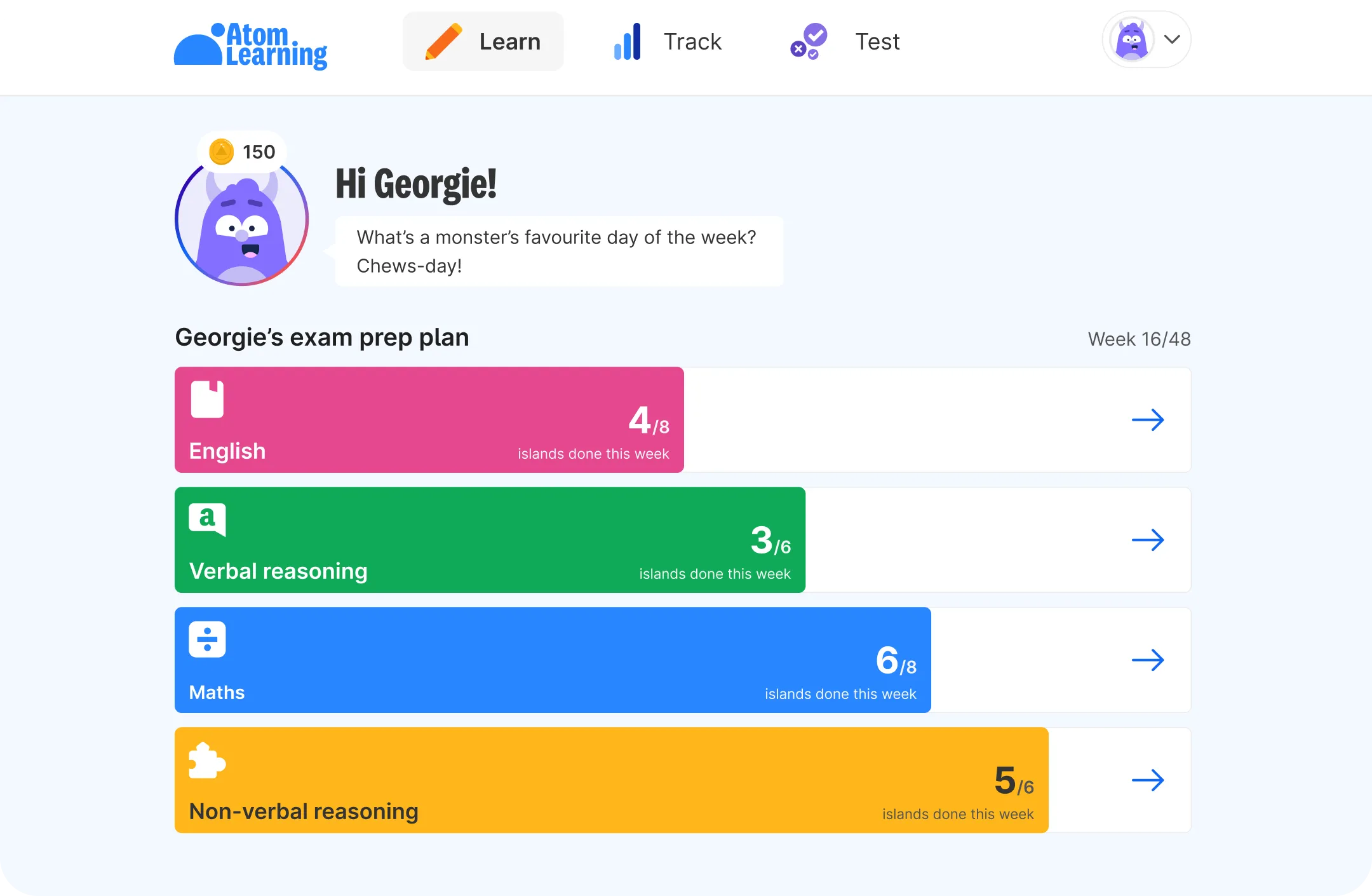
Atom's exam plan makes this easier. Enter your child's target schools and exam dates, and we'll create a personalised weekly plan tailored to the topics they'll be tested on. It shows them what to work on and when, adapts as they improve, and helps them build progress in a calm, manageable way, little and often.
That means less guesswork for you, less stress for them, and a clearer path all the way to exam day.
Build smart exam technique
As your child's knowledge grows, practice tests can help them feel more comfortable with the real exam format.
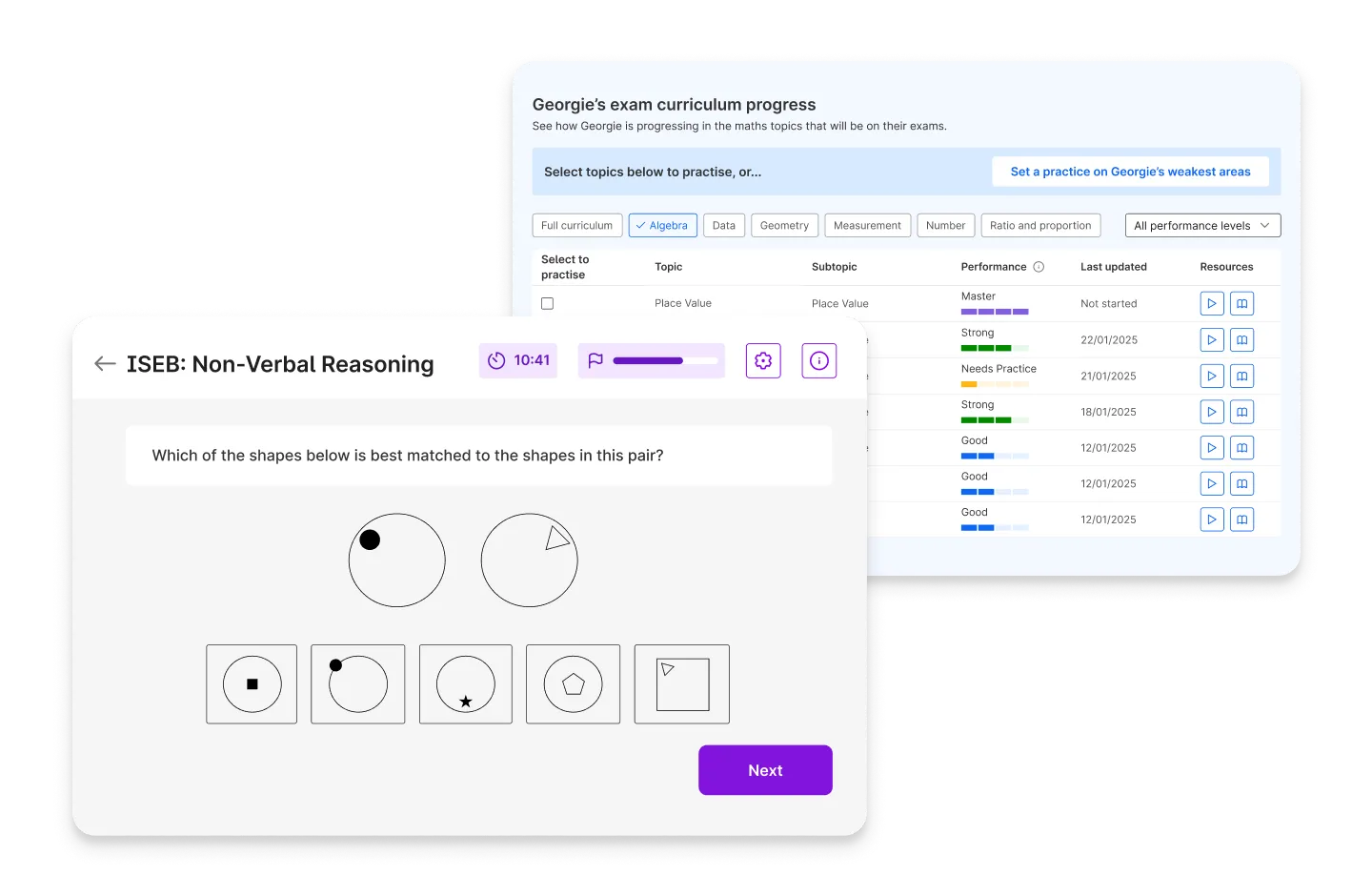
Atom's mock tests are exact replicas of real entrance exams. They're also unlimited, so your child can take the same test repeatedly and see new questions each time. This helps them practise without repeating the same content.
Atom's mock tests are automatically marked. You'll see your child's standardised age score (SAS), where they're doing well, and what they should focus on next. You'll also learn how they compare to other children applying to the same school.
Encourage regular reading
Strong reading skills play a big role in preparation for entrance exams.
Encourage your child to read every day, even for just 10–15 minutes. The key is variety. Mix fiction and non-fiction, different genres, and a range of authors. This helps them become more confident in understanding tone, purpose, and meaning across different texts.
Over time, regular reading will:
- broaden their vocabulary
- improve comprehension and inference
- build confidence in tackling unseen texts
And just as importantly, it can help them enjoy reading, not just see it as exam preparation.
Looking for inspiration? Atom's reading and writing starter kit has suggestions spanning fiction and non-fiction for Years 3–6.
Celebrate progress, not just scores
When you're supporting your child through exam preparation, what really matters is knowing they're moving in the right direction, not just how they scored on a single test.
Atom's progress tracking gives you a clear, simple picture of how your child is doing in each topic and the direction they're moving in. You can see where they're on track, where they might need more practice, and spot progress as it happens.
That makes it easier to give meaningful encouragement, keep motivation steady, and focus on what matters most: consistent improvement, not just one-off results.
Remove the guesswork from ISEB prep.

Worried about how your child will perform in the ISEB Common Pre-Test? The adaptive format can feel unpredictable, but their preparation doesn’t have to.
Atom adapts to your child’s level as they work. We show you exactly what they need to practise and how they’re progressing.
- Follow personalised weekly exam plans that adjust to your child’s performance and show them what to learn next.
- Practise with replica ISEB mock tests that generate new questions every time, so they build real exam skills.
- Track progress and see how they compare to others preparing for the ISEB Pre-Test.
Start your free trial and watch your child master every ISEB subject.