If your child is taking the CAT4 test, this guide will help you and your child understand what to expect.
Read on to:
Find out why schools use the CAT4
Understand the format and structure of the CAT4
Learn how the CAT4 is scored
Discover how to help your child prepare
Plus, sign up for Atom's free CAT4 course – including video lessons and CAT4 practice papers!
What is the CAT4?
CAT4 stands for Cognitive Abilities Test. It's created by GL Assessment – a UK exam board that provides a lot of 11 plus tests.
The CAT4 is a non-adaptive test, which means that every child answers the same questions in the same order. It is designed to assess a child’s reasoning ability and is used by grammar and independent schools to decide if a child is right for the school.
It is also a standardised test. It’s been standardised from around 25,000 children’s answers in the UK and Ireland. This means a child’s performance can be reliably compared to other children of the same age in the UK.
What is the CAT4 used for?
Schools use CAT4 tests for a range of reasons. The results help teachers understand how children think and solve problems. While exams like SATs or GCSEs assess what pupils have learnt in class, CAT4 focuses on reasoning skills. This gives a clearer picture of how a child might learn and develop over time.
The results can highlight strengths that may not be obvious in lessons and show where extra support could make a difference. They also help schools set learning goals and organise teaching groups more effectively.
Schools use CAT4 to:
Assess students for admission to selective schools (including grammar and independent schools)
Put students into groups based on academic ability (also known as streaming!)
Predict future exam results (e.g. predicted grades for GCSEs)
Teachers use CAT4 to:
Understand each student’s ability and potential
Spot strengths and provide extra challenge
Identify who needs more support
Plan the best ways for each child to learn
Support the move from primary to secondary school
What are the CAT4 levels?
The CAT4 test has 10 available levels, each aimed at different age groups. The content in each level is appropriate for that age group.
The most commonly used levels are A–G. If your child is taking the CAT4 as an 11 plus exam, they will likely take Level C or Level D.
Build CAT4 mastery with Atom’s free email course. Get expert video lessons and downloadable CAT4 practice papers sent straight to your inbox, so your child can build the key skills for success whenever it suits you.
In the CAT4, non-verbal reasoning is assessed through:
Figure classification - 10 minutes(available on Atom Home)
Figure matrices - 10 minutes(available on Atom Home)
Children are not allowed to use any additional resources, such as a pencil or scrap paper, in this section.
Figure classification
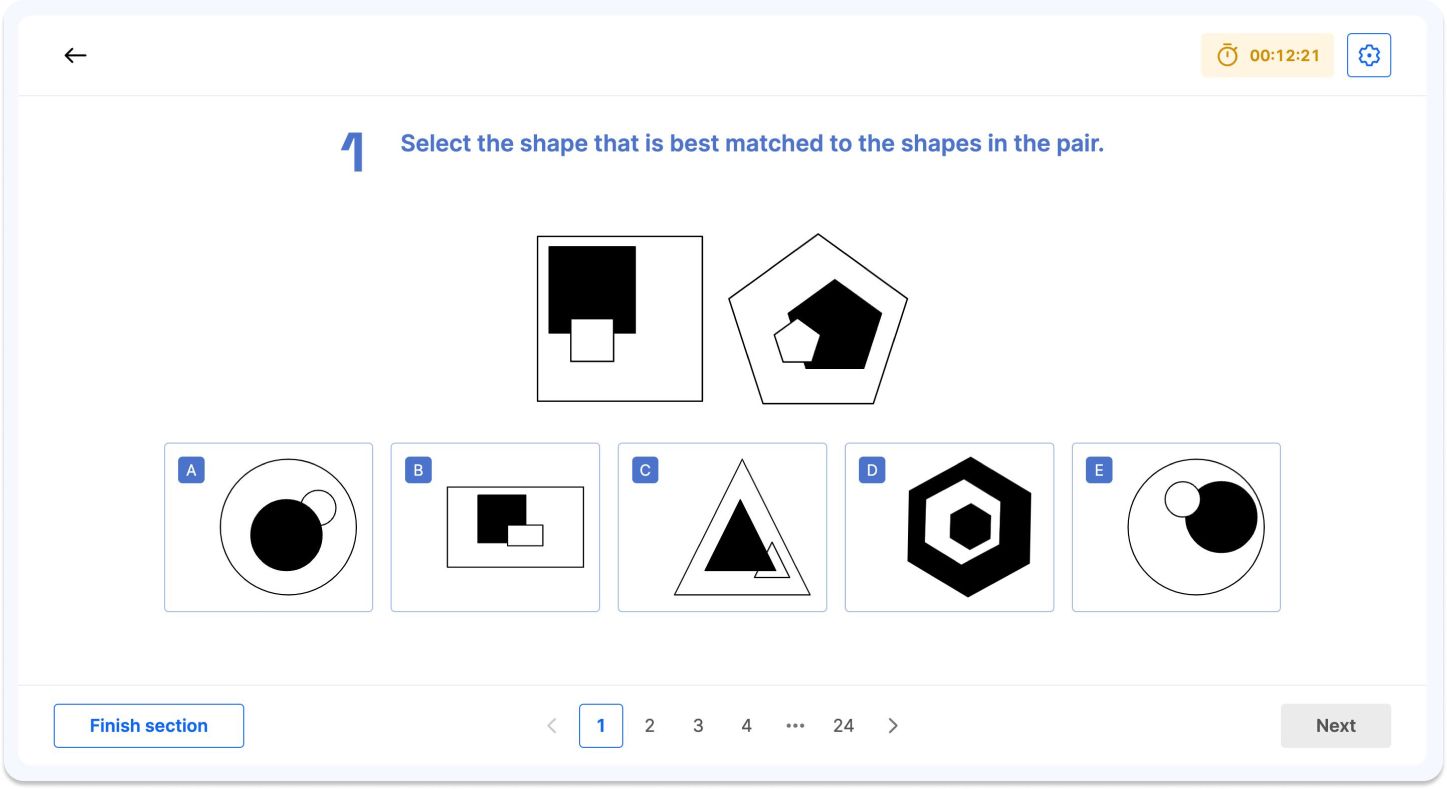
Figure classification tests your child’s ability to recognise and understand visual patterns.
They will see a pair or a group of shapes which are similar in some way. They will then choose one of five options that follow the same pattern.
Answer: E.In the example pair, a large black shape has a smaller white version of the same shape overlapping it. Option E follows the same pattern: a large black circle with a smaller white circle overlapping it.
Figure matrices
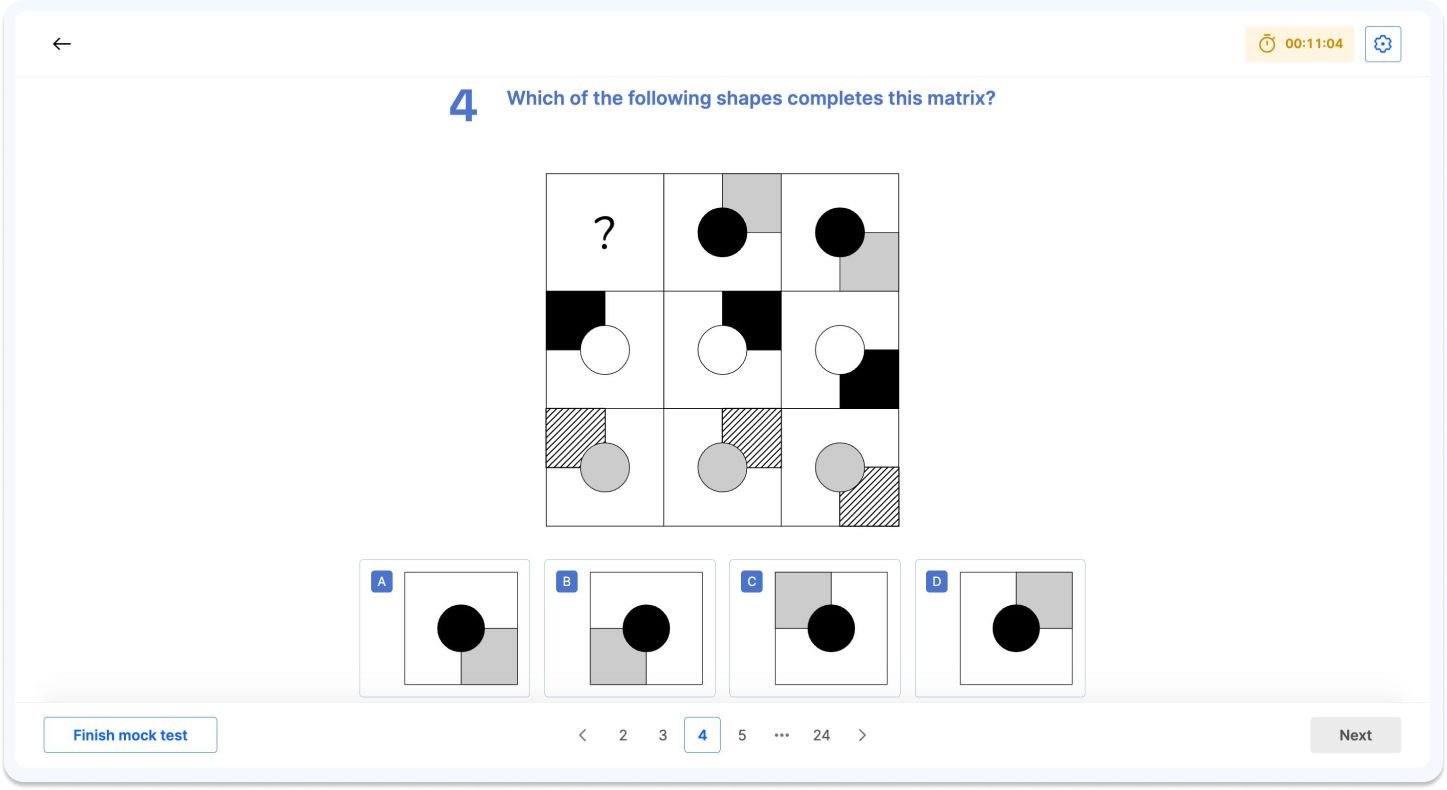
Figure matrices test your child’s ability to spot and apply changes between shapes.
They’ll see a grid of shapes with one missing. To find the missing piece, they’ll need to work out how the shapes change across the grid and choose the option that fits.
Answer: C.Each row follows a pattern where the circle colour changes (black → white → grey) and the background corner shading rotates (grey → black → hatched). In the top row, the missing shape must be a grey circle with a grey shaded corner, which matches option C.
Part 2
The second part of the CAT4 test assesses verbal reasoning and quantitative reasoning.
Verbal reasoning tests how we think and solve problems using written information. Many grammar and independent schools include 11 plus verbal reasoning as part of their Year 7 entry process.
Quantitative reasoning is designed to test maths skills and involves processing patterns using numbers.
Part 2 of the CAT4 test consists of three individually-timed sections:
Verbal classification - 8 minutes(available on Atom Home)
Verbal analogies - 8 minutes(available on Atom Home)
Number analogies - 10 minutes(available on Atom Home)
Children are not allowed to use any additional resources in this section.
Verbal classification
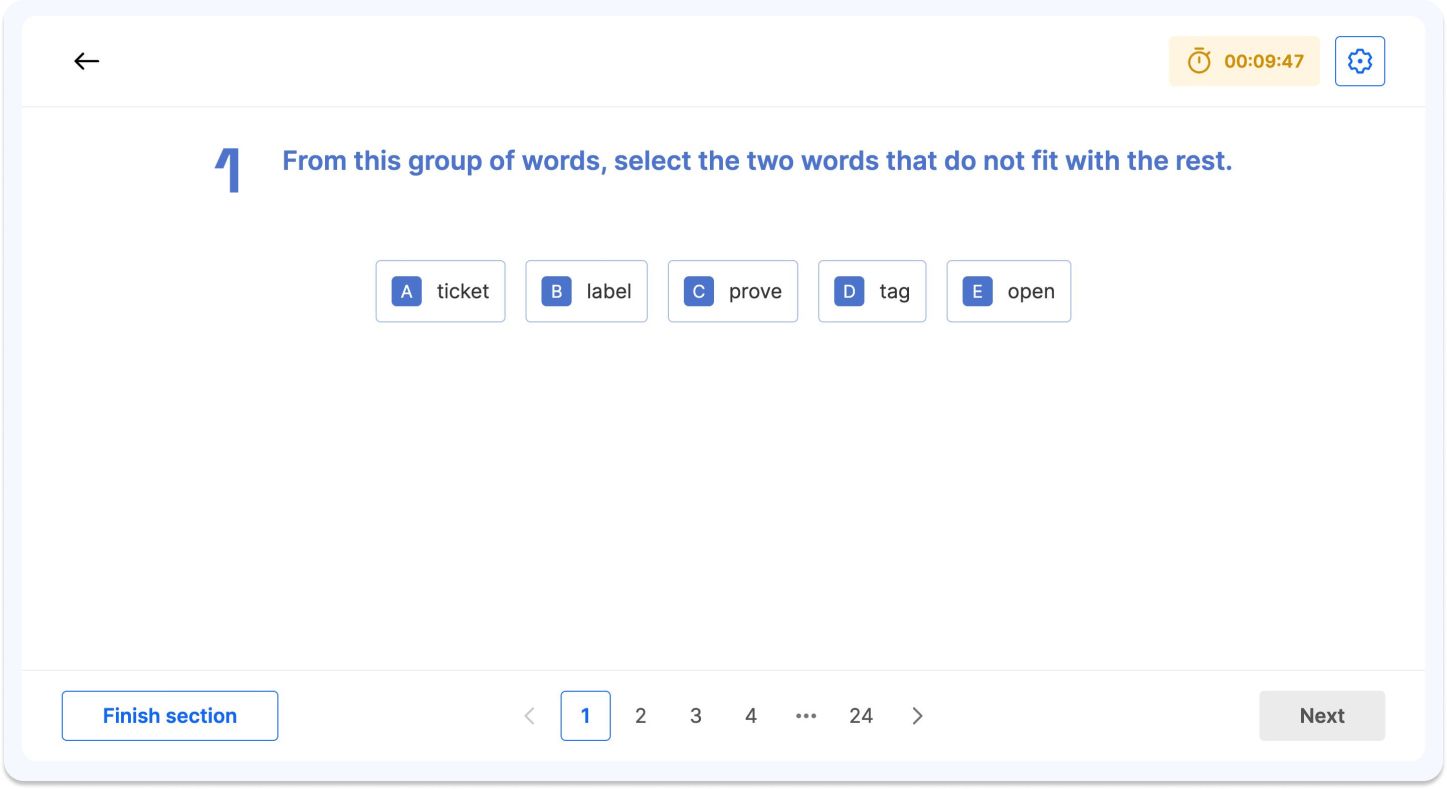
In the verbal classification test, children will see a group of words. They will need to select two words that do not fit in with the rest. For example, two words below don’t match the others.
Answer: C (prove) and E (open).Ticket, label and tag are closely linked because they are items you attach to something to give information. Prove and open are different because they describe actions, not objects.
Verbal analogies
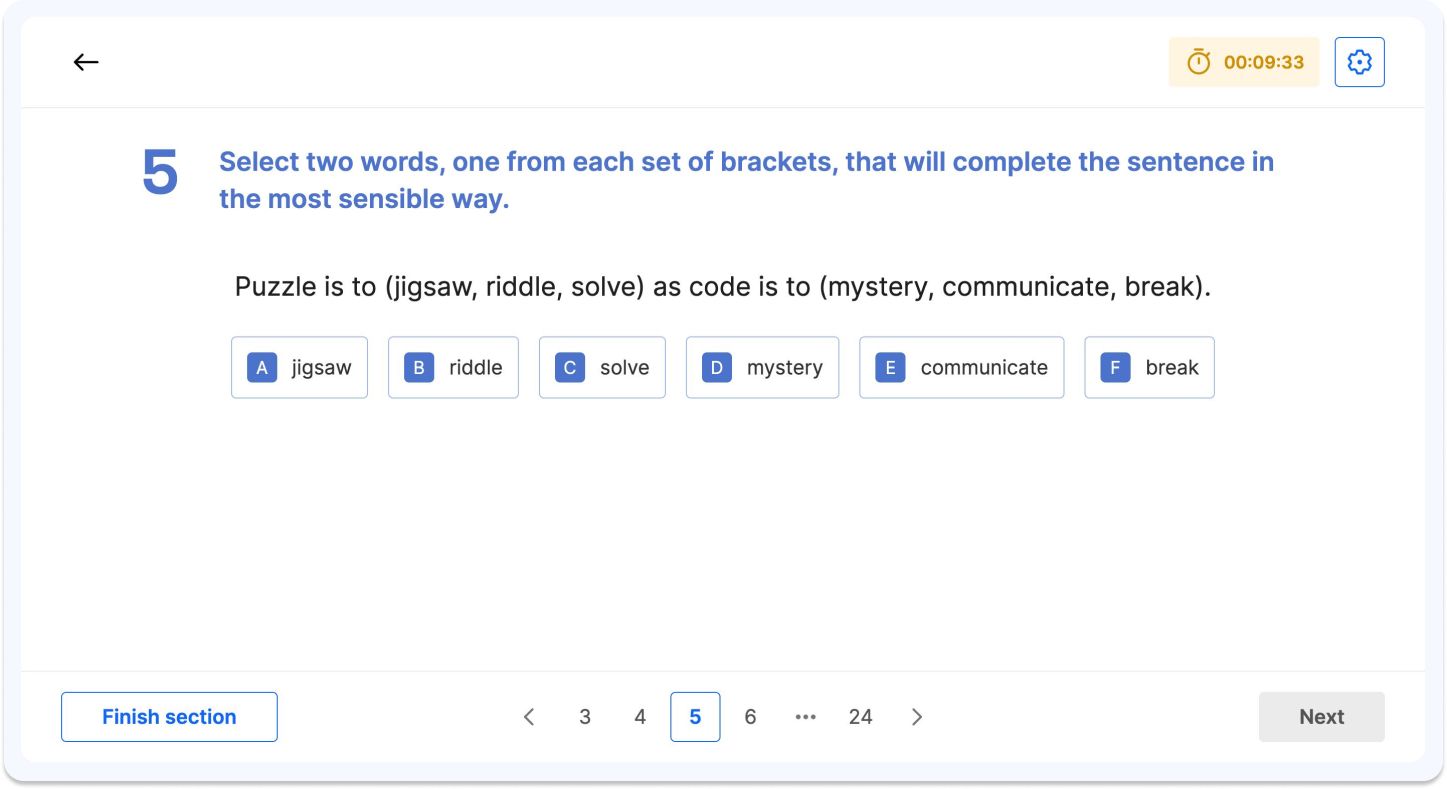
In the verbal analogies test, your child needs to work out the relationship between a pair of words. They are given two sets of options in brackets and must choose one word from each set to complete the sentence.
Answer: C (solve) and F (break).We solve a puzzle and we break a code. This keeps the same verb–noun relationship in both parts of the sentence.
Number analogies
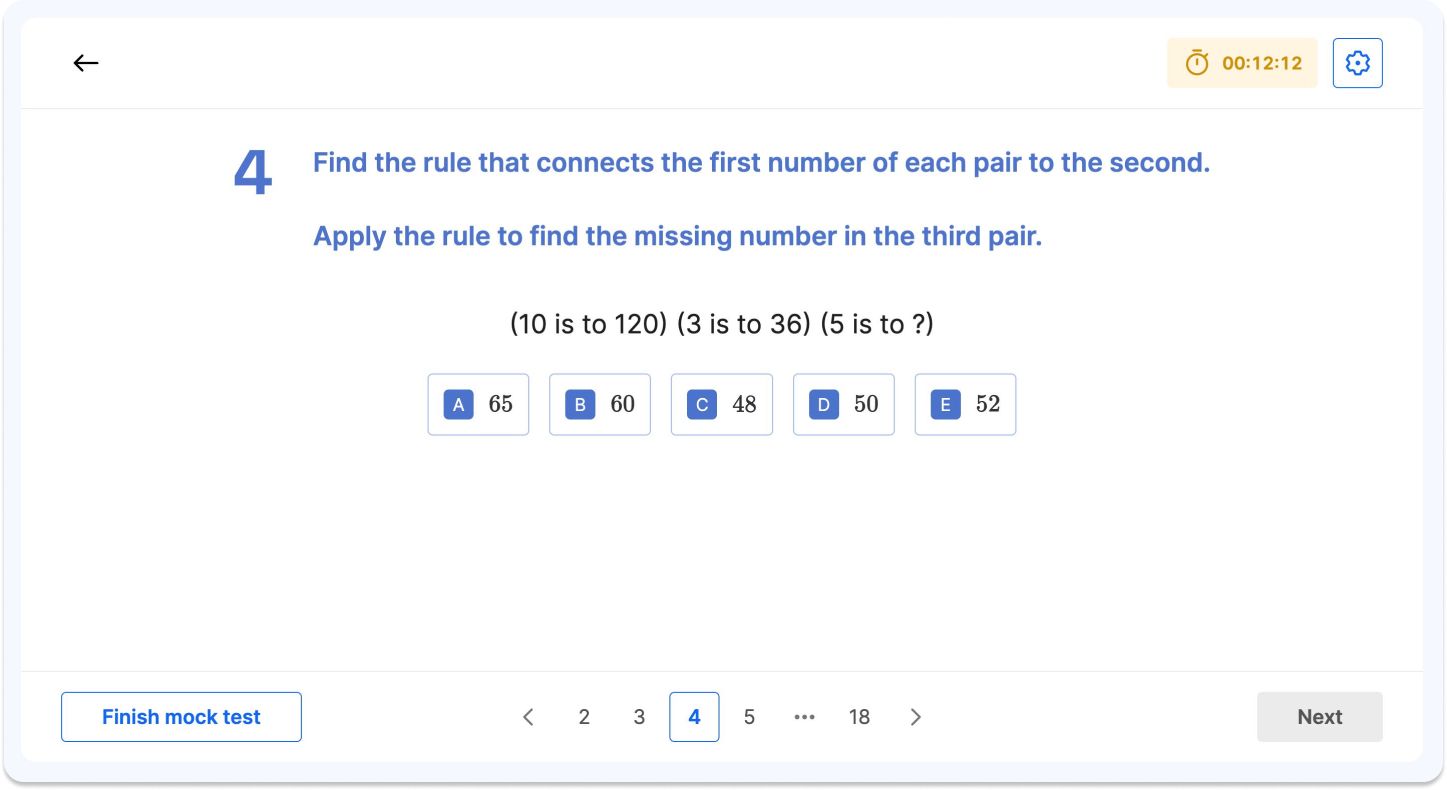
In these questions, your child will see pairs of numbers. The first number is linked to the second by a rule. One number is missing in the last pair. Your child must figure out the rule between the first and second numbers, then use it to find the missing number.
Unlike in the previous tests, your child will be allowed a pencil and paper for working out in this section.
Answer: B (60)The same rule links each pair: multiply the first number by 12.
Part 3
The third and final part of the CAT4 test involves more quantitative reasoning and spatial ability questions. This section tests how children change visual images in their minds and understand rules in number sequences. The skills tested in this part are needed in STEM subjects (science, technology, engineering and maths).
Figure analysis - 9 minutes(available on Atom Home)
Figure recognition - 9 minutes(available on Atom Home)
Your child will be allowed a pencil and paper for rough working out in the number series section, but not for figure analysis or figure recognition.
Number series
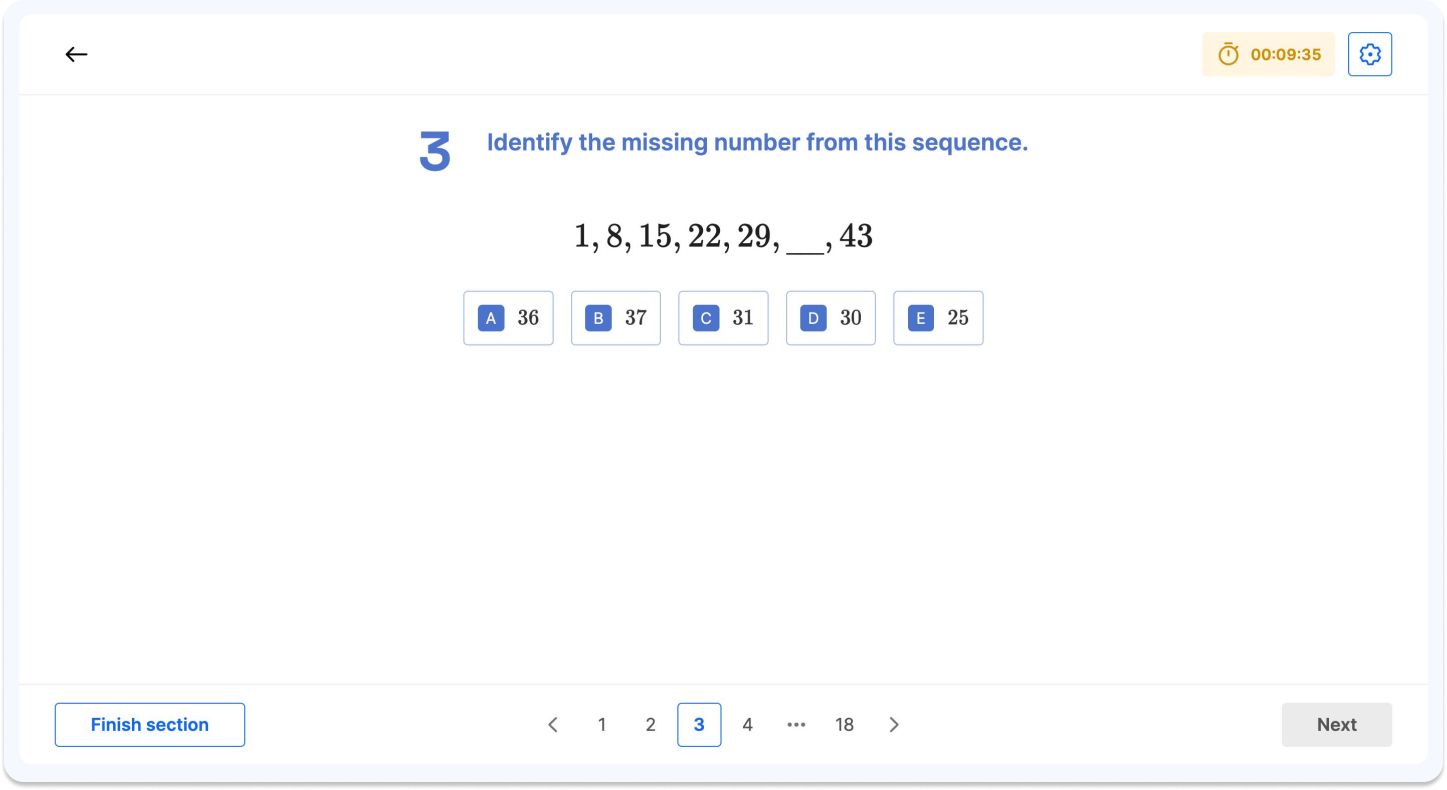
Your child will see a sequence of numbers which are linked by a rule. They need to analyse the numbers to work out the rule, then apply it to find the missing number in the sequence.
Answer: A (36).The sequence increases by 7 each time, so the missing number is 36.
Figure analysis
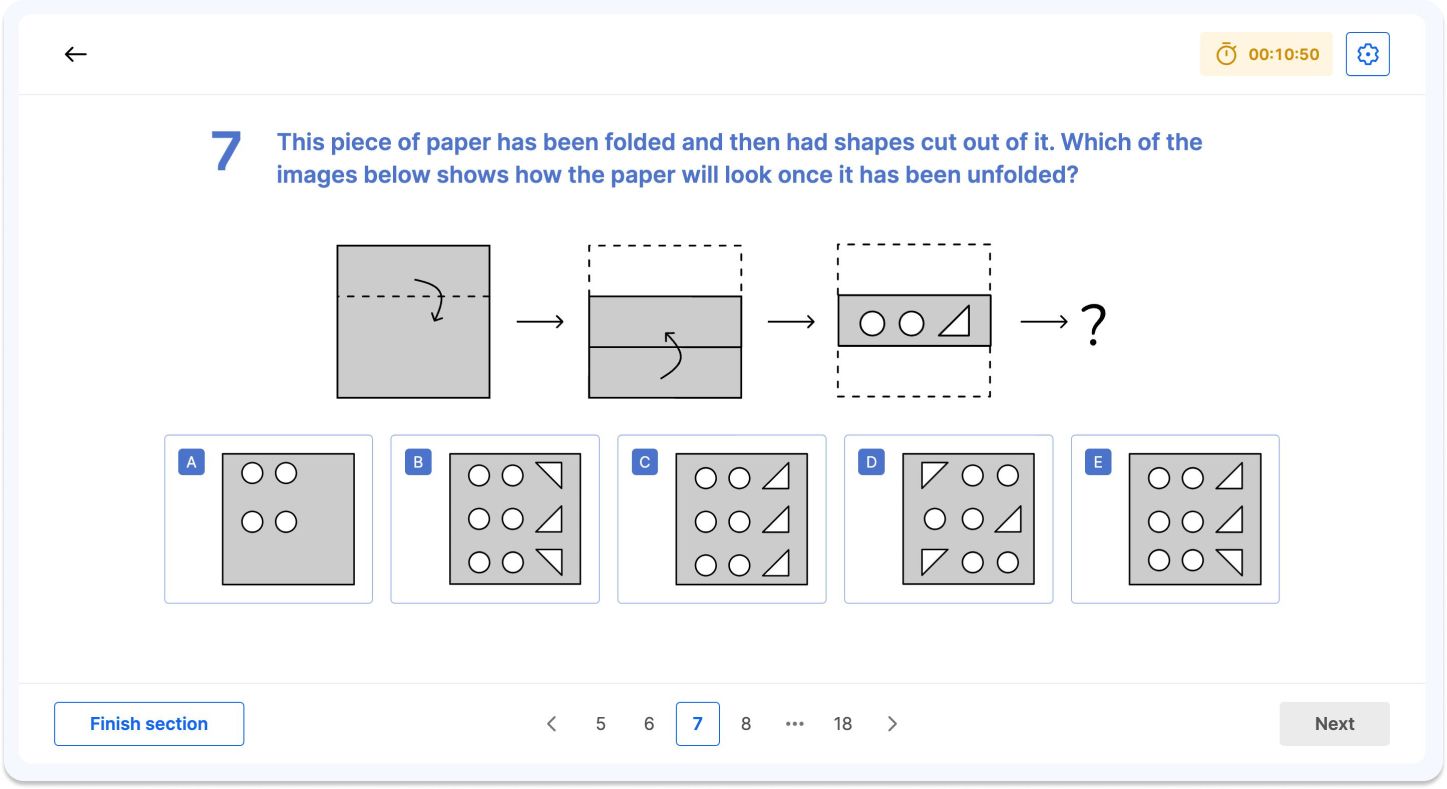
In the figure analysis test, your child will see an image of a square that has been folded and has holes punched out of it.
They will need to visualise how the square would look if it were unfolded, and select the correct square from five options.
Answer: B.When unfolded, the cuts repeat across the folds, making six circles in two rows and three triangles down the right side - just like option B.
Figure recognition
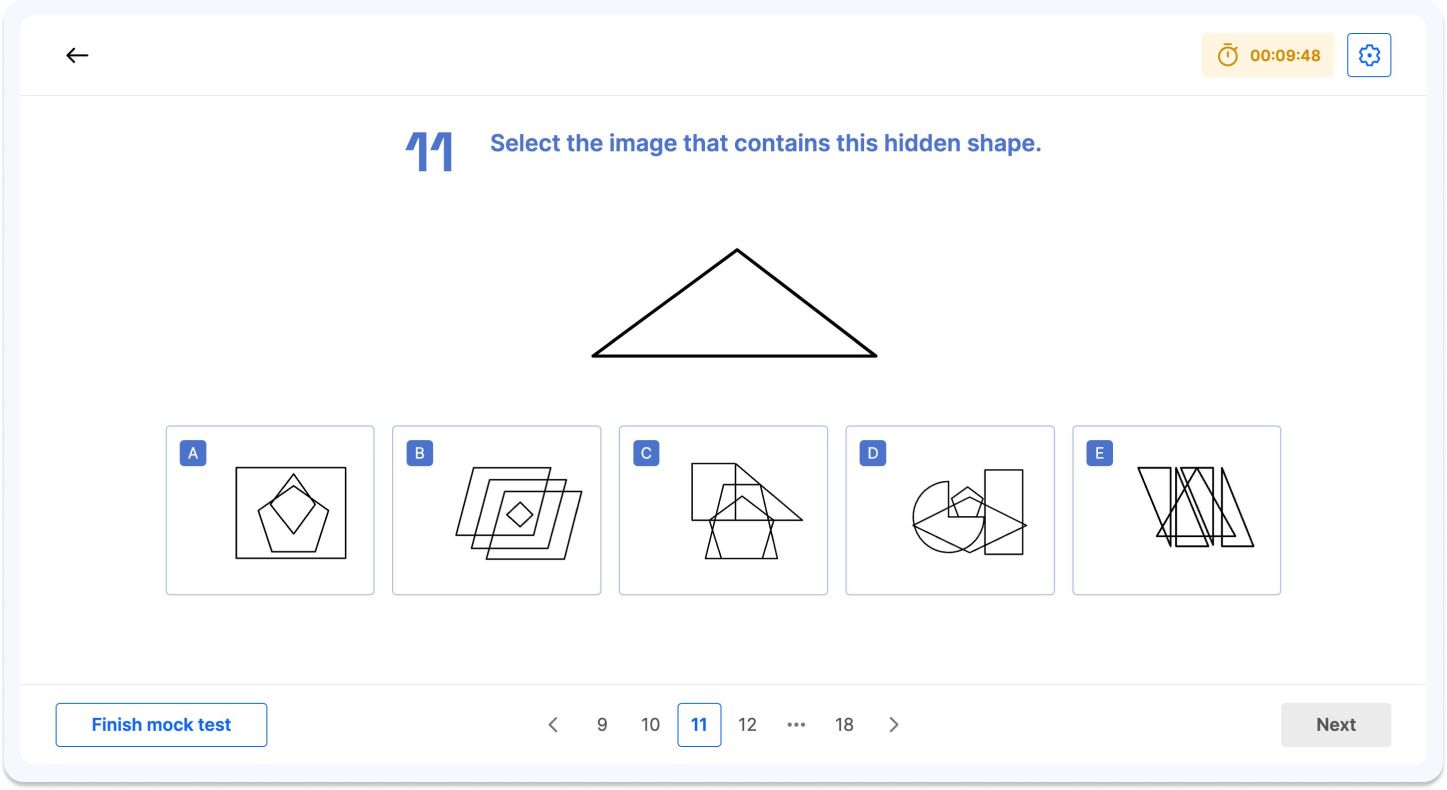
Your child will need to spot a simple shape hidden within a more complex one, choosing the correct option from five choices.
Answer: C. Option C contains the same triangle: a long base with two equal sloping sides forming a peak. If you trace over C, you can see the outline hidden within the overlapping shapes.
How is the CAT4 marked?
A computer marks the CAT4 test. Your child gets a mark for each correct answer, and these are added to make a total score.
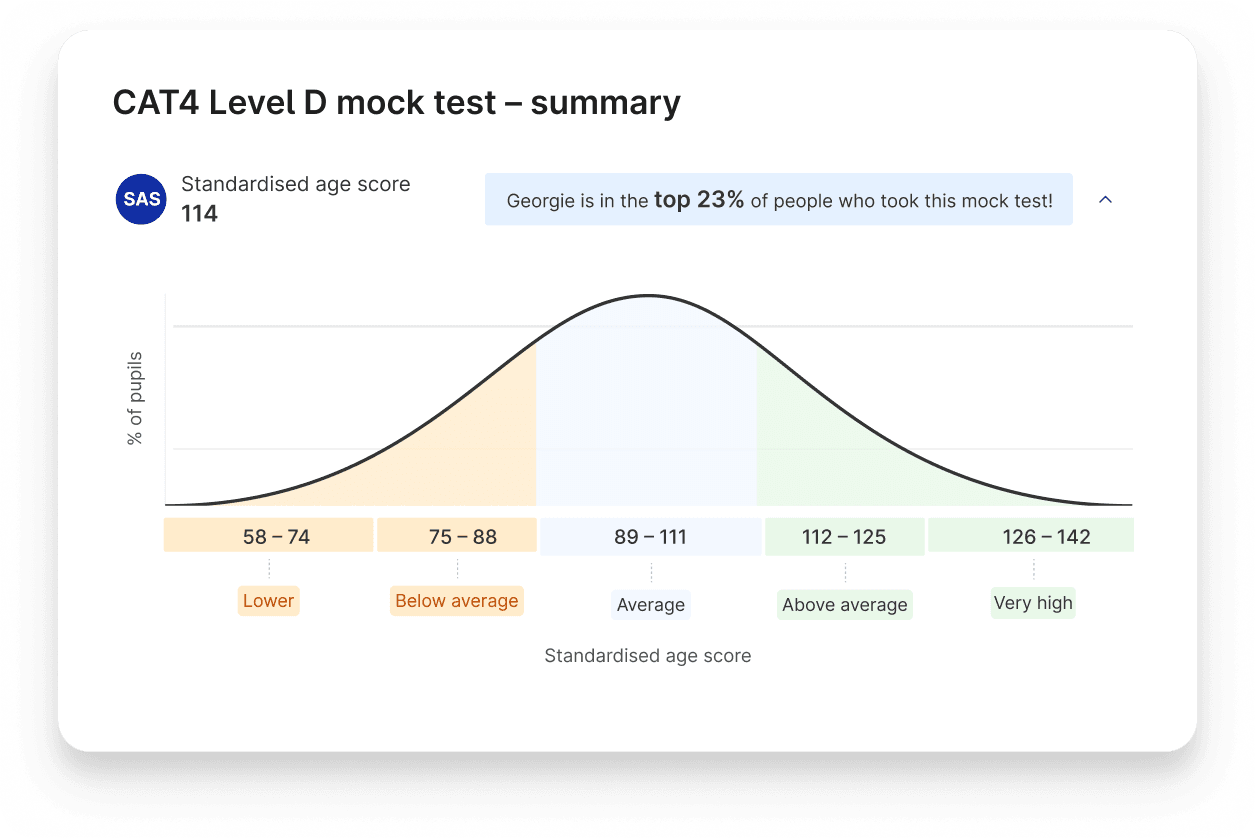
This score is then converted into a standardised age score (SAS). This takes your child’s exact age into account, so younger children are not at a disadvantage. The SAS is the main score schools look at. A score of 100 means a child is exactly average for their age.
The test will provide schools with other key pieces of data, such as:
National percentile ranking (NPR): indicates how the student's score compares to the national cohort, ranked from low (0) to high (100).
Stanine rank (ST): often seen as a visual representation of your child's SAS score when mapped onto a curve, from 1 (low) to 9 (high). A stanine rank of 5 indicates that the child is working at the average ability level for their year group.
The image below shows a student's data after completing a CAT4 practice test on Atom.
What is a good CAT4 score?
Most selective schools are looking for a standardised score of at least 115, and sometimes higher, for Year 7 candidates.
If your child is taking the CAT4 test as part of a streaming process or to work out predicted future grades, your child's school might share their results with you. If you have any questions about your child's results, we always recommend talking this through with their school.
CAT4 FAQs
Is the CAT4 adaptive?
No – CAT4 is a non-adaptive test. The questions are the same for every child and don’t adjust to your child’s level.
Is the CAT4 an IQ test?
Although the CAT4 does not aim to measure a child's IQ, it is similar in some ways to an IQ test for adults.
The CAT4 assesses natural academic ability and potential rather than studied knowledge (such as English, maths and science). Because of this, it is less curriculum-based than traditional school tests.
Is the CAT4 test challenging?
Questions in the CAT4 test are designed to be challenging but age-appropriate. The hardest part of the test can be that the test format is different to school tests.
When is the CAT4 taken?
It's up to the individual school to choose when to administer the CAT4. The timing will vary depending on the level and how the school wishes to use the results. Some common assessment times include:
In September or October of Year 6: 11 plus exam for entry to Year 7
September in Year 7: to stream pupils into sets based on academic ability
The test can also assess individual students who join midway through the school year. GL Assessment advises schools that they'll get the most accurate data comparisons if the test is taken between September and November. This is when standardisation takes place.
Can you practise for a CAT4 test?
The CAT4 test is designed to assess a child's natural academic ability and not their learnt knowledge.
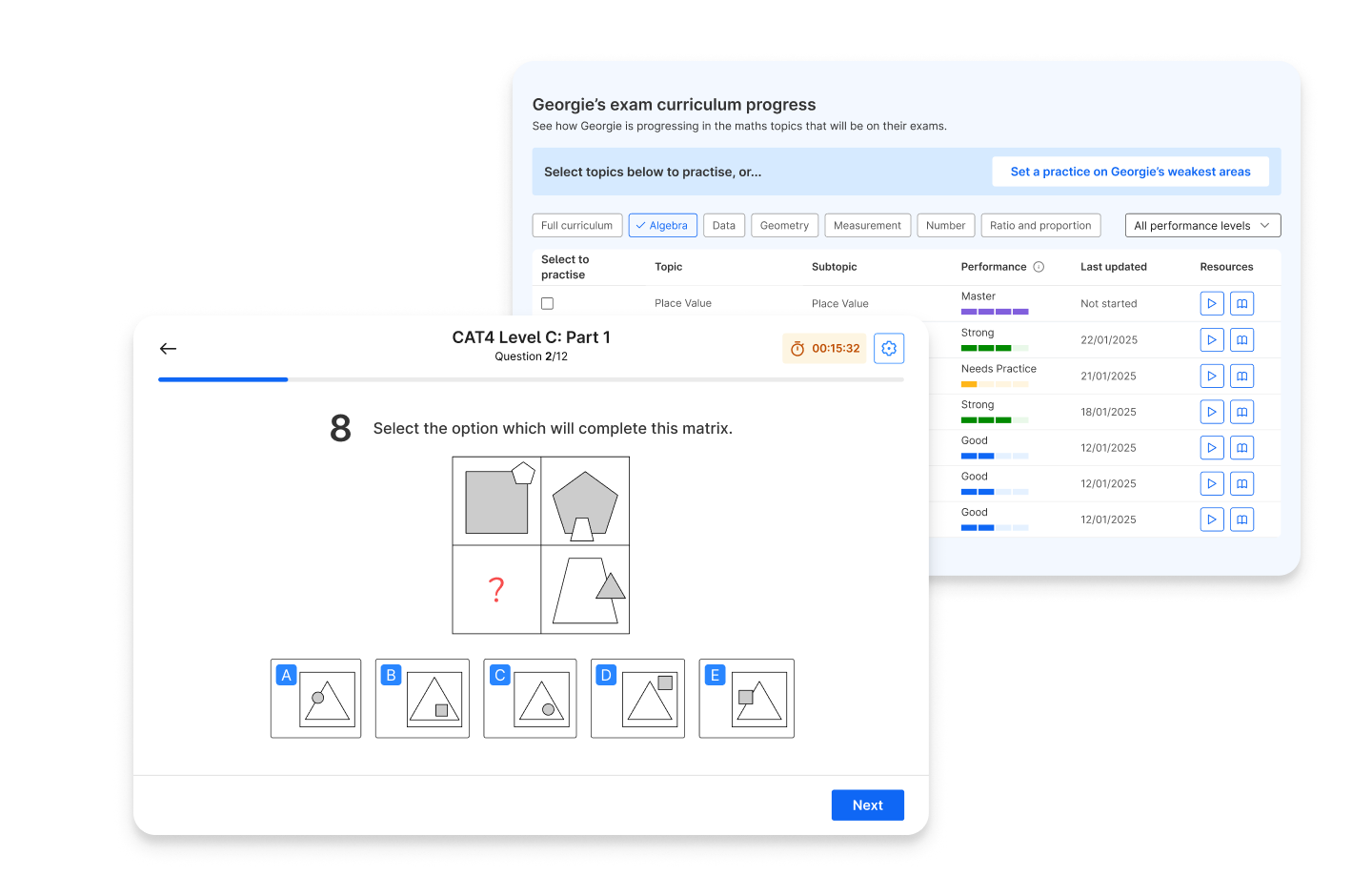
For many children, the CAT4 might be their first experience of a timed assessment. With tools like Atom Home, children can practise realistic questions under timed conditions, learn test-specific knowledge, and build exam confidence. You can try a CAT4 practice test with Atom to get started.
Plus, everything is automatically marked, so you can instantly see which topics to work on next.
No items found.
No items found.
No items found.
No items found.
Make CAT4 preparation clear and manageable.
Not sure what to expect from the CAT4? Whether your child is taking it for school entry or as a streaming or baseline test, the format can feel unfamiliar. Atom breaks the process down into simple steps, showing you exactly what they need to practise and how they’re progressing.