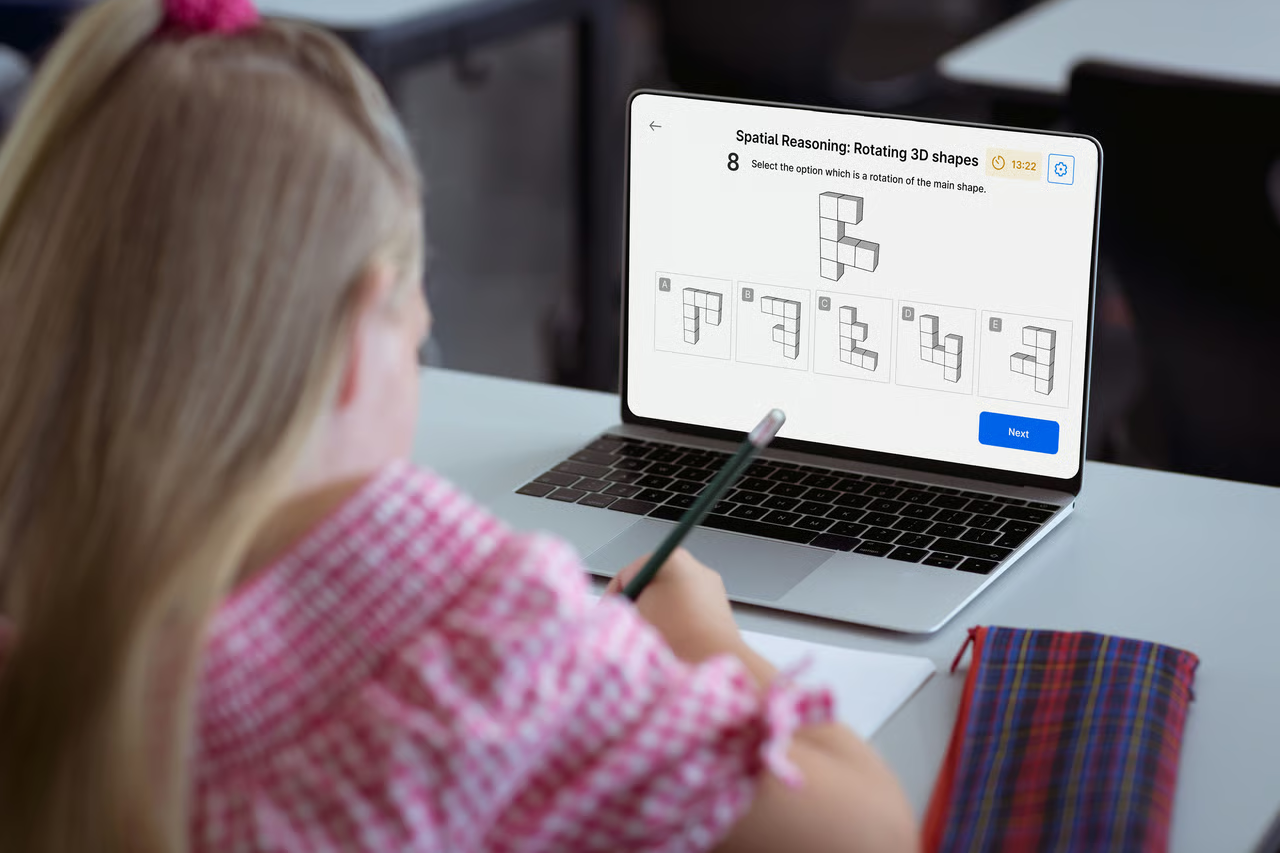
Spatial reasoning is tested in many school entrance exams. It's a particular type of non-verbal reasoning that can help indicate a child's potential.
If your child is taking an 11 plus non-verbal reasoning test, it's a good idea to practise spatial reasoning questions. These aren't taught at school, so getting familiar with these types of questions can help to avoid unpleasant surprises on exam day!
Key takeaways:
- Spatial reasoning involves using mental skill to manipulate and transform 2D and 3D shapes.
- Common 11 plus spatial reasoning questions involve nets, cubs, rotating and combining shapes, and studying what 3D shapes look like from above.
- Many grammar school 11 plus exams test spatial reasoning as part of non-verbal reasoning.
- Understanding the concept of spatial reasoning questions is key for 11 plus exams.
What is spatial reasoning?
Spatial reasoning is a skill involved in non-verbal reasoning. Non-verbal reasoning involves interpreting patterns and analysing shapes, pictures and diagrams. Spatial reasoning focuses specifically on using the mind to manipulate 2D and 3D shapes. Many children find these types of questions difficult, as they require a lot of cognitive power.
Spatial reasoning is a skill we use in daily life, such as playing team sports, reading maps, and drawing images and diagrams. It's also used in careers like construction, architecture, design and engineering.
Will my child need to learn spatial reasoning?
Your child might need to learn how to answer spatial reasoning questions if they are taking 11 plus exams for grammar school entry, or independent senior school entrance exams.
Grammar school 11 plus
Many grammar schools test spatial reasoning in their 11 plus papers. Spatial reasoning is often included in non-verbal reasoning sections.
Most grammar schools use GL Assessment 11 plus papers. Some of these include a non-verbal reasoning section or paper. This usually consists of short timed sections which test non-verbal and spatial reasoning.
Not sure what's tested on your target grammar school's exam? Find out more about your local 11 plus exams here.
Independent school entrance exams
Some selective independent schools test spatial reasoning in their entrance exams.
Some schools use the ISEB Common Pre-Test in their admissions process. This test has a 30-minute non-verbal reasoning section. It includes questions which require children to manipulate 3D figures and diagrams to visualise them in a different way.
The CAT4 test is also sometimes used as an entrance exam. Part 3 of the CAT4 tests figure analysis and figure recognition, which are types of spatial reasoning. Figure analysis involves visualising how an unfolded piece of paper would look if had shapes cut out of it while folded. Figure recognition involves identifying a singular shape from complex shapes.
What types of questions are in 11 plus spatial reasoning?
Spatial reasoning tests are multiple-choice. Your child will need to identify 2D or 3D shapes from a range of options.
Some of the most common 11 plus spatial reasoning questions include:
- Nets and cubes
- Nets from 3D shapes
- Rotating 3D shapes
- Combining shapes
- 3D shapes from above
We've shared some examples for each of these question types from Atom Home below. Find answers and explanations at the bottom of this article!
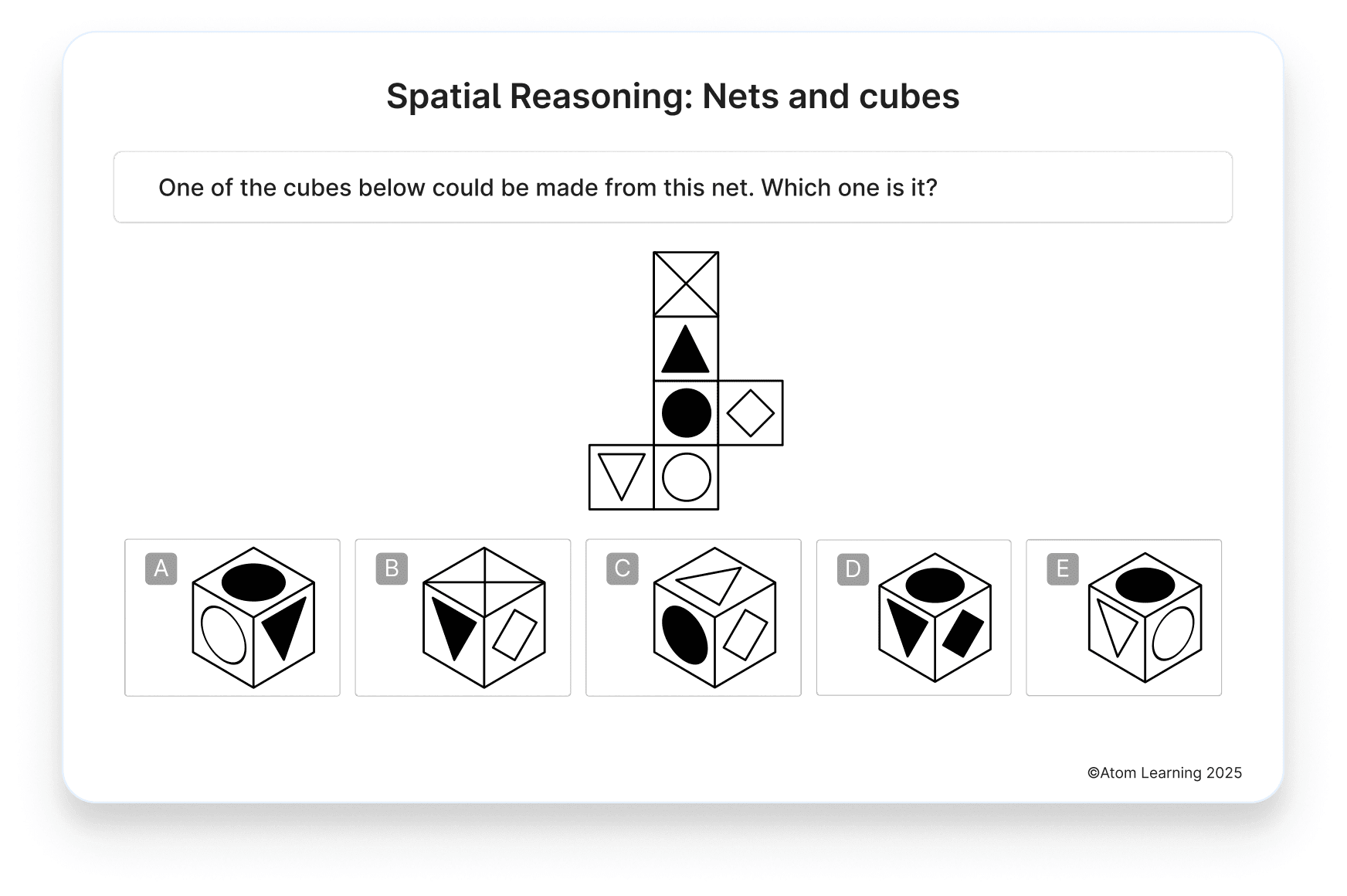
Nets and cubes
In nets and cubes questions, your child will see a 2D net. They will need to interpret patterns on the net and select the correct multiple-choice answer which shows what the net would look like when it is folded up into a cube.
Top tip: look for identifying features on a shape, such as points or arrowheads, to figure out which faces it's pointing towards.
Nets from 3D shapes
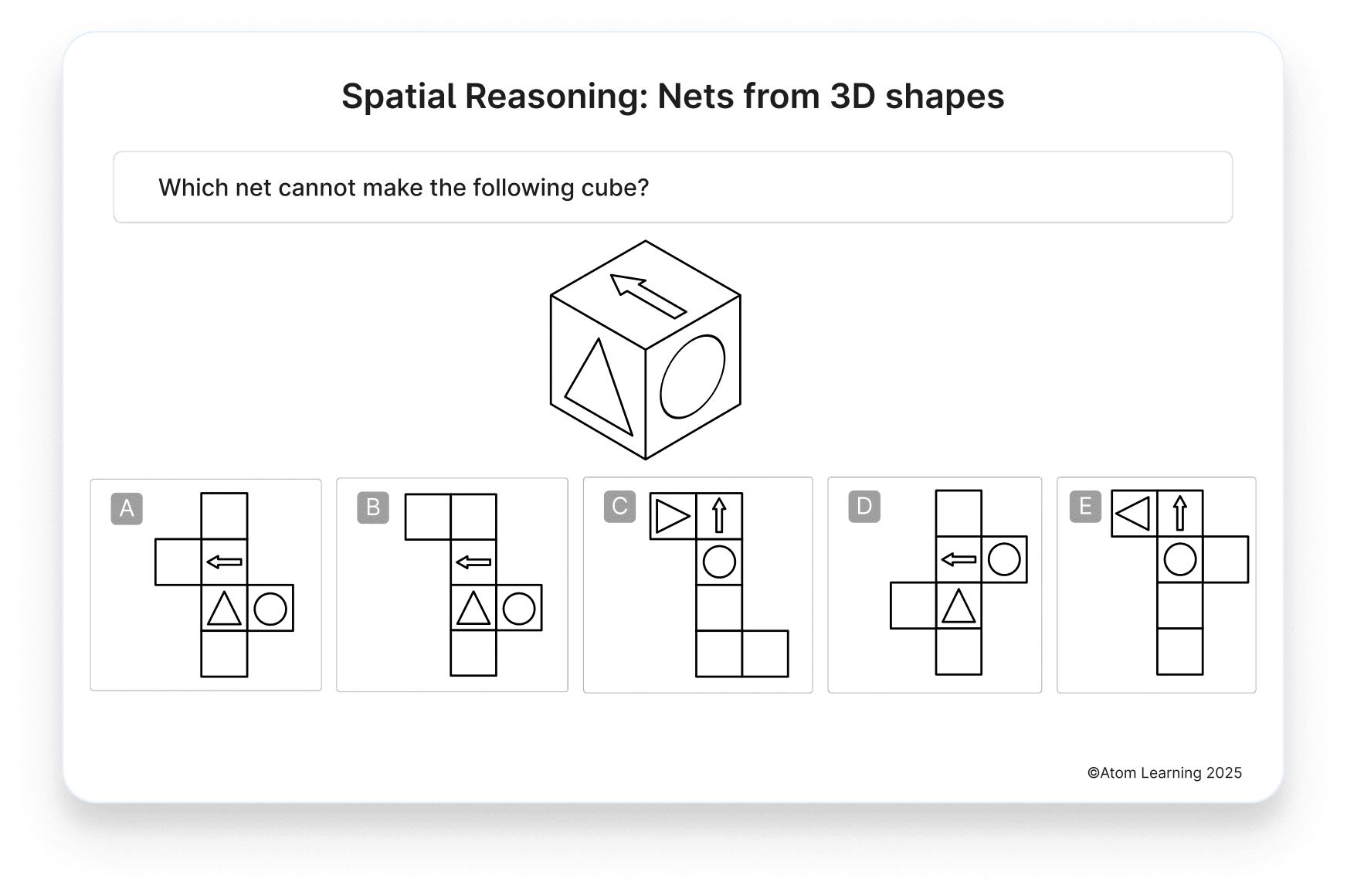
Nets from 3D shapes questions are the inverse of nets and cubes questions. In nets from 3D shapes, your child will see a 3D shape. They will be asked to choose the single correct answer that shows what net the shape would make when it is unfolded.
Top tip: if you're struggling with orientation, try to figure out if any of the shapes on the 3D shape are pointing at any other shape.
Rotating 3D shapes
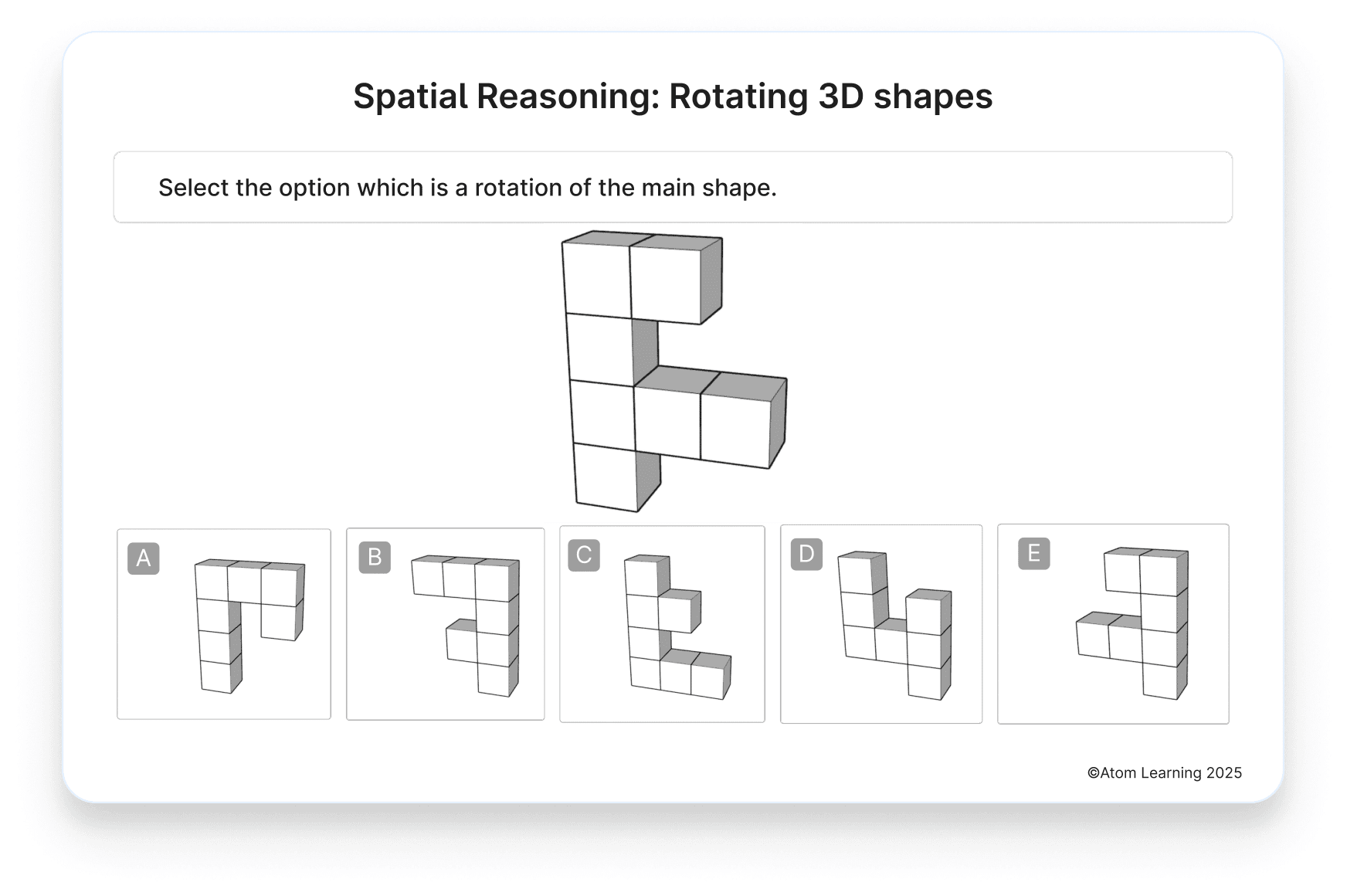
In questions on rotating 3D shapes, your child will need to choose the image that is the correct rotation of a particular 3D shape.
Top tip: 3D shapes can be rotated more than once! They can be rotated in one direction and then in another direction to get the answer.
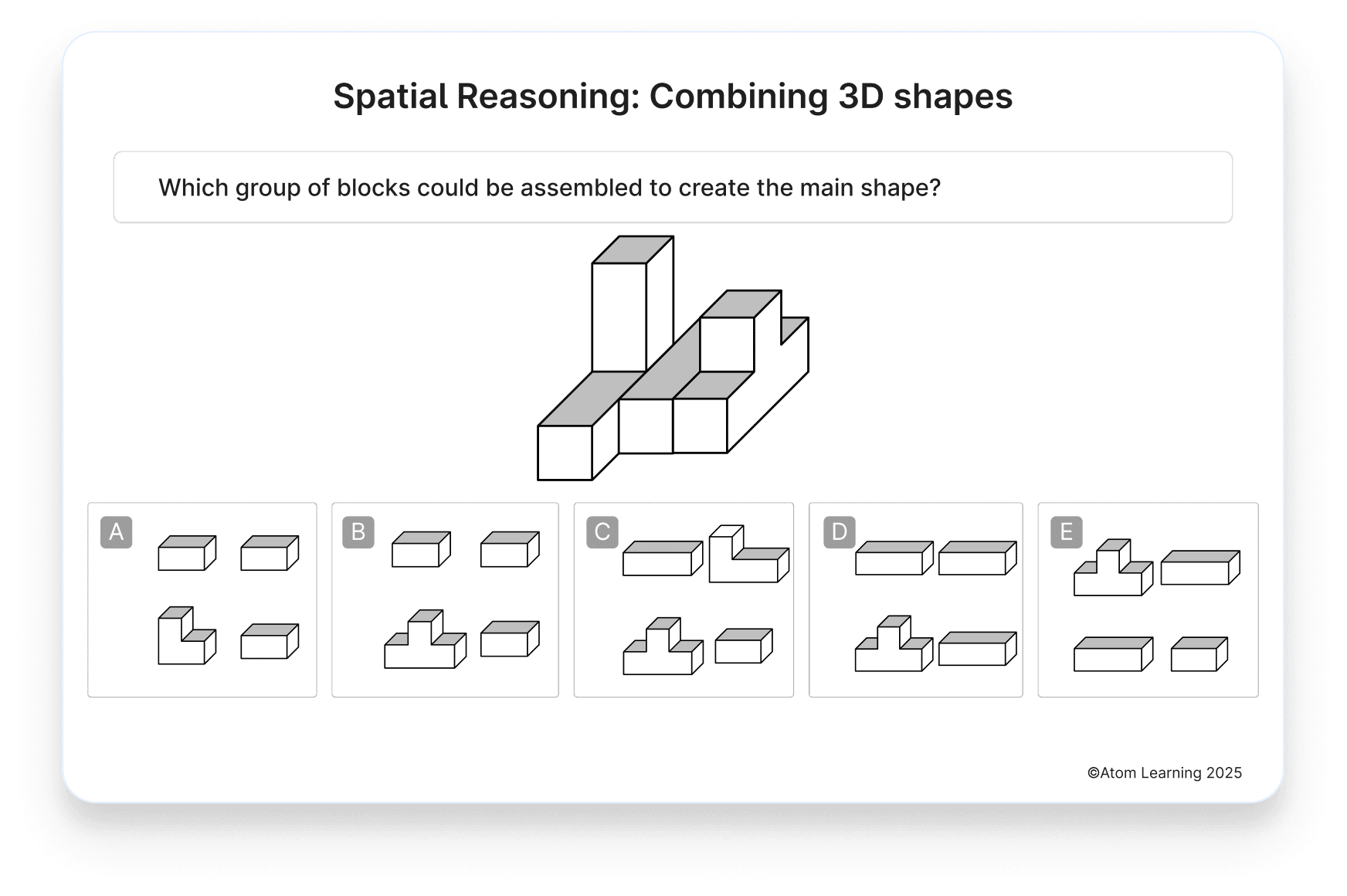
Combining 3D shapes
In combining 3D shapes questions, your child will need to select the group of blocks that can be combined to make the 3D shape in the question.
Top tip: look at how the blocks are positioned. Are there any gaps between them? Pay attention to the dimensions of each block. How tall, short, narrow or wide are they? And lastly, the blocks in the answer options may be rotated, but their proportions (size) are always the same!
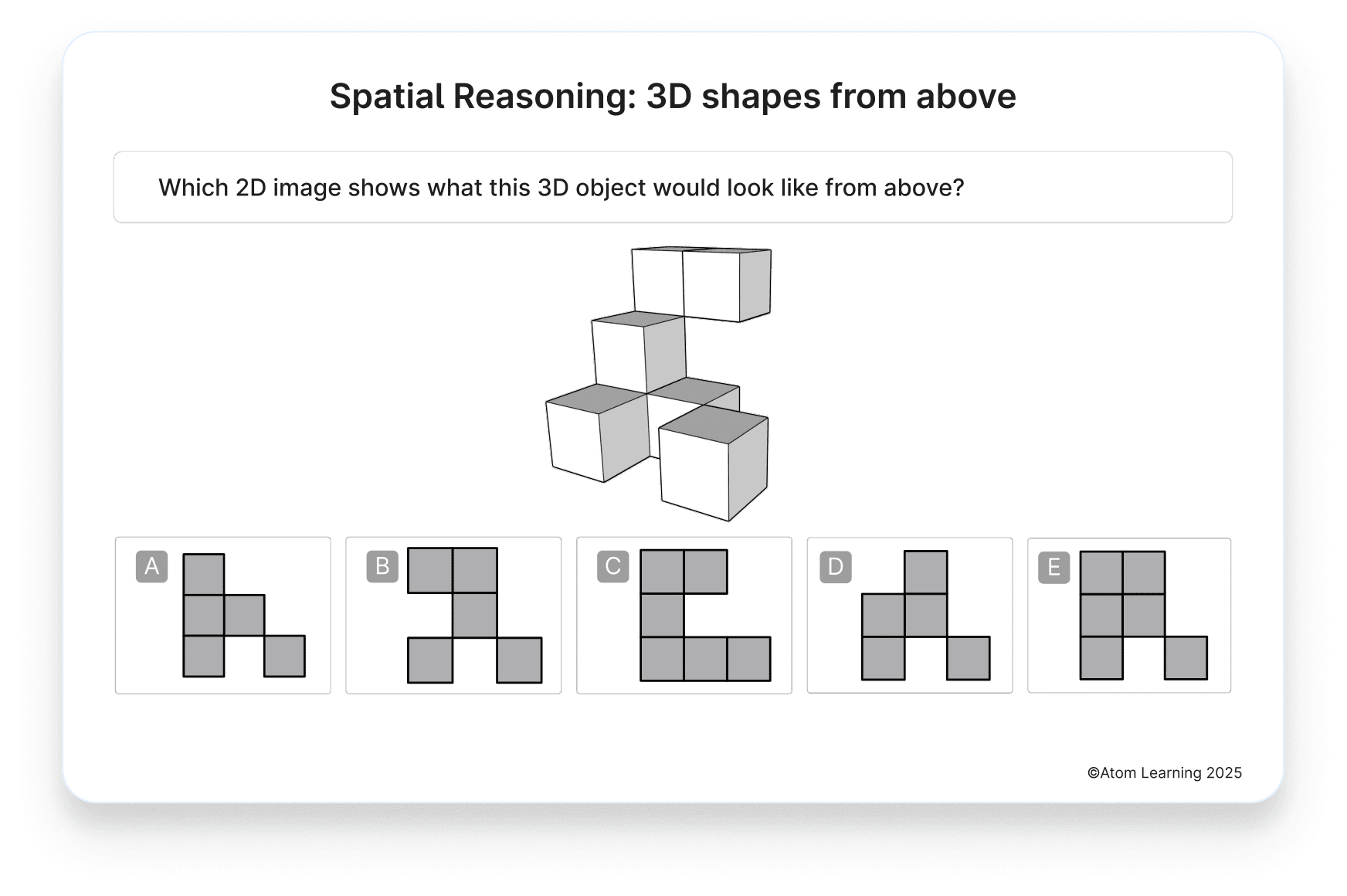
3D shapes from above
In questions on 3D shapes from above, your child will need to choose the 2D plan that shows what the 3D shape would look like if it was viewed from above.
Top tip: try to visualise the gaps as well as the blocks (they're just as important!). Sometimes it can be tricky to work out which blocks are in the same row, so start with the tallest block in each row and then trace a line across and down. And lastly – look out for overhanging blocks (blocks that stick out over a gap with nothing underneath them) and obscured blocks (blocks that you can only see part of). They might be used to confuse you!