Are you considering a grammar school in Dorset for your child? We’ve collated everything you need to know about admissions in 2025–2026. Keep reading to:
- Find out more about grammar schools in Dorset
- Learn about the shared Dorset grammar schools’ entrance test (11 plus)
- Discover which subjects your child will be tested on
- Plus, get exclusive resources to help your child prepare!
Which schools in Dorset use the 11 plus?
Four grammar schools in Dorset have a shared 11 plus exam. These schools are known collectively as the Dorset Consortium. These schools are:
- Bournemouth School (boys)
- Bournemouth School for Girls (girls)
- Parkstone Grammar School (girls)
- Poole Grammar School (boys)
Poole High School and Budmouth Academy are partially-selective secondary schools in Dorset. Only a small proportion of Year 7 places are based on academic criteria. These schools have their own admissions processes.
Dates for your diary
- Tuesday 22nd April 2025: Dorset 11 plus registration opens
- Friday 5th September 2025: Dorset 11 plus registration closes
- Saturday 20th September 2025: Dorset 11 plus exam day
- Friday 10th October 2025: parents receive Dorset 11 plus results
- Friday 31st October 2025: national deadline to apply for school places
- Monday 2nd March 2026: national offers day
Dates can vary, so always check with your target schools!
What is the Dorset grammar schools’ entrance test?
The Dorset grammar schools’ entrance test is an 11 plus exam used by the four grammar schools in Dorset. If you’re interested in more than one grammar school in Dorset, your child will only have to take the exam once.
The exam takes place in September in Year 6. Children who were born between 1st September 2014 and 31st August 2015 will take the entrance test in September 2025 for Year 7 entry in September 2026.
The test is designed to be challenging. Grammar schools use the 11 plus to select children working in the top ability range in their year group. Children who are working at least within the top 25% of their year group are normally well-suited for grammar school.
What's on the Dorset grammar schools’ entrance test?
The Dorset entrance test consists of three papers provided by GL Assessment. Most grammar schools in the UK use 11 plus papers provided by GL Assessment.
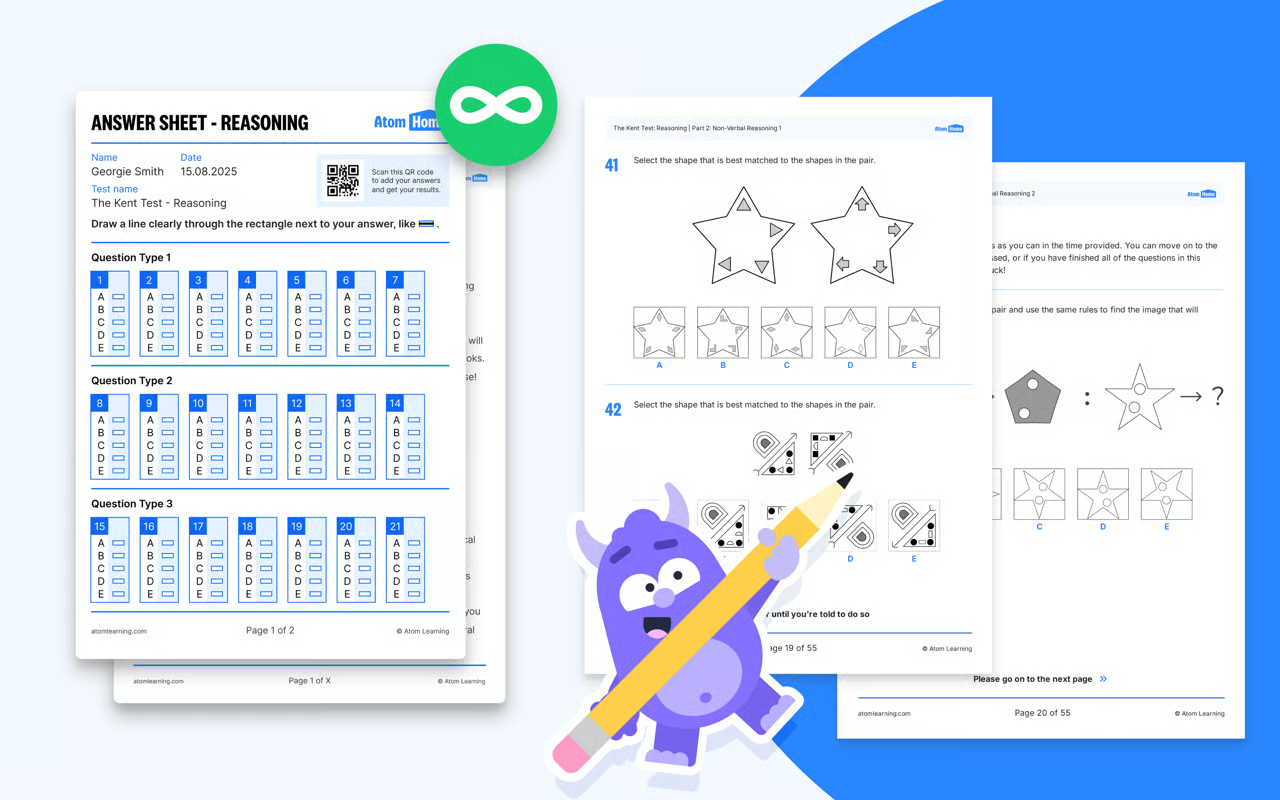
All three papers are multiple-choice. Your child will have separate pre-printed answer sheets, which they will use to mark the answer(s) they think are correct.
The three papers are:
Maths
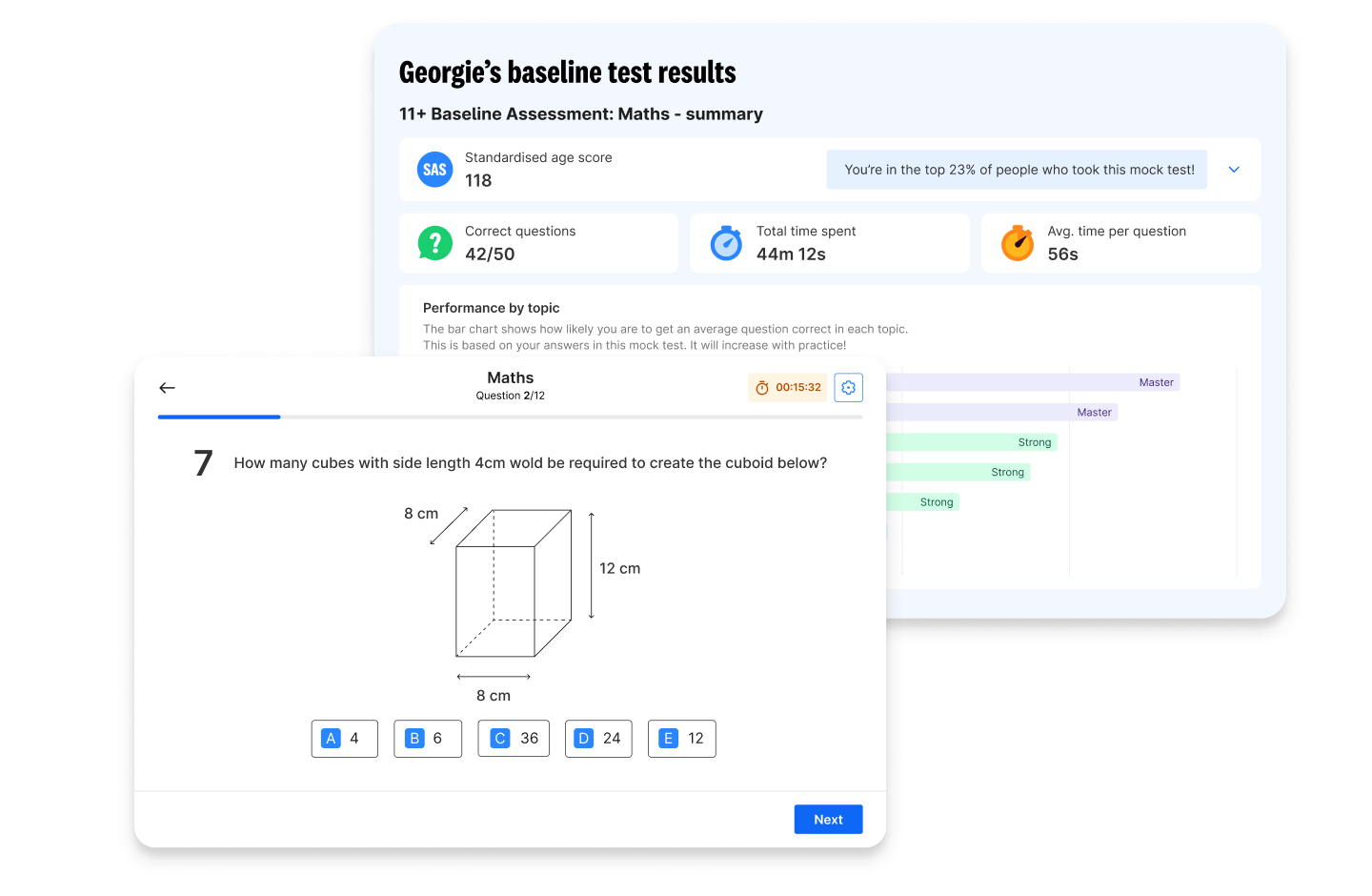
The maths paper lasts 50 minutes. The questions are based on the topics your child will have learned at school during Key Stage 2. These cover Year 5 content, with some questions aimed at Year 6.
The topics normally assessed in a GL Assessment 11 plus maths paper include number, measurement, geometry and statistics. Your child will need to use their skills to solve new kinds of problems for some more advanced questions.
English
The English paper lasts 45 minutes. The test will assess your child’s understanding of English based on the national curriculum taught up to the start of Year 6.
Some questions will test reading comprehension. Your child will need to read a passage of text and answer questions to demonstrate their understanding. Other questions assess further English skills, such as spelling, vocabulary and punctuation.
Verbal reasoning
The verbal reasoning paper lasts 50 minutes. Unlike the English and maths paper, this paper is not based on topics your child will have learned at school. Verbal reasoning is not taught on the national curriculum, so the questions might be unfamiliar to your child. Grammar schools often use 11 plus verbal reasoning papers because they analyse children’s academic potential, rather than what they have already learned.
Verbal reasoning involves reasoning with written information, such as words, letters, numbers and symbols. Your child will need to understand how words are produced and used, and the relationships between them. They might also need to use logic to solve codes and work out the next item in a sequence.
There is a short unmarked practice exercise at the start of the test to help your child understand how to answer the different types of questions.