

Parkstone Grammar School 11+ guide
Applying to Parkstone Grammar School for September 2028? This guide covers the Dorset consortium 11+ assessment in September 2027, the qualifying score, how the 192 Year 7 places are allocated and the key dates for September 2028 entry.
Parkstone Grammar School 11+ at a glance
- School type: girls' grammar school
- Location: Poole, Dorset
- Admissions contact: admissions@parkstone.poole.sch.uk
- Number of places in Year 7: 192 (2027-entry figure — Parkstone Grammar School confirms each year's admission number in its determined arrangements, published the spring before entry.)
- Qualifying score: not yet published for 2028 entry (see below)
- 11+ test: Dorset consortium 11+ assessment (three 40-minute multiple-choice papers in maths, English and verbal reasoning, provided by Quest Assessments from 2028 entry)
- Catchment or priority area: yes — the historic Borough of Poole and listed BH postcodes (see below)
Source: Parkstone Grammar School Admissions Policy for Entry September 2027 (approved November 2025). Last checked October 2026.
Key dates for September 2028 entry
The consortium's official familiarisation page gives these windows for 2028 entry. Exact dates are confirmed in the spring before each cycle. For 2027 entry, registration ran from Monday 13 April 2026 to 12 midday on Friday 4 September 2026, the test took place on Saturday 26 September 2026 and results came out on Friday 16 October 2026. We'll update this page as soon as the 2028-entry dates are published.
Worried about missing an important 11+ deadline?
Get grammar school reminders with the key dates for your target school delivered straight to your inbox.
• Registration deadlines
• Exam dates
• Revision nudges
All tailored to your child. We'll make sure you're always prepared for what's next.

How to apply to Parkstone Grammar School
Parkstone Grammar School is selective, so your child needs to sit the 11+ test to be considered for a place.
You register your child for the consortium tests by completing a registration form with a consortium school; one set of tests counts for all four schools. Registration for 2028 entry hasn't opened yet.
Once you have your child's result, you apply by naming Parkstone Grammar School on your common application form, which goes to your home local authority. For September 2028 entry the deadline is Sunday 31 October 2027. As it falls on a Sunday, you may find it easier to submit your form in the days before.
Reaching the qualifying score makes your child eligible, but it doesn't guarantee a place. If more qualifying children apply than there are places, the school uses its oversubscription criteria, set out further down this page.
What will my child be tested on?
The test is changing for 2028 entry
Parkstone Grammar School has used GL Assessment for its entrance test in recent years. From the September 2027 test, the one that decides September 2028 entry, the Dorset consortium's test is provided by Quest Assessments.
The Quest grammar school tests are paper-based and non-adaptive, in a similar format to the GL tests used previously. Familiarisation materials for parents have been published, and the school will confirm any remaining details before the test.
Qualifying score: not yet published for 2028 entry. Parkstone Grammar School's test is provided by Quest Assessments from the September 2027 test onwards. Scores from previous years were set against the GL test and don't carry across to the new one. The school will publish a qualifying standard for the new test in its own time.
Parkstone Grammar School is one of the grammar schools in the Dorset Consortium of Grammar Schools, which share one set of entrance tests, so your child only sits them once to be considered by more than one of the schools.
The assessment is three papers in maths, English and verbal reasoning, each lasting 40 minutes plus time for instructions. They're sat in one session with a short supervised break, and your child stays in the test room during the break. Expect around two to three hours in the test centre in total.
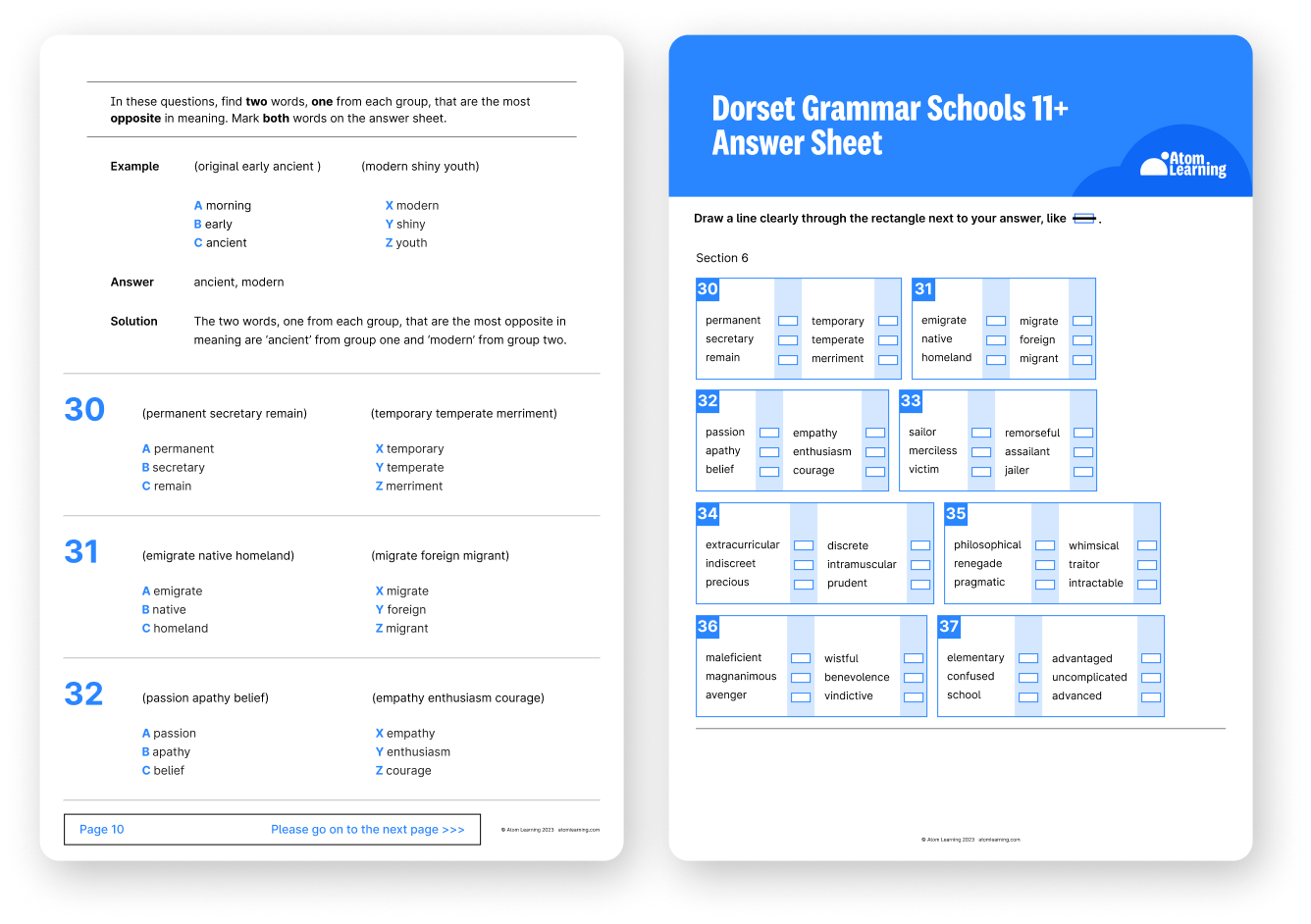
It's a paper test and every question is multiple choice, usually with five options (A to E). Your child doesn't write answers out: they draw a clear horizontal line through the box next to their chosen answer on an OMR (optical mark recognition) answer sheet. There's a question booklet and a separate answer sheet for each subject, and there may be a reading booklet too.
Quest Assessments doesn't answer enquiries from parents. Questions about registration, results, venues and access arrangements go to the school your child is applying to.
The official familiarisation materials for the Dorset consortium 11+ assessment are on the Quest Assessments parent guidance page. Read our guide to the Quest Admissions exam for what the test looks like and how it's marked.
The table below shows what each paper covers.
How are places allocated at Parkstone Grammar School?
If more children reach the qualifying standard than there are 192 Year 7 places, Parkstone Grammar School offers places in the order below. This order comes from the school's admissions policy for 2027/28. The school sets its 2028-entry policy separately, and we'll update this table if anything changes.
Girls with an education, health and care plan (EHCP) naming the school who meet the required standard are admitted first. Within each category, girls with the highest entrance test scores are offered places first. Pupil Premium here means girls who have been eligible for free school meals at any point in the last six years, or children of service personnel in the last six years.
Does Parkstone Grammar School have a catchment area?
The priority area is the historic Borough of Poole, plus the Poole postcodes BH12, BH13, BH14, BH15, BH16, BH17 and BH18 and the BH21 3 postcode area (the policy writes this as "BH21 3**"). Girls living outside it can still be offered a place if they reach the required standard.
If there is a tie for the last place, it goes to the girl whose home is nearest to the school, measured along the shortest safe walking route. If girls live the same distance away, at the same address or in the same block of flats, places are decided by drawing lots, supervised by someone independent of the school.
If you don't live close to the school, it's worth thinking about how your child will get there every day. How long will the journey take? What transport options are available? Will they be travelling independently or with support?
A longer or more complex journey can affect your child's daily routine, including how much time they have for homework, rest and after-school activities. It's a good idea to think about how manageable the school run will be and whether it will work for your family day to day.
How can I help my child prepare for the Dorset consortium 11+ assessment?
The Dorset consortium publishes official familiarisation materials for the test, and that is where families should start. Atom is not an authorised source for this test and has no access to its content. The guidance below is about building the skills the test draws on.
The curriculum doesn't change
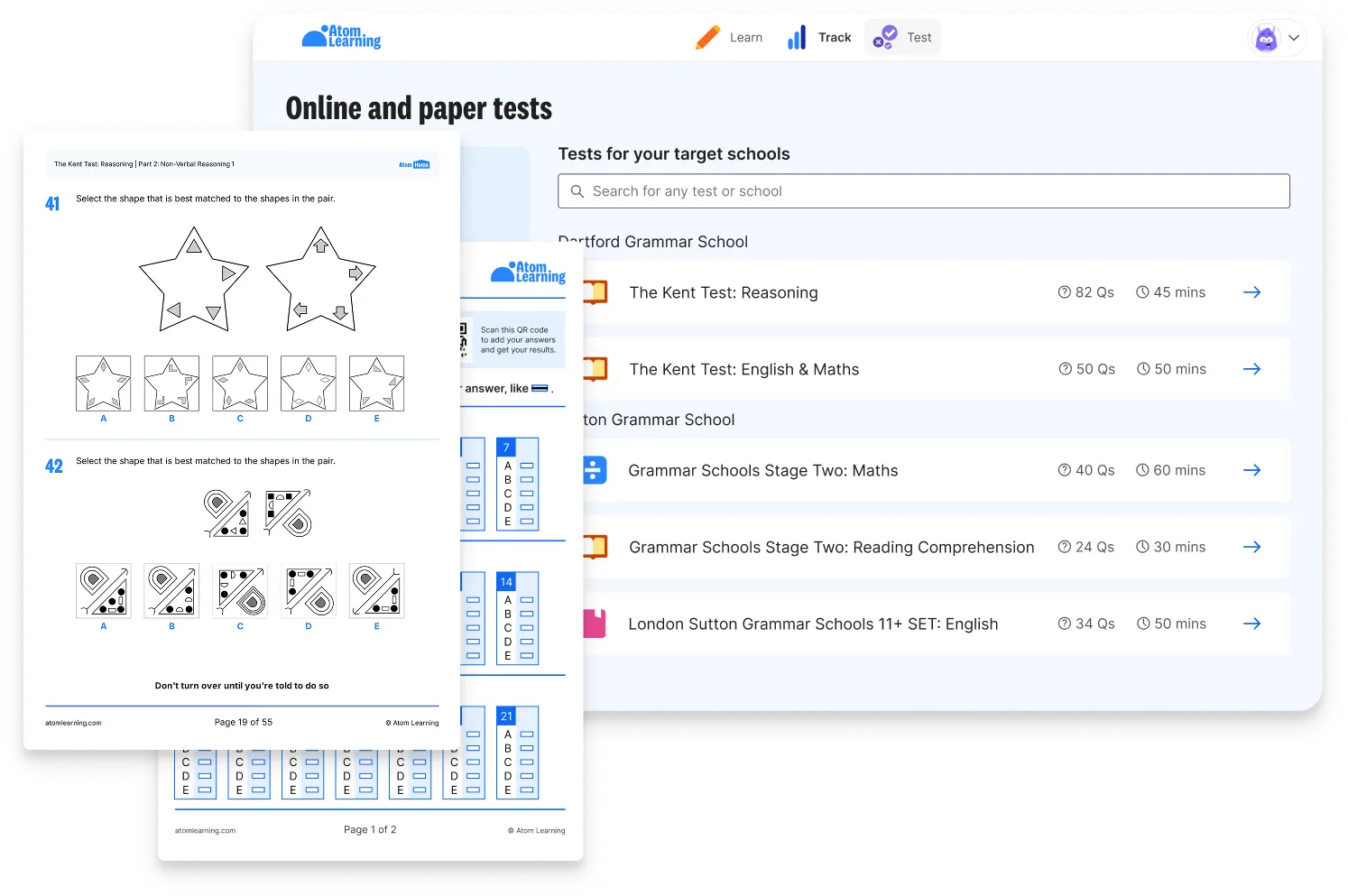
The test draws on the Key Stage 2 curriculum, which is the same material every 11+ test is built from. Atom Home covers that curriculum with over 100,000 teacher-written practice questions across English, maths, verbal reasoning and non-verbal reasoning, so the work a child does is useful whichever test they end up sitting.
Find the gaps early
Atom's progress insights show which topics and question types a child finds hardest, so revision goes where it's actually needed rather than across everything equally.
Practise the conditions, not the questions

Atom's mock tests are built to give children practice working to time, reading an answer sheet and holding their nerve for a full paper. Each one returns a Standardised Age Score and a breakdown of where accuracy dropped under timed conditions.
Take control of your child’s 11+ preparation.

Not sure if your child is on track for the grammar school 11+? You don’t need to guess what to cover or whether they’re ready. Atom shows you exactly what to practise each week and how they’re performing, so you can stay ahead of the process without the stress.
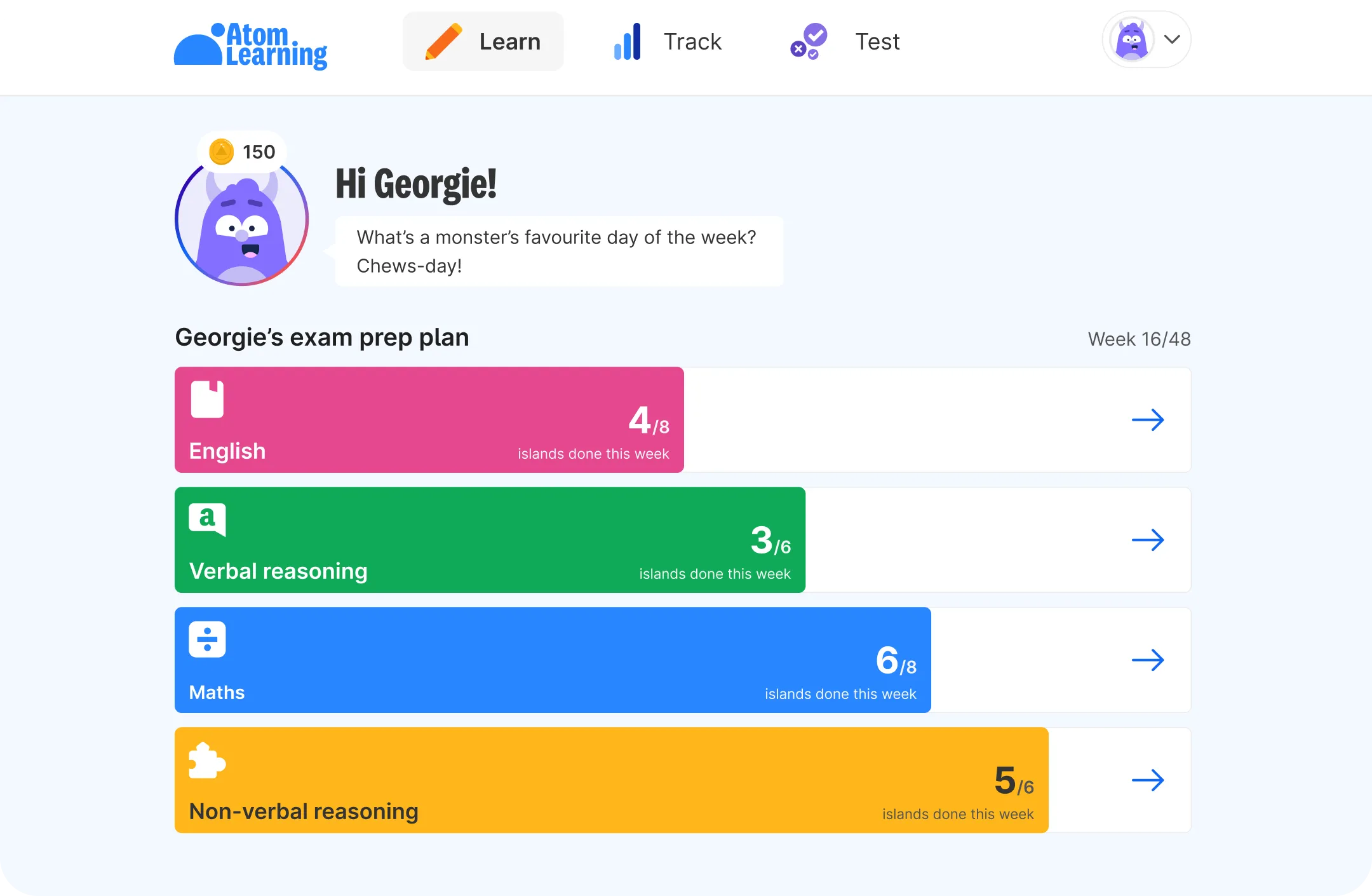
- Follow personalised weekly exam plans that show them what to learn next.
- Download realistic 11+ practice papers and upload a photo for instant, stress-free marking.
- Track progress and see how they compare to others applying to the same schools.
Start your free trial and help your child feel fully prepared for the 11+.