Back to blog

Dorset grammar schools 11 plus guide

By
Atom
|
October 9, 2026

Applying to a Dorset grammar school for September 2028? This guide covers the three-paper entrance test, who sets it, the key dates, and how the four schools allocate their places.

The test provider has changed. From the September 2027 test — the one that decides September 2028 entry — the Dorset Consortium's entrance test is set by Quest Assessments. It replaces GL Assessment. Children who sat the test in September 2026 took the GL version.

Dorset Consortium 11+ at a glance

  • Schools: four, sharing one test
  • Test: three papers, 40 minutes each, sat in one session
  • Provider: Quest Assessments, from the September 2027 test
  • Test date: September 2027 (exact day not yet published)
  • Registration opens: April 2027 (exact date not yet published)
  • Qualifying score: set by each school, not yet published for 2028 entry

‍

Key dates for September 2028 entry

Table dates · HTML
Key dates for the Dorset Consortium 11+ for September 2028 entry. Dates the consortium has not yet published are marked as such.
DateWhat happens
April 2027Registration opens — the consortium hasn't published the exact date
Not yet publishedRegistration closes
September 2027Dorset Consortium 11+ — the consortium hasn't published the exact day
Mid-October 2027Results sent to parents
Sunday 31 October 2027Deadline to apply for secondary school places through your home local authority. This date falls on a Sunday.
Wednesday 1 March 2028National offer day
No items found.

The Dorset Consortium hadn't published its exact registration and test dates when this page was last checked. We've shown the months it has confirmed and left the rest open rather than estimating from last year's timetable, because the test provider has changed and the old pattern may not hold. Always check with your target schools nearer the time.

Which schools use the Dorset Consortium 11+?

Four grammar schools in Dorset share one entrance test, known as the Dorset Consortium 11+:

Your child sits the test once, even if you apply to more than one of them.

Poole High School and Budmouth Academy are partially selective secondary schools in Dorset. Only a small proportion of their Year 7 places are allocated on academic criteria, and they run their own admissions processes.

What is the Dorset Consortium 11+?

The Dorset Consortium 11+ is the shared entrance test for the four grammar schools above. It is sat in September of Year 6. Children born between 1 September 2016 and 31 August 2017 sit it in September 2027 for entry to Year 7 in September 2028.

The test assesses reasoning, maths and English. Grammar schools offer places to children performing towards the top of the national ability range for their age.

The test has moved from GL Assessment to Quest Assessments

From the September 2027 test, the consortium's test is provided by Quest Assessments rather than GL Assessment. The change is set out on Quest's parent guidance page for the Dorset 11+. Atom Home and Quest Assessments are both part of Atom Learning.

What this means for last year's scores. A qualifying score belongs to the test that produced it. Marks published for the GL test in previous years don't carry across to the new one, and each school will publish a qualifying standard for the new test in its own time. If you find a Dorset pass mark from an earlier year, it won't tell you what your child needs in September 2027.

What's in the test?

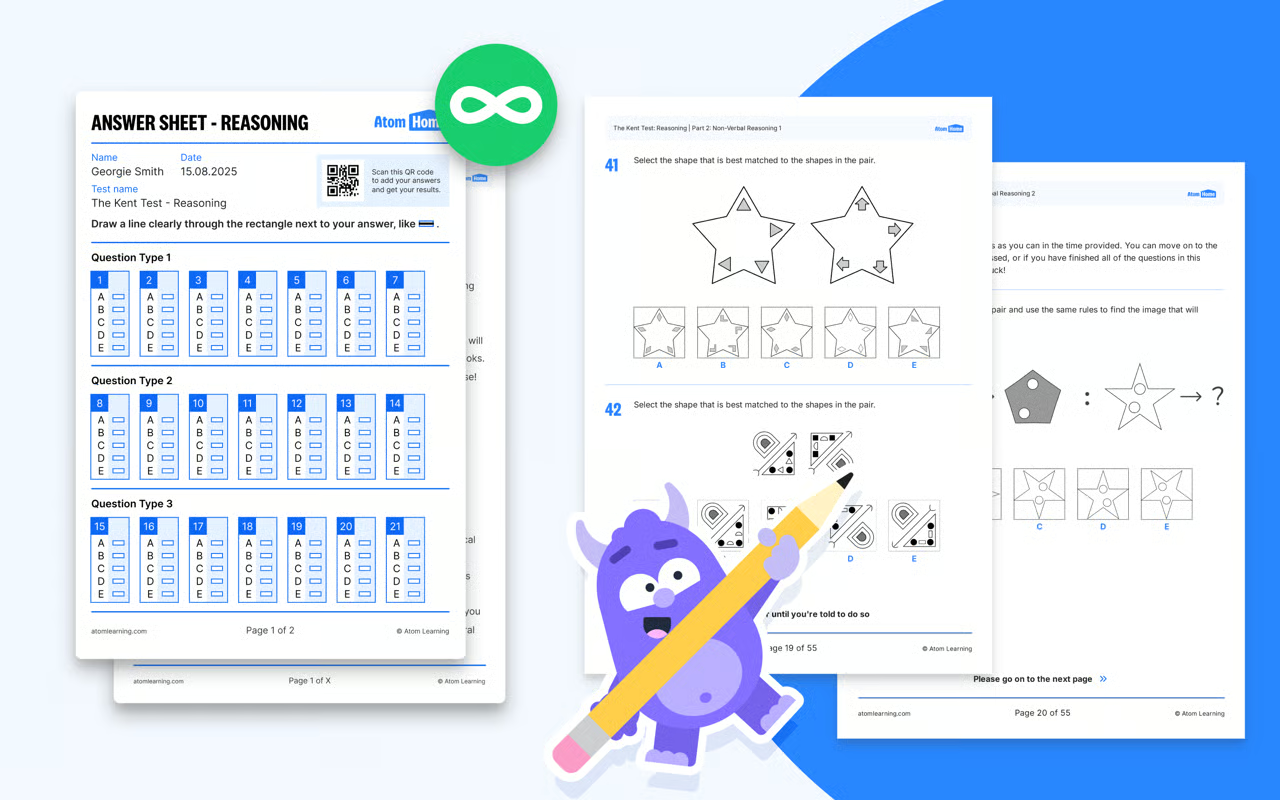
Three papers, all multiple choice, sat in one session with a short supervised break. Your child marks their answers on separate pre-printed answer sheets. Quest's guidance says the whole thing typically takes two to three hours including settling in and instructions.
The three papers in the Dorset Consortium 11+ from the September 2027 test, with what each one covers and how long it lasts.
PaperLengthWhat it covers
Maths40 minutesKey Stage 2 maths: number, measurement, geometry and statistics, mostly Year 5 content with some Year 6
English40 minutesReading comprehension, plus spelling, vocabulary and punctuation, to the national curriculum taught up to the start of Year 6
Verbal reasoning40 minutesReasoning with words, letters, numbers and symbols. Not taught on the national curriculum
No items found.

Maths questions are based on what your child has covered at Key Stage 2, mostly Year 5 content with some aimed at Year 6, and some of the harder questions ask them to apply those skills to unfamiliar problems.

The English paper tests reading comprehension — reading a passage and answering questions on it — alongside spelling, vocabulary and punctuation.

Verbal reasoning is the one that isn't taught at school. It asks children to reason with words, letters, numbers and symbols: how words relate to each other, solving codes, working out what comes next in a sequence. Grammar schools use it because it shows academic potential rather than what a child has already been taught, which also means the question types will be unfamiliar unless your child has seen them before.

There is usually a short unmarked practice exercise at the start to show your child how each question type works.

‍

How is the test scored?

Answer sheets are marked using Optical Mark Recognition (OMR). Scores are then age-standardised, so younger children in the year group aren't disadvantaged.

Results are sent to parents in mid-October 2027. If your child meets the qualifying standard for your target school, you then apply through your common application form.

What's the pass mark?

There is no single fixed pass mark, and none has been published for 2028 entry. Instead:

  • Every child's age-standardised score is ranked
  • Each school sets its own qualifying score
  • Some priority groups, including Looked After Children and children eligible for Pupil Premium, may qualify with a lower score

Meeting the qualifying score makes your child eligible. It doesn't guarantee a place — each school then applies its own oversubscription criteria.

How to apply

If you're considering a grammar school, it's worth speaking to your child's teacher first. Grammar schools select children working towards the top of their year group, and their teacher can tell you whether they think your child would keep up with the pace.

1. Register for the test

To be considered at any of the four schools, register your child for the Dorset Consortium 11+.

  • Registration opens: April 2027 — exact date not yet published
  • Registration closes: not yet published

You register through the website of any participating school. Details of the test day follow shortly after.

2. Apply for school places

Results arrive in mid-October 2027, telling you whether your child met the qualifying standard at your target schools. Use them to decide which schools to name on your common application form, checking each school's admissions policy before you list it.

The form goes to your home local authority by Sunday 31 October 2027. That date falls on a Sunday, so it's worth submitting before the weekend.

3. National offer day

On Wednesday 1 March 2028 you'll find out which school your child has been allocated. They'll get a place at your highest preference for which they meet the criteria and where places are available.

If none of your preferred schools has a place, your child will be offered one elsewhere in your area. You can appeal to an independent panel; your local authority sends information about appealing alongside the offer.

How can I help my child prepare?

Stay on track with a clear plan

One of the hardest parts of 11+ preparation is knowing what to focus on, when, and how to make steady progress without it taking over family life.

A clear, structured plan helps your child feel less overwhelmed and more in control. It means they build skills in the right order, cover everything they need, and avoid last-minute cramming.

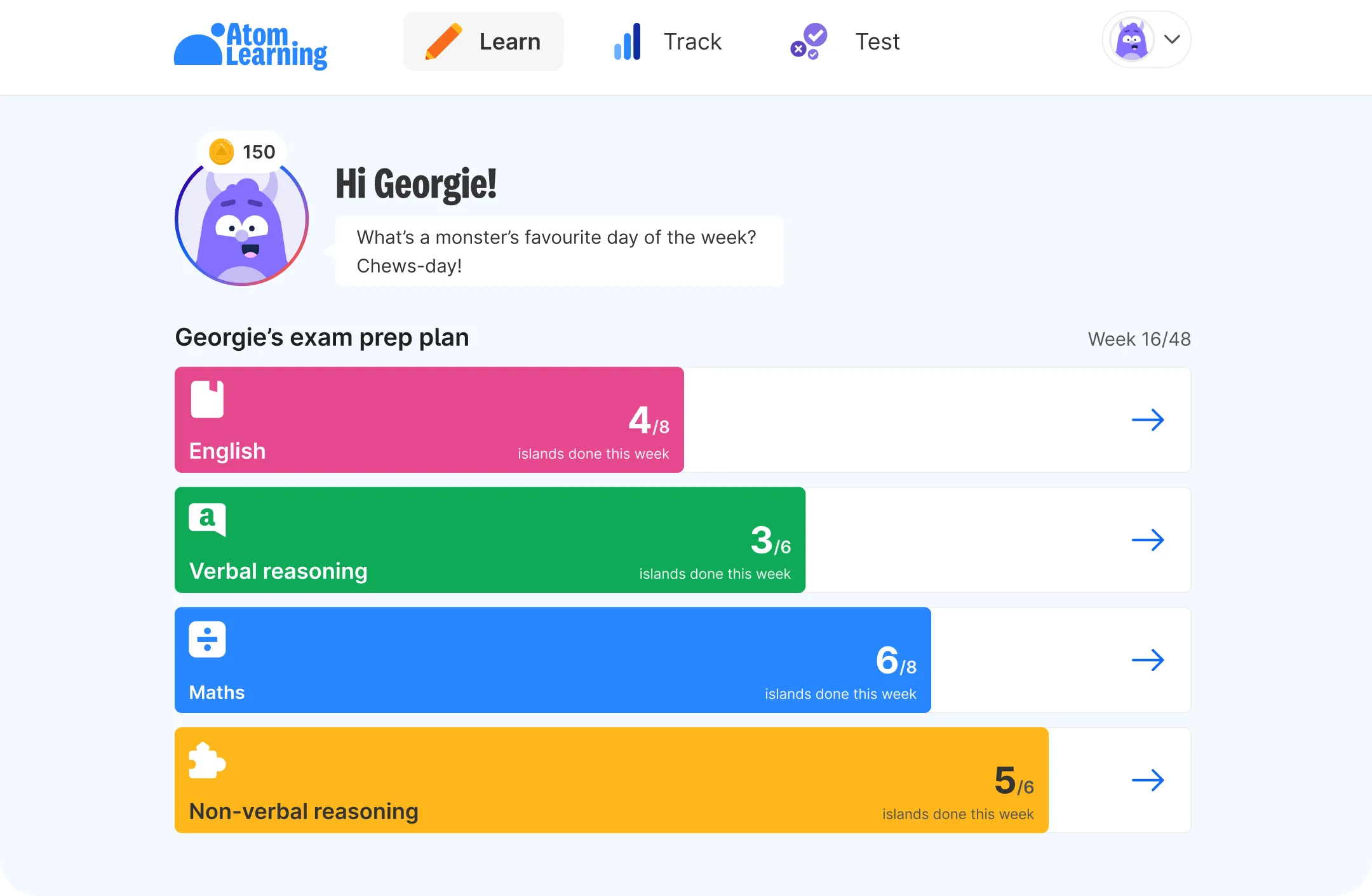
Atom's exam plan makes this easier. Enter your child's target schools and exam dates, and we'll build a personalised weekly plan around the topics they'll meet. It adapts as they improve and keeps things manageable — little and often.

Practise working to time

The curriculum behind the test is the Key Stage 2 content your child is already taught, so the work that helps most is making those foundations secure and then getting comfortable working under timed conditions.

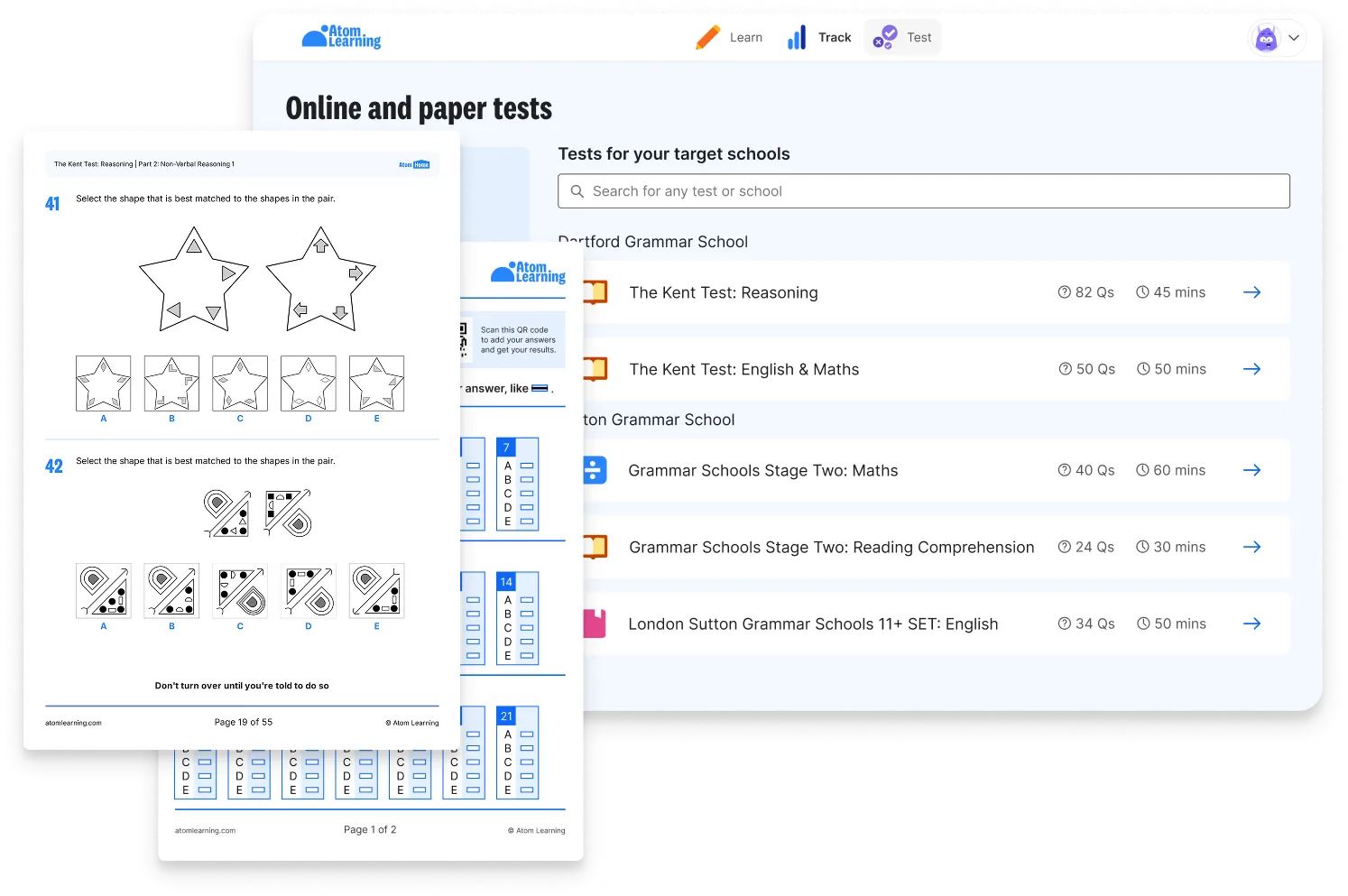
Atom's 11+ practice papers are built to match the format, timing and question styles of real 11+ exams. They're unlimited, so your child can sit the same paper repeatedly and get new questions each time.

Photograph the completed answer sheets and upload them for instant marking, a standardised age score (SAS), and a clear view of which topics to work on next.

Encourage regular reading

Strong reading skills play a big role in 11+ preparation, and feed directly into both the English and verbal reasoning papers.

Encourage your child to read every day, even for 10–15 minutes. The key is variety — fiction and non-fiction, different genres, a range of authors. Over time, regular reading will:

  • broaden their vocabulary
  • improve comprehension and inference
  • build confidence with unseen texts

And it can help them enjoy reading rather than see it as exam preparation.

Looking for inspiration? Explore Atom's free reading and writing starter kit.

Celebrate progress, not just scores

What matters through 11+ preparation is knowing your child is moving in the right direction, not how they scored on one test.

Atom's progress tracking shows how they're doing across topics and which way each one is heading, so you can keep encouragement specific and motivation steady.

‍

No items found.

Take control of your child’s 11+ preparation.

Not sure if your child is on track for the grammar school 11+? You don’t need to guess what to cover or whether they’re ready. Atom shows you exactly what to practise each week and how they’re performing, so you can stay ahead of the process without the stress.

Endorsed by grammar schools, trusted by families.

Start your free trial and help your child feel fully prepared for the 11+.

Try Atom for free