Contents
Are you considering a grammar school in Gloucestershire for your child? We’ve collated everything you need to know about admissions in 2026–2027. Keep reading to:
Find out more about grammar schools in Gloucestershire
Learn about the Gloucestershire Grammar Schools’ Entrance Test (11 plus)
Discover which subjects your child will be tested on
Plus, get exclusive resources to help your child prepare!
There are seven grammar schools in Gloucestershire. They all use the same 11 plus entrance exam.
Denmark Road High School (girls)
Marling School (boys)
Pate’s Grammar School (mixed)
Ribston Hall High School (girls)
Sir Thomas Rich’s School (boys)
Stroud High School (girls)
The Crypt School (mixed)
Monday 18th May 2026: Gloucestershire Grammar Schools' Entrance Test registration opens
Friday 26th June 2026: Gloucestershire Grammar Schools' Entrance Test registration closes
Monday 7th September 2026: information about test centre arrangements is sent to parents by this date
Saturday 12th September 2026: Gloucestershire Grammar Schools' Entrance Test
Mid-October 2026: parents receive test results
Saturday 31st October 2026: secondary school common application deadline
Monday 1st March 2027: national school offers day
Dates can vary between schools and may be subject to change.
The Gloucestershire Grammar Schools’ Entrance Test is an 11 plus exam used by the seven grammar schools in Gloucestershire. If you’re interested in applying to more than one grammar school in Gloucestershire, your child will only have to take the exam once.
The Gloucestershire 11 plus takes place in September in Year 6. Children who were born between 1st September 2015 and 31st August 2016 will take the Gloucestershire Grammar Schools’ Entrance Test on Saturday 12th September 2026 for Year 7 entry in September 2027.
The test is designed to be challenging. Grammar schools use the 11 plus to select children working in the top ability range in their year group. Children who are within the top 25% of their year group are normally well-suited for grammar school.
The Gloucestershire Grammar Schools’ Entrance Test consists of two papers provided by GL Assessment.
Each paper lasts around one hour. This includes time for instructions, some worked (unmarked) example questions, and the real test questions. There is a short break between the two papers.
One paper assesses verbal skills. This includes reading comprehension, vocabulary and verbal reasoning. The other paper assesses non-verbal reasoning and maths skills. All of the questions in both papers are multiple-choice.
In the verbal skills paper, your child will see questions testing reading comprehension, vocabulary, and verbal reasoning.
Verbal reasoning is not taught at primary school, so they might be unfamiliar with these types of questions. Verbal reasoning assesses how well they can apply logic and solve problems with written information, such as words, letters, symbols and numbers.
Your child will need to use skills such as:
processing verbal information
spotting similarities and differences between words
using logical thinking to solve problems
identifying patterns
understanding rules, such as word choice and grammar
answering questions to show their understanding of a text
using accurate capital letters, punctuation and spelling
In the non-verbal and maths paper, your child will be tested on their knowledge of the Key Stage 2 maths curriculum. They will also be assessed on non-verbal reasoning, which is not a subject taught at school. This tests how well they can apply logic and solve problems with visual information, such as shapes, diagrams and pictures.
They will need to use skills like:
processing graphic information
following visual patterns and rules
applying the maths skills they have learned at school
using spatial awareness
using logical thinking to solve problems
using quick mental arithmetic
understanding shapes, space and measures
Preparing for the Gloucestershire Grammar Schools Entrance Test can feel daunting — knowing what to cover, keeping your child motivated, and making sure you’re on the right track. With Atom Home, you’ll have everything you need to guide your child with confidence. No tutor required.
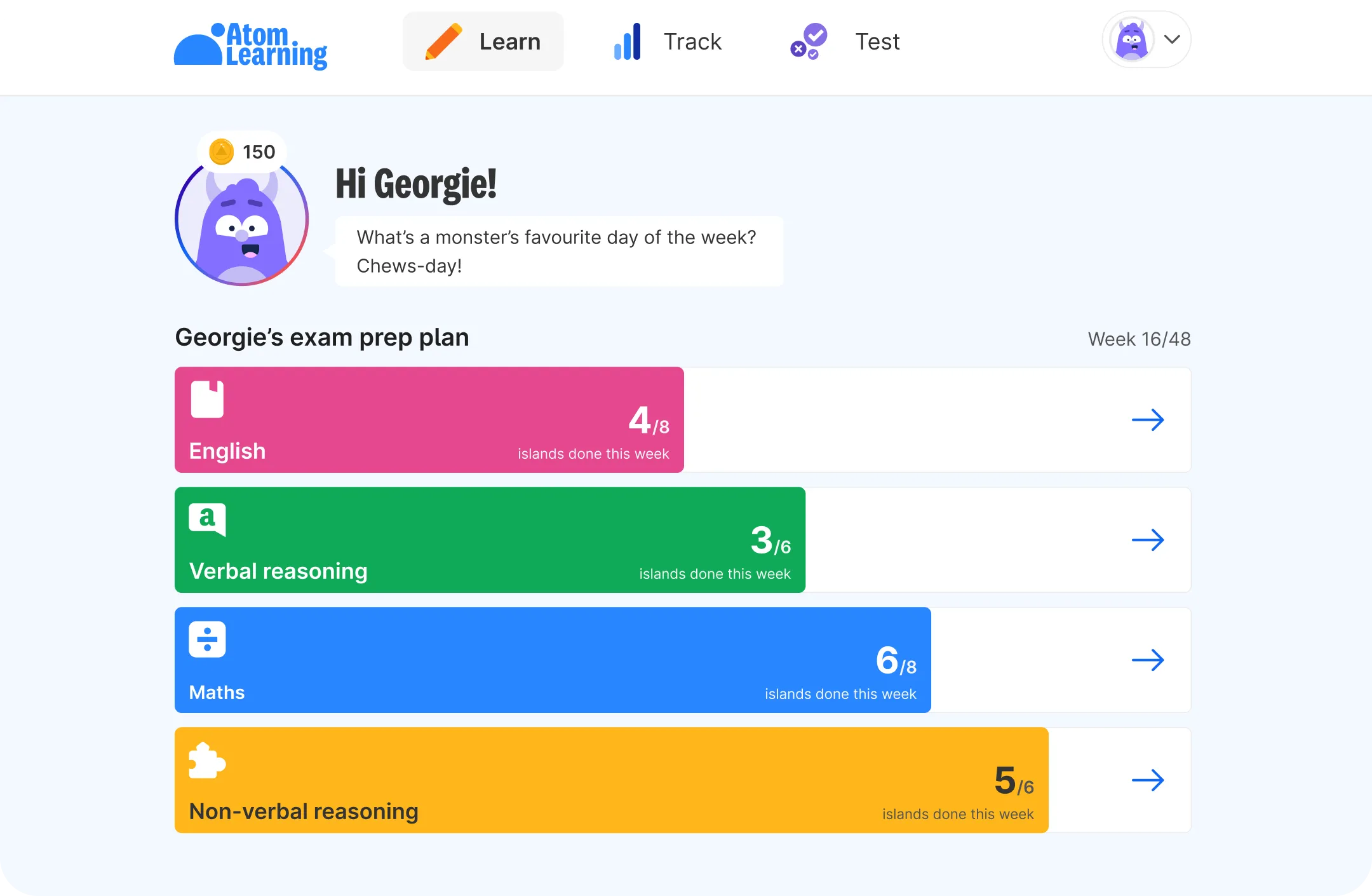
Get a personalised exam plan each week, so your child covers every topic in manageable steps
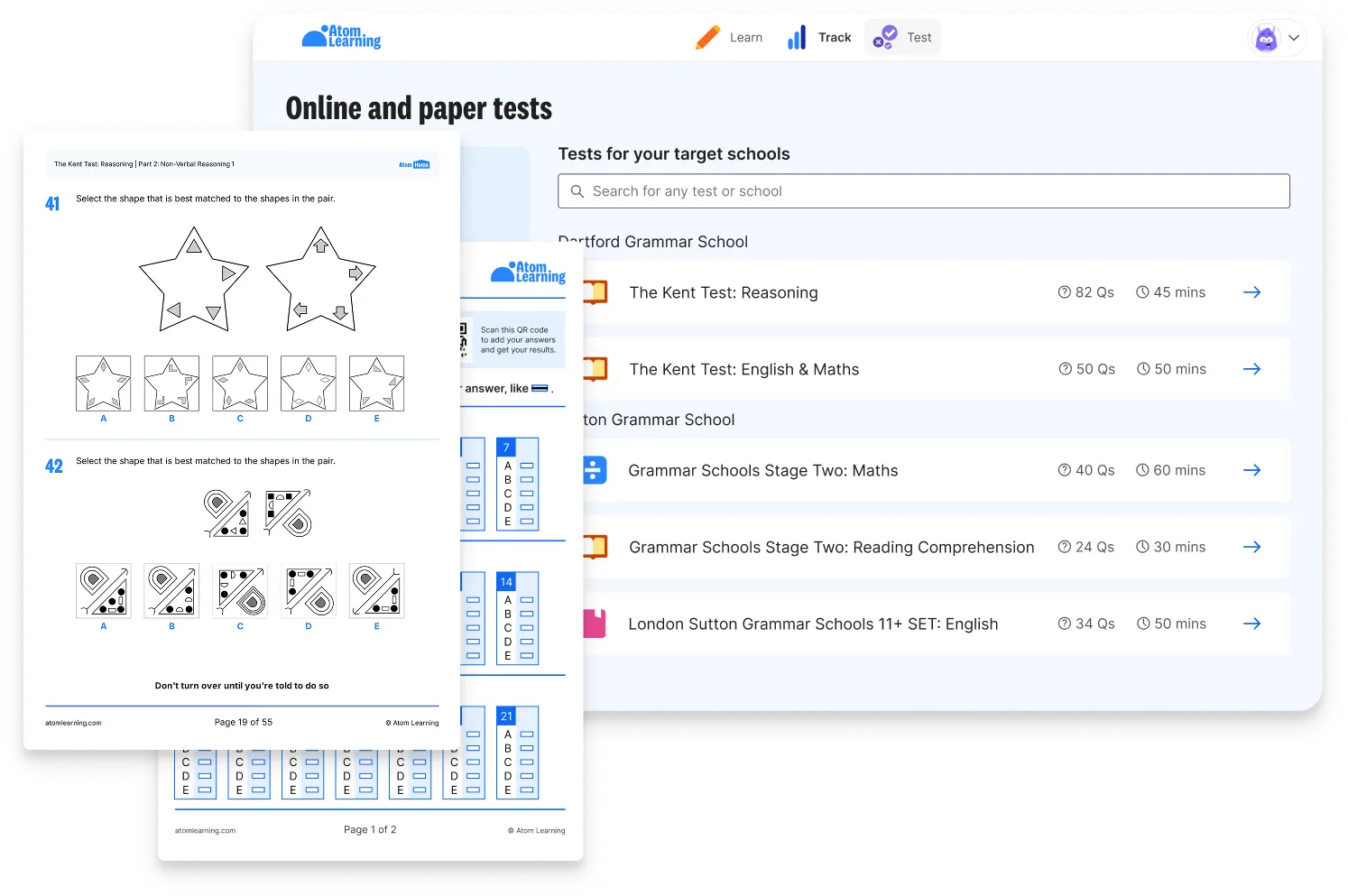
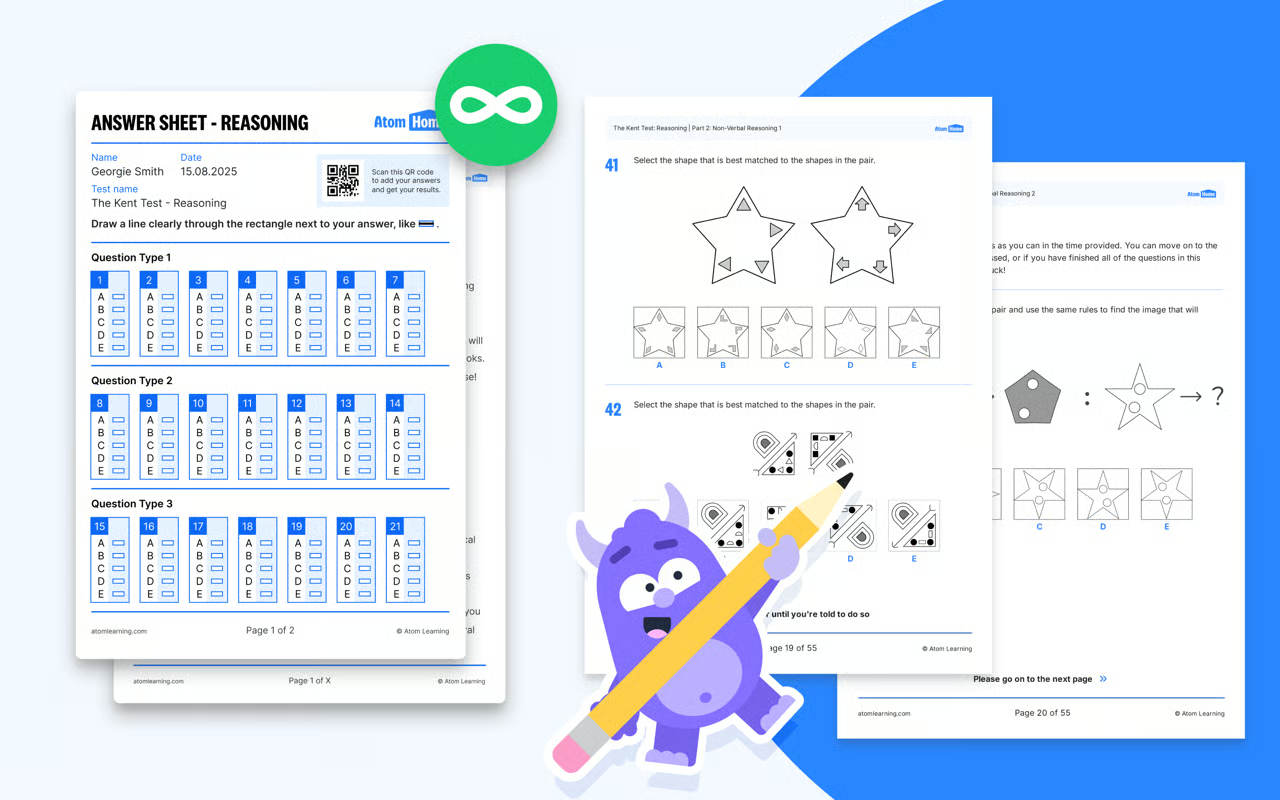
Download unlimited Gloucestershire 11+ practice papers, then upload a photo of their answers for instant, stress-free results
Take unlimited Gloucestershire 11+ mock tests that replicate the real exam, building confidence under timed conditions
Track their performance with SAS scores and comparisons against other children applying to Gloucestershire grammar schools
Join 100,000+ families who trust Atom to help their children excel in Key Stage 2 and entrance exams. Endorsed by grammar schools, loved by parents.
After the test, your child’s answer sheets are marked using Optical Mark Recognition (OMR). This technology picks up the marks your child has made to show which answers they think are correct. Your child receives a mark for every correct answer.
These marks are age-standardised. Age-standardisation is a common practice in 11 plus scoring and ensures younger children aren’t disadvantaged.
Your child’s results will be emailed to you in mid-October 2026. You’ll receive a different email from each school that you chose to share with on your registration form.
If your child meets your target school’s qualifying standard, you can then apply for a place on your common application form (CAF).
There is no set pass mark for the Gloucestershire Grammar Schools’ Entrance Test. All children’s standardised scores are placed in rank order, and each school decides on a ‘qualifying standard’.
‘Looked after children’, ‘previously looked after children’, and children who are eligible Pupil Premium tend to be prioritised for places. The qualifying score they need to achieve to be eligible for a place might be lower than children in other groups.
Every grammar school has different admissions criteria. We’ve included the admissions criteria for each Gloucestershire grammar school below:
If you're considering a grammar school in Gloucestershire for your child, it's a good idea to speak to your child's teacher first.
Grammar schools are academically-selective and select children working towards the top of their year group. Your child's teacher will be able to tell you whether they think your child will be able to keep up with the pace in a grammar school.
If you would like your child to be considered for a place at one of the seven Gloucestershire Grammar Schools, you’ll need to register them to take the local exam.
Registration for the 2026 exam opens on Monday 18th May 2026 on the participating schools’ websites. You’ll need to complete your child’s application before Friday 26th June 2026.
Your child’s test results will be sent to you in mid-October 2026. You’ll find out if your child has achieved the minimum score necessary to apply for a place.
You can use these results to decide which schools to name on your secondary school common application form. Before listing a school on your form, check the admissions policy and make sure your child is eligible.
The application form must be submitted to your home local council by 31st October 2026.
On Monday 1st March 2027, you'll find out if your child has been allocated a place at your preferred school.
If no places are available at your preferred schools, your child will be offered a place at another school in your area. You can appeal via an independent panel. Information about how to appeal will be sent to you by your local authority along with your school offer on National Offers Day.
The 11 plus exam is designed to be challenging. Here are our top tips to help your child prepare for the Gloucestershire Grammar Schools’ Entrance Test in September 2026.
It’s important to build a good knowledge base before the 11 plus. Using a ‘little and often’ approach when learning is key – our brains encode new information more effectively when dealing with smaller ‘chunks’ of information. For children aged 10–11, child psychologists recommend regular study sessions of 20–30 minutes.
Atom Home makes learning a more enjoyable process for your child. They'll explore exciting worlds full of interactive questions, earning coins to spend in the Atom shop. Atom adapts to your child, showing them questions at just the right level of difficulty to keep them motivated.
11 plus exams test your child’s ability to analyse and interpret written information. Regular reading is a great way to help your child build these skills.
Encourage them to read books from different genres and by a diverse range of authors. Increasing the variety of your child’s reading will help them understand different styles, tones and purposes. Meanwhile, reading a little every day will help widen their vocabulary, sharpen their analytical thinking, and enhance their imagination.
When your child feels confident with the topics they’ve learnt in Year 5, they’ll be ready to put their knowledge to the test.
Practice tests can help your child develop problem-solving skills and build confidence working under test conditions. They’re also a great way to consolidate learning and highlight knowledge gaps for further improvement.
With Atom Home, you'll unlock online mock tests and printable practice papers. Enjoy automatic marking and progress tracking with the online tests, and help your child get familiar with the real exam experience with printable practice papers.
Setting regular, achievable goals and celebrating your child’s progress – no matter how big or small – will help keep their motivation high.
Make sure to encourage a growth mindset. This means celebrating effort, as well as achievement! When your child makes mistakes or struggles to understand a particular topic, help them understand that they’ll improve through practice. Regular praise will help your child improve their resilience when tackling new and challenging topics.
Help your child prepare for the Gloucestershire Grammar Schools’ Entrance Test with Atom’s free 11+ course.
Get four GL Assessment style practice papers (English, maths, verbal reasoning and non-verbal reasoning), marking guidance, and video lessons sent straight to your inbox!
Contents