If your child is preparing for secondary school entrance exams, you may have heard conflicting information about whether there will be a creative writing task. Read on to find out:
what to expect from 11 plus creative writing exams
how to help your child prepare
which schools will require your child to do a creative writing test
What is 11 plus creative writing?
Children applying for 11 plus entry to selective schools may need to complete a creative writing task as part of the exam. The task could be to write an original short story or continue a story from a given text.
Some grammar schools include creative writing as part of their 11 plus exams. We've included a list of these below.
Many independent senior schools include creative writing tests in their English exams. You can find out whether your child's target school includes creative writing in the entrance exam by visiting the 'admissions' page on the school website.
Join Atom’s free creative writing course
Help your child become a confident, imaginative writer. Atom’s free email course for Years 3-6 includes video lessons, writing prompts and expert guidance. Watch them build storytelling skills, strengthen their grammar, and boost exam-ready writing at their own pace.
Children applying to grammar schools within the Consortium of Selective Schools in Essex (CSSE) have a writing task as part of their 11 plus exam. They will need to create a creative response to a prompt. The examiner will be looking for original ideas, accurate vocabulary, spelling, puncutation and grammar, and an appropriately varied structure.
Children applying to any of the 32 grammar schools within the Kent local authority area take the Kent Test. This includes a 40-minute creative writing exercise.
The creative task is not formally marked and won't form part of the total scores, but it might be used by a local headteacher panel in borderline cases or in an appeal.
Children applying to The Henrietta Barnett School will have a creative writing task if they are shortlisted for the second stage. The English paper will combine questions in both reading comprehension and creative writing.
Children who are shortlisted for Round 2 will have a creative writing task. This is part of a one-hour English paper, which will also assess reading comprehension.
London – Kingston upon Thames
Both Tiffin schools within the London Borough of Kingston upon Thames use 'longer writing' tasks as part of their second stage exams.
These second stage tests are set by the schools themselves. Children will also be tested in reading comprehension and maths.
London – Sutton
Children applying to grammar schools in Sutton take the Sutton Selective Eligibility Test (SET). Children who are shortlisted for the second stage take further exams. This includes an extended writing task which lasts between 40 minutes and 1 hour (depending on the school).
Merseyside
St Anselm's College in Birkenhead includes a 30-minute writing task as part of its 11 plus exam.
The task includes prompts and five to ten minutes for planning.
The content and format of 11 plus creative writing tests can vary depending on the school. Some tests might ask your child to:
continue a short story based a paragraph of narrative text
describe a place or a situation
write a letter or an article to persuade the reader to feel a certain way
write their own short story based on some bullet points for guidance
write their own descriptive or narrative piece based on a picture
Getting used to writing for different audiences and purposes can put your child in good stead for 11 plus creative writing exams.
What are examiners looking for?
Creative writing is subjective. After all, everyone has different interests when it comes to reading for pleasure! However, there are specific things examiners are looking for when marking 11 plus creative writing papers. These include:
Structure – does the piece have a clear beginning, middle and ending?
Creativity – has your child introduced unique ideas and demonstrated a strong imagination?
Spelling, punctuation and grammar – are they all accurate, and have they made use of sentence variety?
Vocabulary – have they used more advanced vocabulary (while making sense in context) than others their age? Have they introduced a wide range of adjectives, nouns and adverbs?
Typical 11+ creative writing mark schemes
Take a look at a typical creative writing mark scheme below. This is used to assess children applying for 11+ entry to a leading independent school.
In this example, children are marked out of 30. Up to 20 points are available for content and style, and up to 10 points are available for spelling and grammar. Children are rewarded for the quality, rather than the quantity, of their writing.
Content and style (out of 20)
20 or 19 marks:
Focus on the task is excellent.
Writing is enjoyable with flair.
Tone, mood and atmosphere are successfully controlled.
Vocabulary is consistently impressive.
Figurative and sensory language is outstanding.
Characterisation is convincing and sustained.
18, 17 or 16 marks:
Focus on the task is good.
Writing is strong.
Tone, mood and atmosphere are mostly controlled.
Vocabulary is carefully considered.
Figurative and sensory language is sustained.
Characterisation is clear.
15, 14, 13 or 12 marks:
Focus on the task is competent.
Tone, mood and atmosphere are mostly generally varied and convincing.
Vocabulary is competent.
Figurative and sensory language are attempted with some success.
Characterisation has been attempted, but might be unconvincing or (at the bottom of this band) contradictory.
11, 10, 9 or 8 marks:
Focus on the task is variable.
Writing is straightforward.
Tone, mood and atmosphere have been attempted.
Vocabulary is straightforward.
Figurative and sensory language is rarely used.
Characterisation is straightforward.
7, 6, 5, 4 or 3 marks:
Focus on the task is limited.
Tone, mood and atmosphere are limited and uncontrolled.
Vocabulary is basic or repetitive.
There is no effective imagery or sensory language.
Characterisation is limited.
2 or 1 marks:
There is little content that can be rewarded.
Spelling and grammar (out of 10)
10 or 9 marks:
Punctuation, spelling and grammar are highly secure.
Vocabulary choice is ambitious and accurate.
Sentence structures are varied successfully.
Paragraphs are used for effect.
8 or 7 marks:
Punctuation, spelling and grammar are mostly secure.
Vocabulary choice is expressive and mostly accurate.
Sentence structures are varied mostly with success.
Paragraphs are sometimes used for effect.
6, 5 or 4 marks:
Punctuation, spelling and grammar errors do not affect understanding of the piece.
Vocabulary choice is competent, but less expressive.
There is some attempt to vary sentence structures.
Paragraphs have been used, but not for effect.
3 or 2 marks:
Punctuation, spelling and grammar errors might affect understanding of the piece.
Vocabulary choice is unimaginative.
Sentence structures are unvaried or use incorrect punctuation.
There is some attempt to use paragraphs.
1 mark:
Punctuation, spelling and grammar are significant inaccurate.
Vocabulary choice is limited.
Sentence structures have issues that affect understanding of the piece.
There is little or no attempt to use paragraphs.
How to prepare for 11 plus creative writing tests
Developing creative writing skills can be one of the most challenging parts of preparing for exams. Here are our top tips to help your child become a confident writer!
Vocabulary
Developing a wide and varied vocabulary is key for children to produce an interesting piece of writing. Including lots of adjectives and adverts is one of the best ways to grab a reader's attention.
We recommend that your child keeps a vocabulary log. As they read, they should record any new words with their definition and an example of the word used in a sentence.
Planning
In 11 plus exams, creative writing tasks usually last around 30 minutes (although this can vary from school to school). This isn't very long to produce an extended piece of writing – including planning time!
While it can be tempting to skip planning and start writing immediately, this will result in an unstructured piece of writing. As examiners are looking for evidence of a clear structure, your child may lose important marks.
We always recommend spending at least 5 minutes planning at the beginning of any creative writing exam. Your child should use this time to define what they will include in the beginning, middle and end of their piece.
Spelling, punctuation and grammar
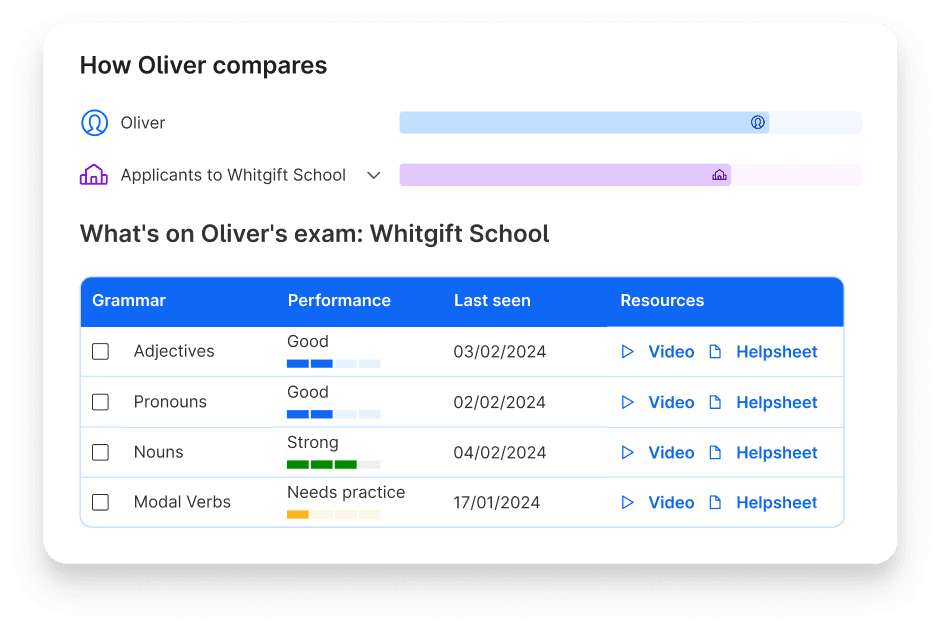
Creative writing marks are not only awarded for content and creativity, but also for accurate spelling, punctuation and grammar. Your child can practise these topics on Atom Home.
Your child's learning plan includes questions and activities in Key Stage 2 English. These adapt to their performance, so they'll see questions at just the right level of difficulty to keep them motivated. On your 'Track' page, you can see how your child is progressing and any topics which need improvement.
Reading
One of the most effective ways to improve writing is through reading. Reading is a fantastic way to introduce your child to new vocabulary, as well as accurate grammar and punctuation. Reading a wide variety of content and genres will expose them to new writing styles and ideas that they can incorporate into their work.
If your child enjoys a particular book, ask them why they like it. Is it the vivid character descriptions, use of adjectives, or adventurous plot? This can help your child recognise what to include in their own writing.
You can use prediction and storytelling games to help develop your child's creativity. Once they reach the end of a chapter, get them to write a paragraph on what they think will happen next. If they didn't like the end of a story, they can have a go at writing an alternative ending.
Not sure if your child is on track for the grammar school 11+? You don’t need to guess what to cover or whether they’re ready. Atom shows you exactly what to practise each week and how they’re performing, so you can stay ahead of the process without the stress.