

Back to blog

Hampton School 11+ entry guide

By
Atom
|
June 16, 2026

Are you thinking about applying to Hampton School for 11+ entry? Find out everything you need to know about the admissions process and how to prepare for the entrance exam.

Key information for Hampton School

  • School type: boys' independent day school
  • Location: Hampton, Middlesex
  • Admissions contact: admissions@hamptonschool.org.uk
  • 11+ exam: school-set papers (English, words and reasoning, and maths)
  • Financial assistance: means-tested bursaries
  • Scholarships: academic, art, chess, choral, performing arts and sport

Important dates for 2027 entry

  • Sunday 1st November 2026: closing date for registration and bursary applications
  • Tuesday 17th November 2026: closing date for scholarship applications
  • Saturday 21st November 2026: 11+ entrance and academic scholarship examination
  • Monday 4th January 2027: 11+ interviews
  • Tuesday 5th January 2027: 11+ interviews
  • Friday 12th February 2027: results emailed to parents
  • Early March 2027: deadline for accepting places

How to apply to Hampton School

Hampton School is selective. This means that your child will need to take an entrance exam to be eligible for a place.

You must register your child for Year 7 entry via the school website. Registration opens in the summer term in Year 5 and closes in the autumn term in Year 6.

Hampton School sets its own 11+ entrance exam. There are three papers: English, words and reasoning, and maths. The exam takes place in November when your child is in Year 6.

Children who perform well in the entrance exam are shortlisted for interviews. These take place in January.

You will receive your child's results in mid-February. If they are offered a place at Hampton School, you will have until early March to accept.

What will my child be tested on?

The Hampton School 11+ entrance exam consists of three papers. The whole exam lasts around two hours and five minutes in total.

English

The English paper lasts 40 minutes and includes sections on reading comprehension and creative writing.

In the creative writing section, your child will be asked to write an original piece of descriptive writing based on an image. Marks are awarded for:

  • Using language skills (grammar, punctuation, and vocabulary) to engage the reader
  • The ability to create convincing dialogue
  • Use of controlled sentences of varying length and pattern
  • Overall coherence and relevance to the image

Reading a wide range of fiction is a great way to help your child prepare for this section.

Words and reasoning

The words and reasoning paper lasts 40 minutes. This paper tests your child's ability to extract information from different factual materials — such as maps or timetables — and a passage of text. Children who enjoy reading non-fiction (science, history, and similar subjects) often find this style of assessment suits them well.

The paper also includes verbal reasoning and non-verbal reasoning questions, assessing your child's understanding of word meanings and their ability to solve visual and verbal puzzles. Some questions are in multiple-choice format.

Maths

The maths paper lasts 45 minutes. Questions are based on topics covered in Key Stage 2 maths, but they may involve two or three different stages. Your child will need to apply what they've learned to solve problems, rather than simply recall facts.

No items found.

How are places decided?

Children who perform well in the entrance exam are invited back to the school for interviews in January. Hampton places considerable weight on this stage — it's an opportunity for the school to get to know each boy as a person and to explore his academic and all-round potential, as well as how well he fits with the school's ethos and values.

Your child will meet separately with two members of teaching staff for around 30 minutes in total.

Places are offered in mid-February. These are based on:

  • performance in the entrance exam
  • the interview
  • a reference from the headteacher at your child's current school

If your child is offered a place, you will need to accept by early March.

How can I help my child prepare for the test?

Applying to senior school can feel like a big milestone, but preparation doesn't have to be overwhelming. Here's how you can help your child prepare for test day.

Stay on track with a clear plan

One of the hardest parts of exam preparation is knowing what to focus on, when, and how to make steady progress without it taking over family life.

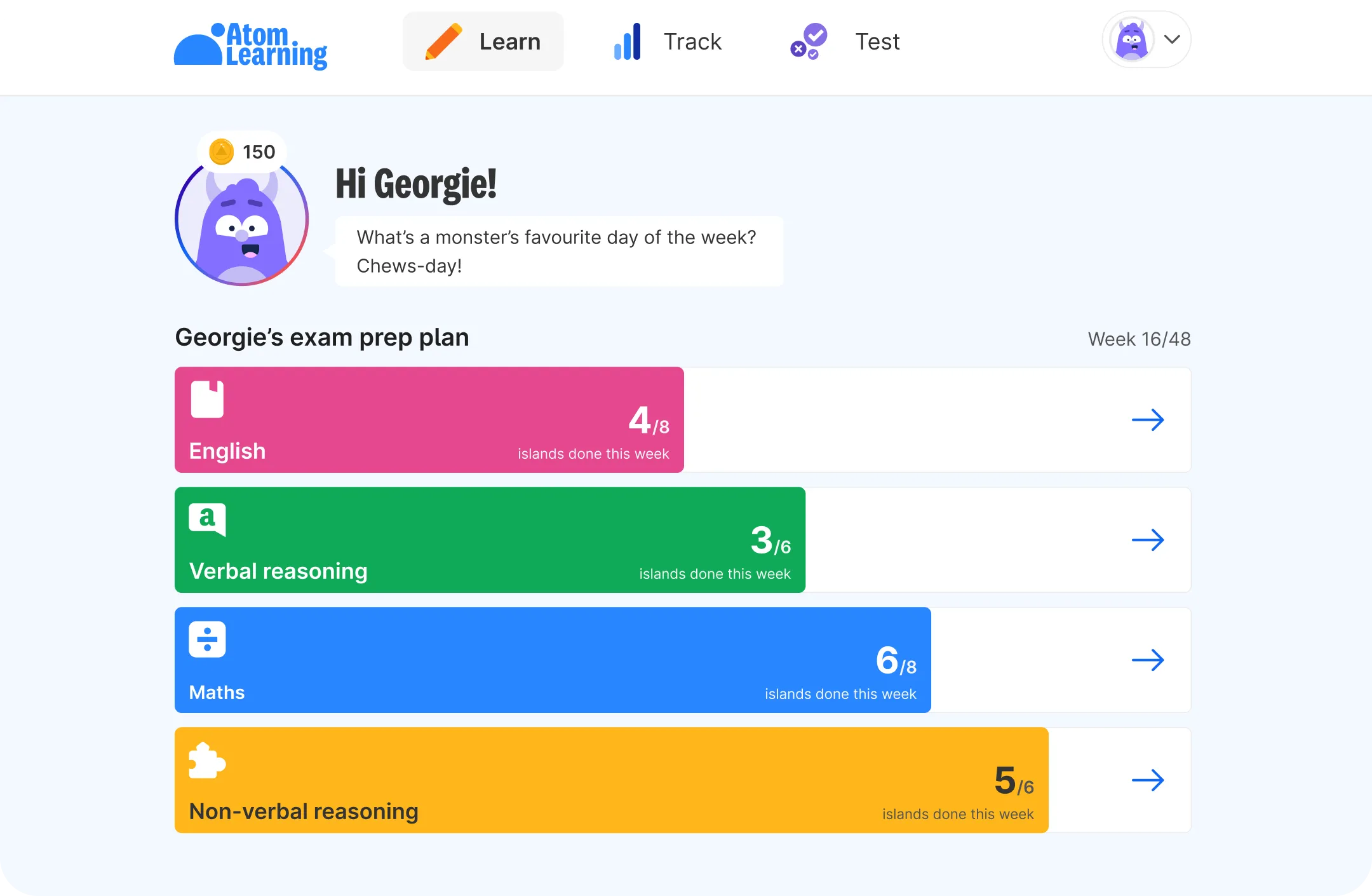
A clear, structured plan helps your child feel less overwhelmed and more in control. It ensures they build skills in the right order, cover everything they need, and avoid last-minute cramming.

Atom's exam plan makes this easier. Enter your child's target schools and exam dates, and we'll create a personalised weekly plan tailored to the topics they'll be tested on. It shows them what to work on and when, adapts as they improve, and helps them build progress in a calm, manageable way — little and often.

That means less guesswork for you, less stress for them, and a clearer path all the way to exam day.

Build smart exam technique

As your child's knowledge grows, practice tests can help them feel more comfortable with the real exam format.

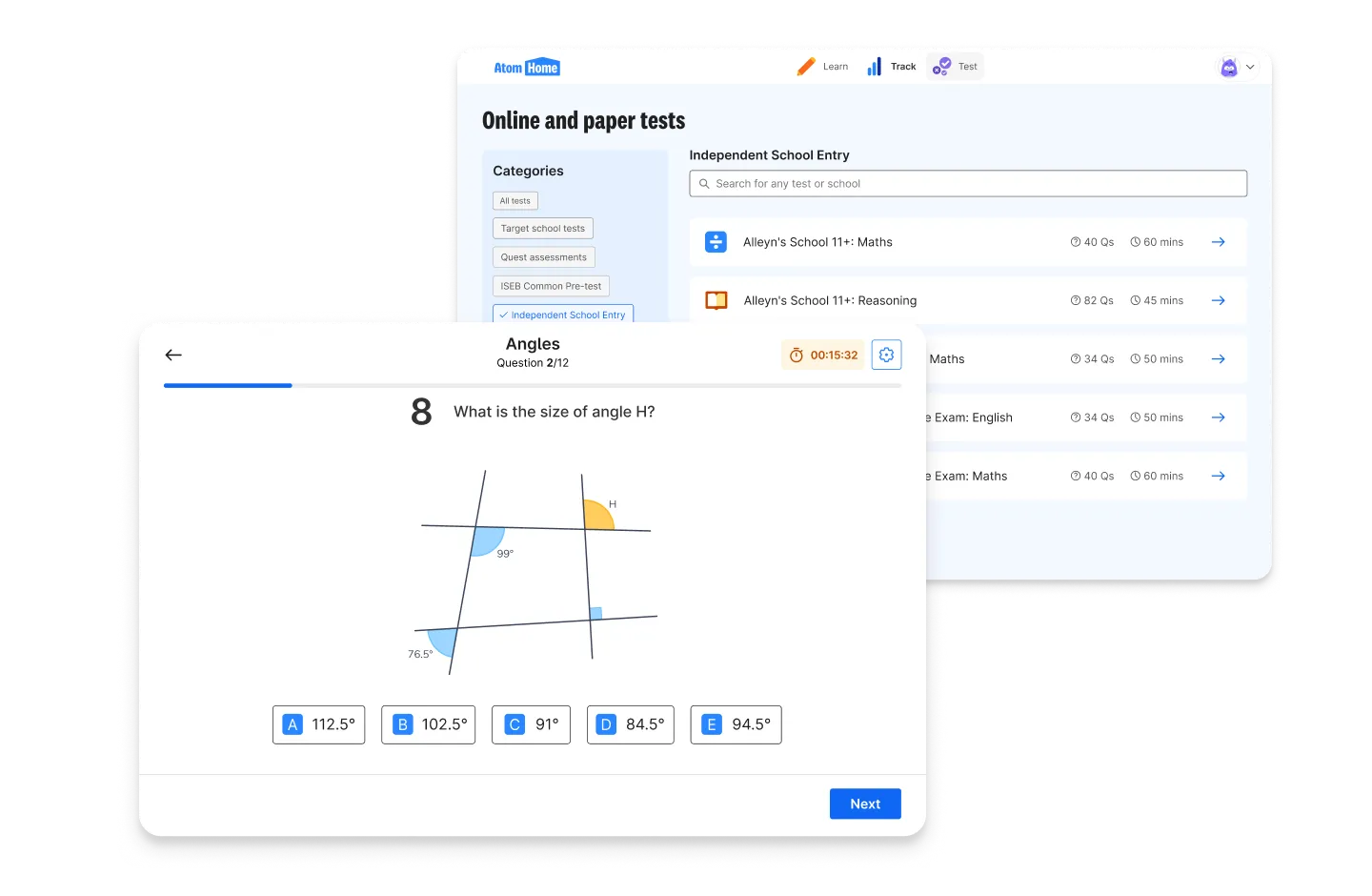
Atom's mock tests are exact replicas of real entrance exams. They're also unlimited — your child can take the same test repeatedly and see new questions each time. This helps them practise without repeating the same content.

Atom's mock tests are automatically marked. You'll see your child's standardised age score (SAS), where they're doing well, and what they should focus on next. You'll also learn how they compare to other children applying to the same school.

Encourage regular reading

Strong reading skills play a big role in preparation for entrance exams.

Encourage your child to read every day, even for just 10–15 minutes. The key is variety. Mix fiction and non-fiction, different genres, and a range of authors. This helps them become more confident in understanding tone, purpose, and meaning across different texts.

Over time, regular reading will:

  • broaden their vocabulary
  • improve comprehension and inference
  • build confidence in tackling unseen texts

And just as importantly, it can help them enjoy reading — not just see it as exam preparation.

Looking for inspiration? Atom's reading and writing starter kit has suggestions spanning fiction and non-fiction for Years 3–6.

Celebrate progress, not just scores

When you're supporting your child through exam preparation, what really matters is knowing they're moving in the right direction — not just how they scored on a single test.

Atom's progress tracking gives you a clear, simple picture of how your child is doing in each topic and the direction they're moving in. You can see where they're on track, where they might need more practice, and spot progress as it happens.

That makes it easier to give meaningful encouragement, keep motivation steady, and focus on what matters most: consistent improvement, not just one-off results.
No items found.
No items found.
No items found.
No items found.

Take control of your child’s independent school prep.

Worried about keeping pace with the competition? Independent school exams can feel unpredictable, but your child’s preparation doesn’t have to be. Atom shows you exactly what to practise and how they’re performing, so you can stay ahead throughout the admissions process. 

Partnered with leading independent schools, trusted by families.

Start your free trial and help your child get ready for senior school entry.

Try Atom for free
No items found.

Contents