How are places allocated at Queen Elizabeth Grammar School?
To be eligible for a place, your child must reach the required standard in the entrance test. The pass mark is set each year after the exam, based on the performance of the cohort.
First, 32 places (20% of the year group) are awarded solely by ranked test score; the highest-scoring children receive these places first. Children with an Education, Health and Care Plan that names QEGS are also admitted before oversubscription criteria are applied.
If the remaining number of eligible applicants exceeds the places available, Queen Elizabeth Grammar School applies oversubscription criteria. Places are prioritised in this order:
- Looked after and previously looked after children
- Children who have a sibling attending QEGS at the time they would start
- Up to 10 places for children who receive Pupil Premium (including Service Premium)
- Children of permanent members of QEGS staff employed for at least two years
- Children living within the QEGS catchment area, ranked by test score, then by distance
- All other children, ranked by distance from the school
Does Queen Elizabeth Grammar School have a catchment area?
Yes. Queen Elizabeth Grammar School has a catchment area covering Penrith and the surrounding area. Children living within the catchment area are prioritised ahead of those outside it when places are being allocated.
Anyone can register for and sit the entrance test regardless of where they live, but if you live outside the catchment area, it is worth thinking carefully about the practicalities of the daily journey, including travel time, after-school activities and punctuality.
How can I help my child prepare for the test?
The Queen Elizabeth Grammar School Entrance Test can feel like a big milestone, but preparation doesn't have to be overwhelming. Here's how you can help your child prepare for test day.
Stay on track with a clear plan
One of the hardest parts of 11+ preparation is knowing what to focus on, when, and how to make steady progress without it taking over family life.
A clear, structured plan helps your child feel less overwhelmed and more in control. It ensures they build skills in the right order, cover everything they need, and avoid last-minute cramming.
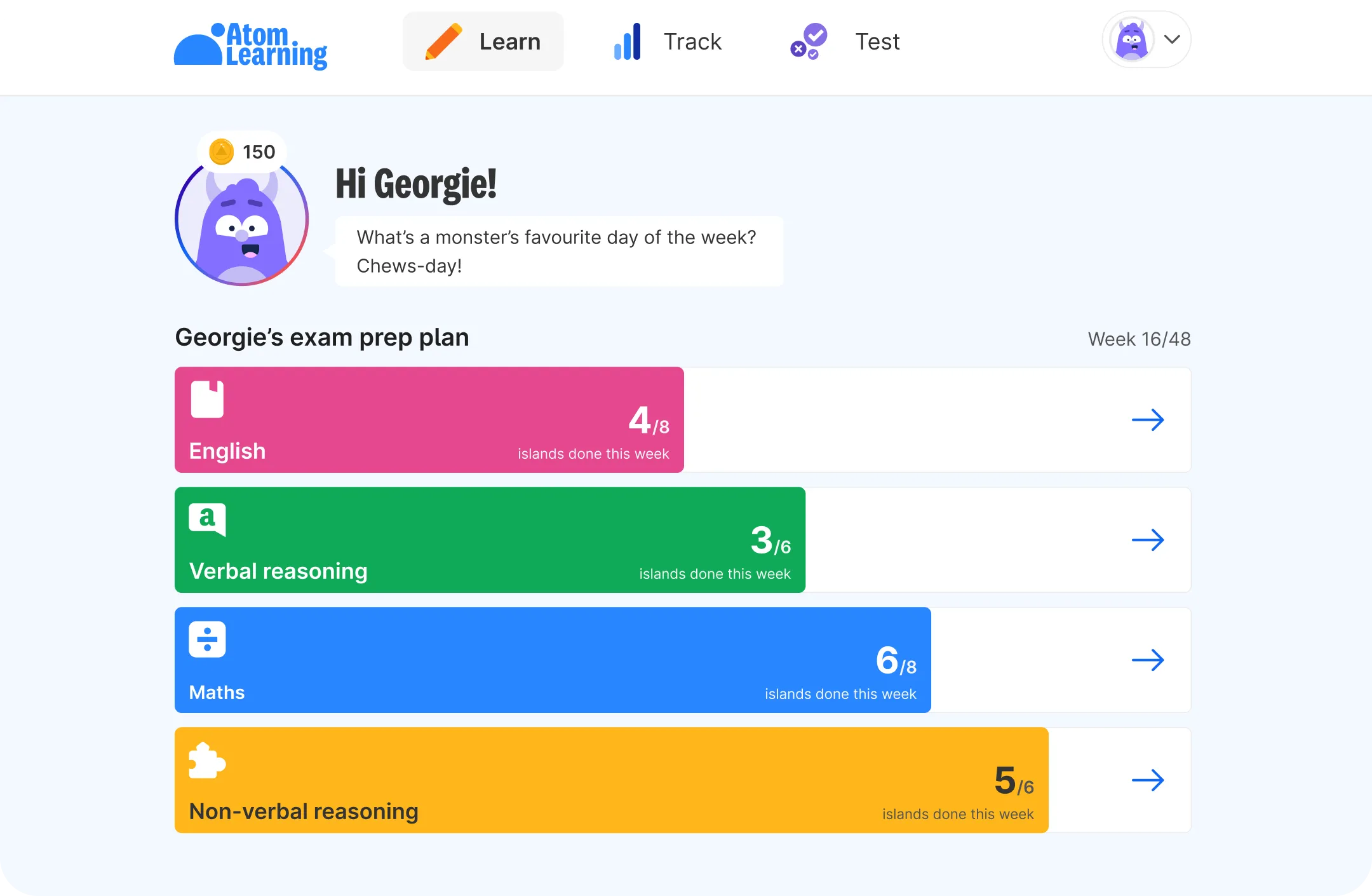
Atom's exam plan makes this easier. Enter your child's target schools and exam dates, and we'll create a personalised weekly plan tailored to the topics they'll be tested on. It shows them what to work on and when, adapts as they improve, and helps them build progress in a calm, manageable way — little and often.
That means less guesswork for you, less stress for them, and a clearer path all the way to exam day.
Encourage regular reading
Strong reading skills are central to the FSCE test, which places English at the heart of its assessment.
Encourage your child to read every day, even for just 10–15 minutes. The key is variety. Mix fiction and non-fiction, different genres, and a range of authors. This helps them become more confident in understanding tone, purpose, and meaning across different texts.
Over time, regular reading will broaden their vocabulary, improve comprehension and inference, and build confidence in tackling unseen passages.
Looking for inspiration? Explore Atom's free reading and writing starter kit for helpful suggestions of age-appropriate books your child can read!
Celebrate progress, not just scores
When you're supporting your child through 11+ preparation, what really matters is knowing they're moving in the right direction — not just how they scored on a single test.
Atom's progress tracking gives you a clear, simple picture of how your child is doing in each topic and the direction they're moving in. You can see where they're on track, where they might need more practice, and spot progress as it happens.
That makes it easier to give meaningful encouragement, keep motivation steady, and focus on what matters most: consistent improvement, not just one-off results.