If you're thinking about grammar school for your child, we're here to help!
At Atom Learning, we’ve supported 110,000+ families with Key Stage 2 and school entrance exams. This guide takes you through everything you need to know about the 11+.
Key takeaways
- Children applying to grammar schools take a test known as the 11 plus in the autumn term in Year 6.
- 11 plus tests English, maths, verbal reasoning and non-verbal reasoning. The specific content varies depending on the school.
- 11 plus exams are taken on paper and usually last around 2 hours. Most 11 plus exams are multiple-choice.
- The 11 plus is challenging. It’s designed to identify children working at the top ability range in their year group.
- Learning in short bursts and testing knowledge with 11 plus practice papers is the best way to get ready.
What is the 11 plus exam?
The 11 plus is an entrance exam used by grammar schools to select children for Year 7. Grammar schools are free secondary schools that select pupils based on ability.
The name of the exam refers to the age at which children start secondary school (aged 11). Children take the 11 plus exam in Year 6 when they are 10 or 11 years old.
The 11 plus aims to test your child's attainment in core subjects, like English and maths. It can also identify your child's academic potential. Schools use the results of the 11 plus to decide which children are most likely to thrive in their school.
Selective independent schools (private schools) also have entrance exams. These are sometimes referred to as 11 plus exams. They might test similar subjects to grammar schools, but the admissions process and difficulty varies. This article focuses on grammar school exams only.
When is the 11 plus in the UK?
The 11 plus is only used in England. There are no grammar schools in Scotland or Wales. Since 2008, the 11 plus has ended in Northern Ireland and been replaced by an exam known as the Transfer Test.
Children taking the 11 plus in England take the exam in the autumn term of Year 6. Most schools hold the exam in September, although a few hold it in early October.
Grammar schools often release their 11 plus exam dates during the summer term in Year 5.
Key dates for 11 plus exams in 2025
What does the 11 plus exam consist of?
The content of the 11 plus exam depends on your child's target school. Some grammar schools will take the same test where they are part of a group, or consortium. Others have unique tests specific to their school.
If you want to apply to more than one grammar school in a consortium, your child only needs to take one exam. If you would like to apply to schools outside of a consortium, your child will need to take an 11 plus test for each school.
11 plus exams assess some, or all, of these subjects:
- English – usually reading comprehension and spelling, punctuation and grammar. A few 11 plus exams also test creative writing.
- Maths
- Verbal reasoning
- Non-verbal reasoning
11 plus English and maths exams test Key Stage 2 topics. Your child will have been taught most of these topics in their English (or Literacy) and maths (or Numeracy) lessons.
Some 11 plus exams include Year 6 content that your child will not have learned yet. This is to assess how well they can apply problem-solving skills in unfamiliar situations.
Verbal reasoning and non-verbal reasoning are not included on the national curriculum. If your child is at a state primary school, they will not learn these subjects at school.
Verbal and non-verbal reasoning tests your child's cognitive ability. This involves understanding patterns, spotting connections, and solving problems. Verbal reasoning involves letters and words, and non-verbal reasoning involves shapes and diagrams.
What is the format of the 11 plus exam?
The format of the 11 plus exam depends on the exam board providing the test.
Many grammar schools in England use 11+ exams created by GL Assessment. A few grammar schools use tests by FSCE (Future Stories Community Enterprise).
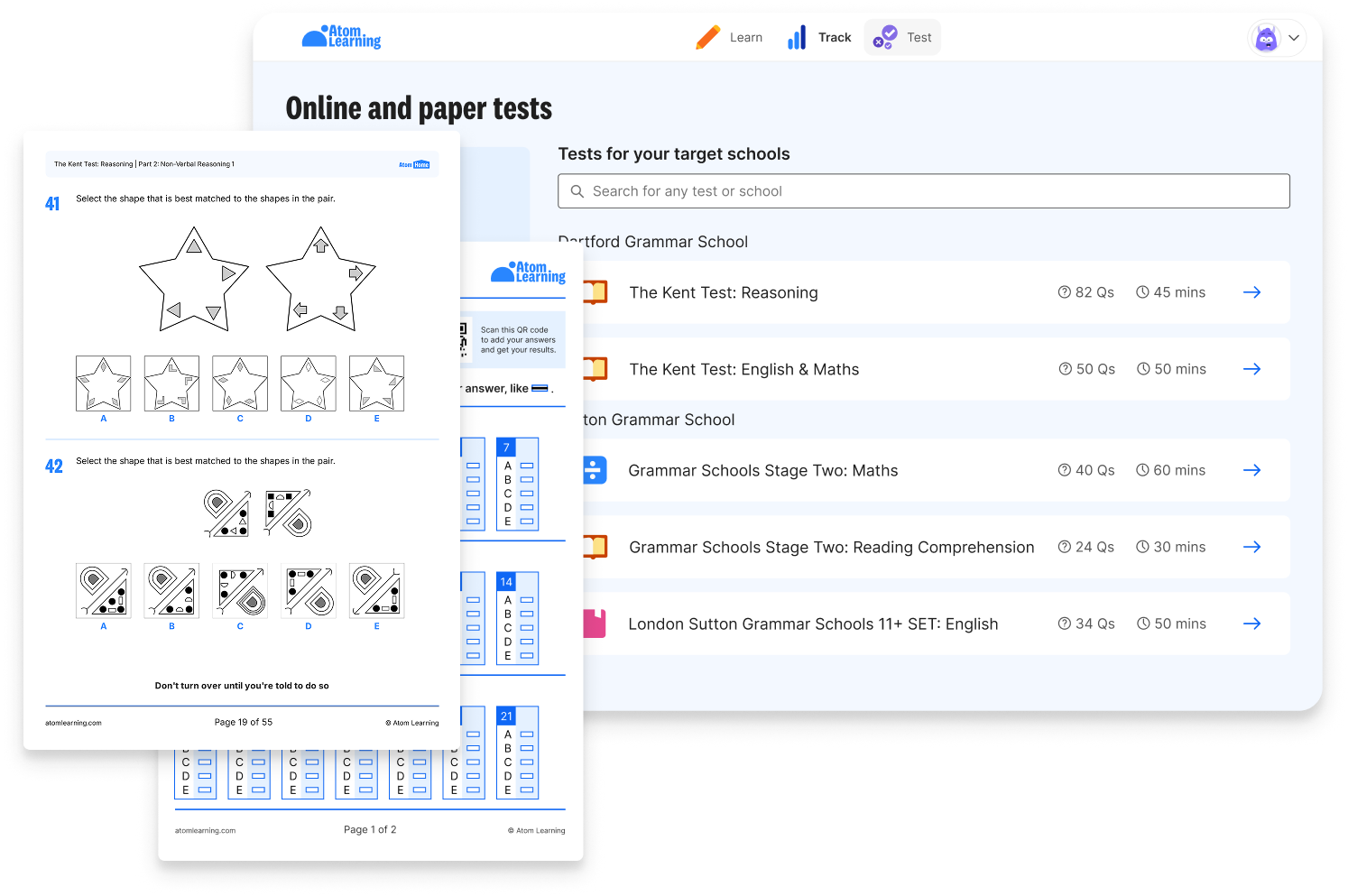
For both GL Assessment and FSCE exams, your child will have a question booklet and answer sheets. The answer sheets look a bit like lottery tickets. For each question, your child needs to shade the option (usually A–E) they think is correct on their answer sheet.
The question will indicate whether they need to choose one or two answers. Your child should read the question carefully to make sure they have chosen the right number of answers.
After the exam, technology called Optical Mark Recognition (OMR) scans your child's answer sheets. Your child will receive a mark for every correct answer. It's important that your child fills in their answer sheets clearly.
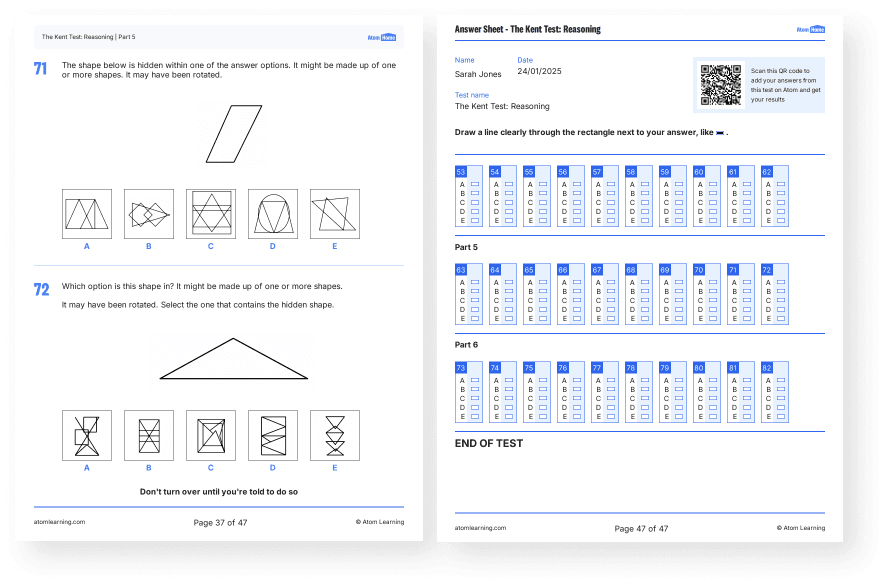
Pictured: a downloadable 11+ practice paper and answer sheets available to Exam Prep Plus subscribers on Atom Home.
Some grammar schools create their own 11 plus test papers. For these, your child might need to write their answers in a question booklet. They might also need to provide short written answers.
If your child's 11 plus exam tests creative writing, they will need to provide a longer written answer. This is usually a response to a creative writing topic or prompt. Teachers and examiners mark creative writing tests.
.avif)