Atom Learning is partnered with Maidstone Grammar School. You can read more about our partnership here.
Applying to Maidstone Grammar School for September 2028? This guide covers the Kent Test, the qualifying score, how the 205 Year 7 places are allocated and the key dates for September 2028 entry.
Maidstone Grammar School 11+ at a glance
School type: boys' grammar school (girls join in the sixth form)
Number of places in Year 7: 205 (2027-entry figure — Maidstone Grammar School confirms each year's admission number in its determined arrangements, published the spring before entry.)
Qualifying score: Kent County Council sets the qualifying score after each test. After the 2025 test (for September 2026 entry), children needed a total of 332 or more, with no single score below 108. Some children are assessed as suitable through a local headteacher panel instead. Maidstone Grammar School gives extra priority to boys in its listed parishes who score 360 or more.
11+ test:Kent Test (two multiple-choice papers of about an hour each, plus a writing task that isn't marked)
Catchment or priority area: yes - priority for boys in listed parishes (see below)
Source: Maidstone Grammar School Admission Arrangements for September 2027. Last checked October 2026.
Key dates for September 2028 entry
Kent County Council runs the Kent Test and sets its dates in the county's co-ordinated admissions scheme. It hasn't published the 2028-entry dates yet, so the windows below follow the 2027-entry timetable: registration ran from Monday 1 June 2026 to Wednesday 1 July 2026, the test took place on Thursday 10 September 2026 for children at Kent primary schools (the weekend of 12 and 13 September 2026 for everyone else) and results were due on Thursday 15 October 2026. We'll update this page as soon as Kent County Council publishes the 2028-entry dates.
Key dates for Maidstone Grammar School 11+ entry in September 2028, with expected windows where the school has not yet confirmed exact dates.
Date
What happens
Early June 2027
Kent Test registration expected to open
Early July 2027
Kent Test registration expected to close
Early to mid-September 2027
Kent Test expected: a weekday for children at Kent primary schools, the following weekend for everyone else
Mid-October 2027
Kent Test results expected
Sunday 31 October 2027
National closing date for secondary school applications. Kent County Council confirms its own closing date in its co-ordinated admissions scheme; for 2027 entry it moved the date to the following Monday.
Wednesday 1 March 2028
National offer day for secondary school places
Worried about missing an important 11+ deadline?
Get grammar school reminders with the key dates for your target school delivered straight to your inbox.
Maidstone Grammar School is selective, so your child needs to sit the 11+ test to be considered for a place.
You register your child for the Kent Test with Kent County Council during its registration window. Late registrations go to Kent County Council by email at kent.admissions@kent.gov.uk.
Once you have your child's result, you apply by naming Maidstone Grammar School on your common application form, which goes to your home local authority. Application deadline: Sunday 31 October 2027. This is the national closing date. Kent County Council has in the past moved the deadline to the following Monday when 31 October falls on a weekend — it did so for 2027 entry, when the date moved to Monday 2 November. The council confirms its own closing date in its co-ordinated admissions scheme, usually published the year before. Treat 31 October as the date to work to, and check the council's scheme before you submit.
Reaching the qualifying score makes your child eligible, but it doesn't guarantee a place. If more qualifying children apply than there are places, the school uses its oversubscription criteria, set out further down this page.
What will my child be tested on?
The Kent Test is run by Kent County Council and used by the grammar schools across Kent, so your child only sits it once to be considered for any of them. Kent County Council says the tests in English, maths and reasoning are devised by GL Assessment.
There are two multiple-choice papers, and answers go on a separate answer sheet. The first is an English and maths paper lasting an hour. Each section starts with a 5-minute practice exercise, followed by a 25-minute test. The English section is a comprehension exercise plus questions on literacy skills. The second is a reasoning paper of about an hour, including practice, with verbal and non-verbal reasoning sections of roughly the same length.
Your child also completes a writing task. It lasts 40 minutes, including 10 minutes of planning. It isn't marked, but a local headteacher panel may read it as part of the headteacher assessment stage.
Results give three standardised scores, for English, maths and reasoning, plus a total. Each score ranges from 69 to 141.
The table below shows what each paper covers.
The Kent Test papers for September 2028 entry: length and content of each paper.
Paper
Length
What it covers
English and maths paper
1 hour (each section is a 5-minute practice exercise, then a 25-minute test)
Reading comprehension and literacy questions; maths
Reasoning paper
About 1 hour, including practice sections
Verbal reasoning and non-verbal reasoning, in sections of roughly the same length
Writing task
40 minutes, including 10 minutes of planning
Not marked; may be used by a local headteacher panel
How are places allocated at Maidstone Grammar School?
If more children reach the qualifying standard than there are 205 Year 7 places, Maidstone Grammar School offers places in the order below. This order comes from the school's admissions policy for September 2027. The school sets its 2028-entry policy separately, and we'll update this table if anything changes.
Maidstone Grammar School oversubscription criteria in priority order, from the September 2027 admissions policy.
Priority
Who it covers
EHCP
Boys with an Education, Health and Care Plan naming the school are admitted first, if agreed with the local authority
1
Qualifying boys in care or previously in care
2
Qualifying boys living in one of the listed parishes who score 360 or more in the Kent Test
3
Other qualifying boys living in one of the listed parishes
4
All other qualifying boys
No items found.
Within criteria 2, 3 and 4, places go first to boys receiving targeted free school meals at the time of application, then to boys with a brother at the school, then to children of staff employed for two or more years (or recruited to a skill-shortage post), then to boys living nearest the school.
Does Maidstone Grammar School have a catchment area?
Maidstone Grammar School gives priority to boys who live in its listed parishes: Addington, Aylesford (includes Eccles), Barming, Bearsted, Bicknor, Birling, Borough Green, Boughton Malherbe, Boughton Monchelsea, Boxley, Bredhurst, Broomfield and Kingswood, Burham, Chart Sutton, Collier Street, Coxheath, Detling, Ditton, Downswood, East Farleigh, East Malling and Larkfield, East Sutton, Frinsted, Harrietsham, Headcorn, Hollingbourne, Hucking, Hunton, Ightham, Kings Hill, Langley, Leeds, Lenham (includes Lenham & Platts Heath), Leybourne, Linton, Loose, Maidstone, Marden, Mereworth, Nettlestead, Offham, Otham, Platt, Ryarsh, Snodland, Stansted, Staplehurst, Stockbury, Sutton Valence, Teston, Thurnham, Tovil, Trottiscliffe, Ulcombe, Wateringbury, West Farleigh, West Malling, West Peckham, Wichling, Wormshill, Wrotham, Wouldham, Yalding (includes Laddingford). Boys outside these parishes can still apply and are considered under criterion 4. Distances are measured in a straight line.
If two or more boys have equal priority, random selection decides which is ranked first.
If you don't live close to the school, it's worth thinking about how your child will get there every day. How long will the journey take? What transport options are available? Will they be travelling independently or with support?
A longer or more complex journey can affect your child's daily routine, including how much time they have for homework, rest and after-school activities. It's a good idea to think about how manageable the school run will be and whether it will work for your family day to day.
How can I help my child prepare for the test?
The Kent Test can feel like a big milestone, but preparation doesn't have to be overwhelming. Here's how you can help your child prepare for test day.
Stay on track with a clear plan
One of the hardest parts of 11+ preparation is knowing what to focus on, when, and how to make steady progress without it taking over family life.
A clear, structured plan helps your child feel less overwhelmed and more in control. It ensures they build skills in the right order, cover everything they need, and avoid last-minute cramming.
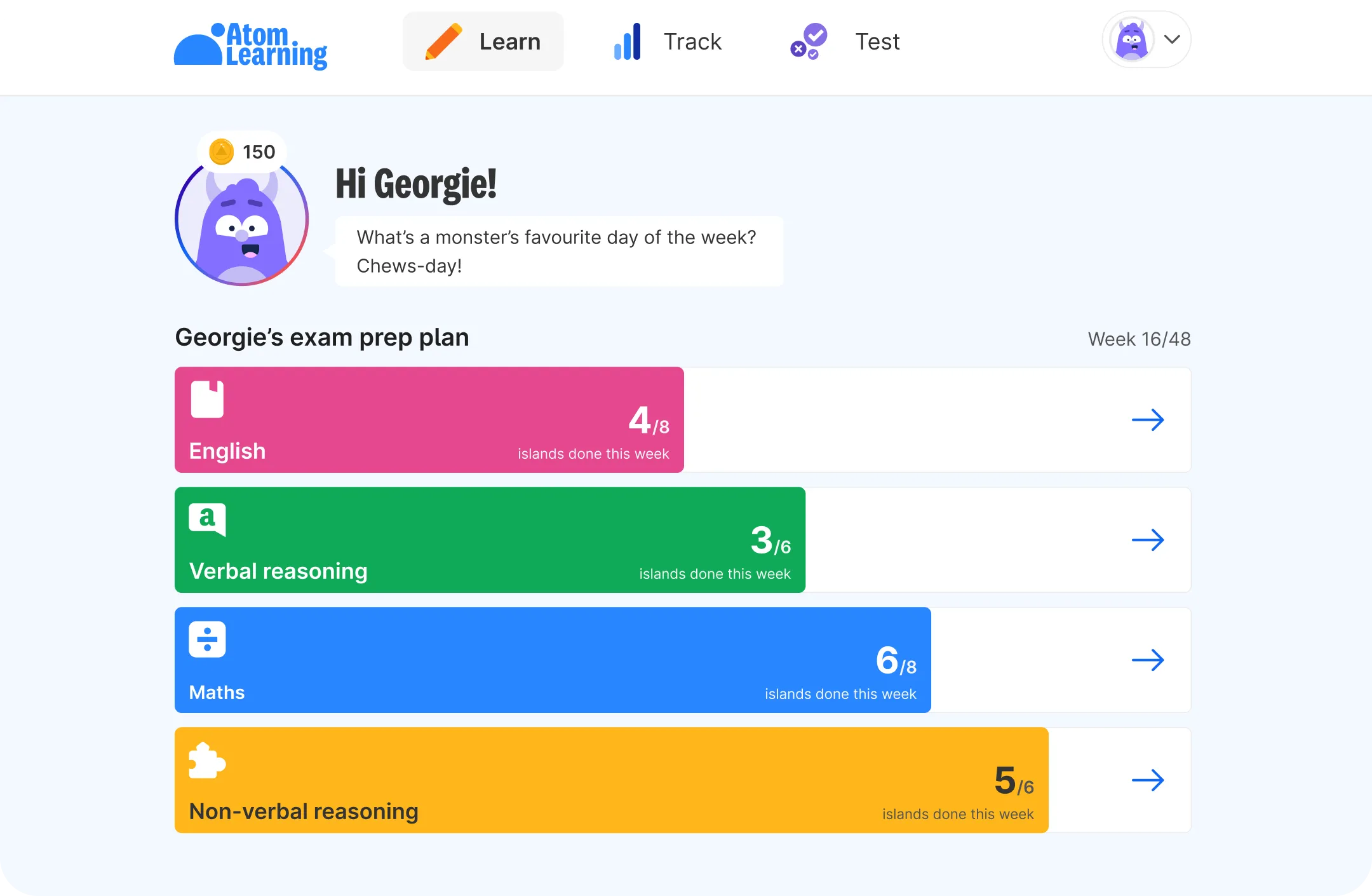
Atom's exam plan makes this easier. Enter your child's target schools and exam dates, and we'll create a personalised weekly plan tailored to the topics they'll be tested on. It shows them what to work on and when, adapts as they improve, and helps them build progress in a calm, manageable way — little and often.
That means less guesswork for you, less stress for them, and a clearer path all the way to exam day.
Build smart exam technique
As your child's knowledge grows, practice tests can help them feel more comfortable with the real exam format.
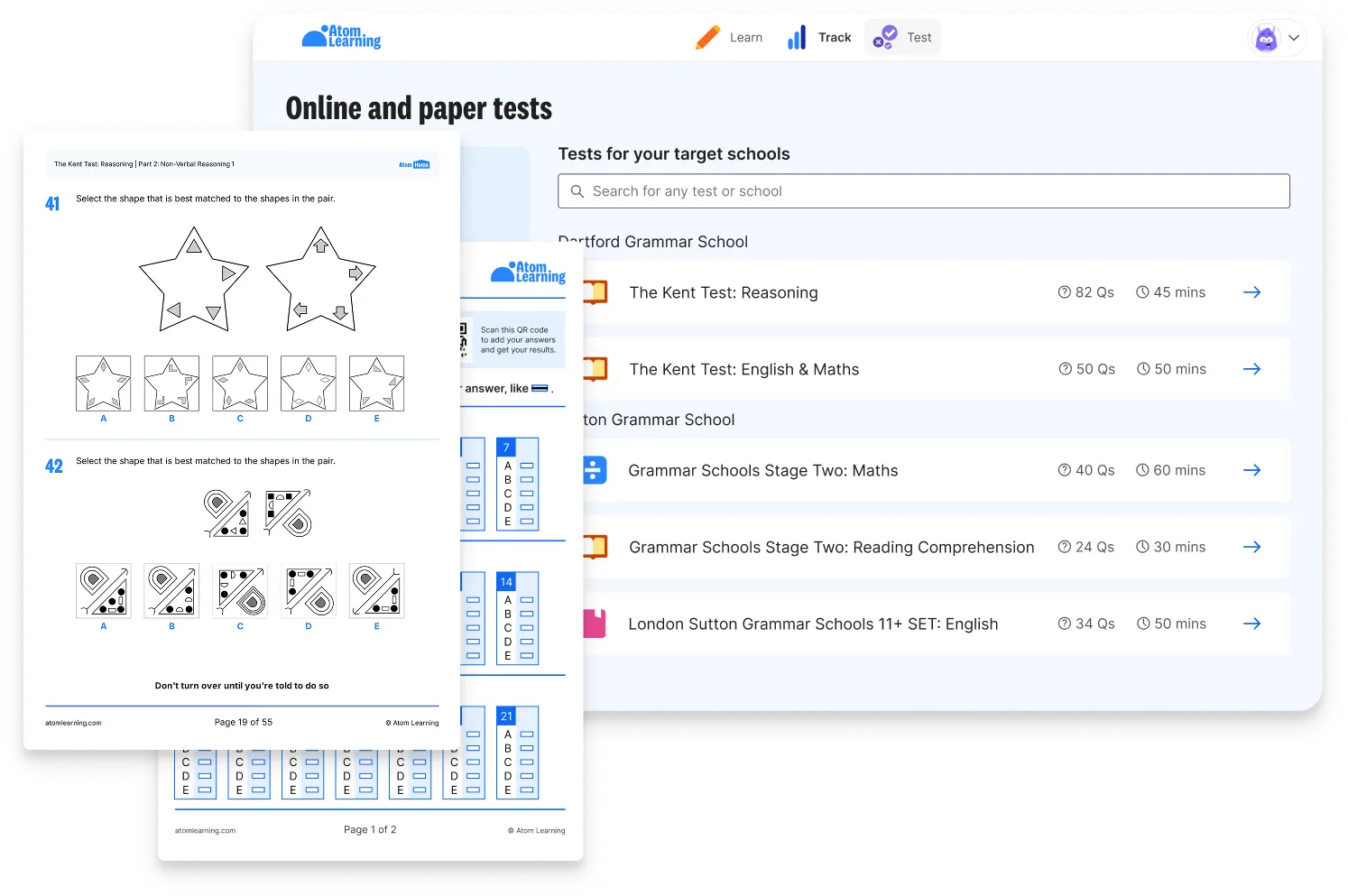
Atom's 11+ practice papers are built to match the format, timing and question styles of real 11+ exams. They're also unlimited — you can download the same paper again and again, and your child will get new questions each time. This helps them practise without repeating the same content.
We've made marking easy for you, too. Simply photograph your child's answer sheets and upload them to Atom. The papers are marked instantly, showing your child's standardised age score (SAS), where they're doing well, and what they should focus on next. You'll also learn how they compare to other children applying to the same school.
Encourage regular reading
Strong reading skills play a big role in 11+ preparation.
Encourage your child to read every day, even for just 10–15 minutes. The key is variety. Mix fiction and non-fiction, different genres, and a range of authors. This helps them become more confident in understanding tone, purpose, and meaning across different texts.
Over time, regular reading will:
broaden their vocabulary
improve comprehension and inference
build confidence in tackling unseen texts
And just as importantly, it can help them enjoy reading — not just see it as exam preparation.
When you're supporting your child through 11+ preparation, what really matters is knowing they're moving in the right direction — not just how they scored on a single test.
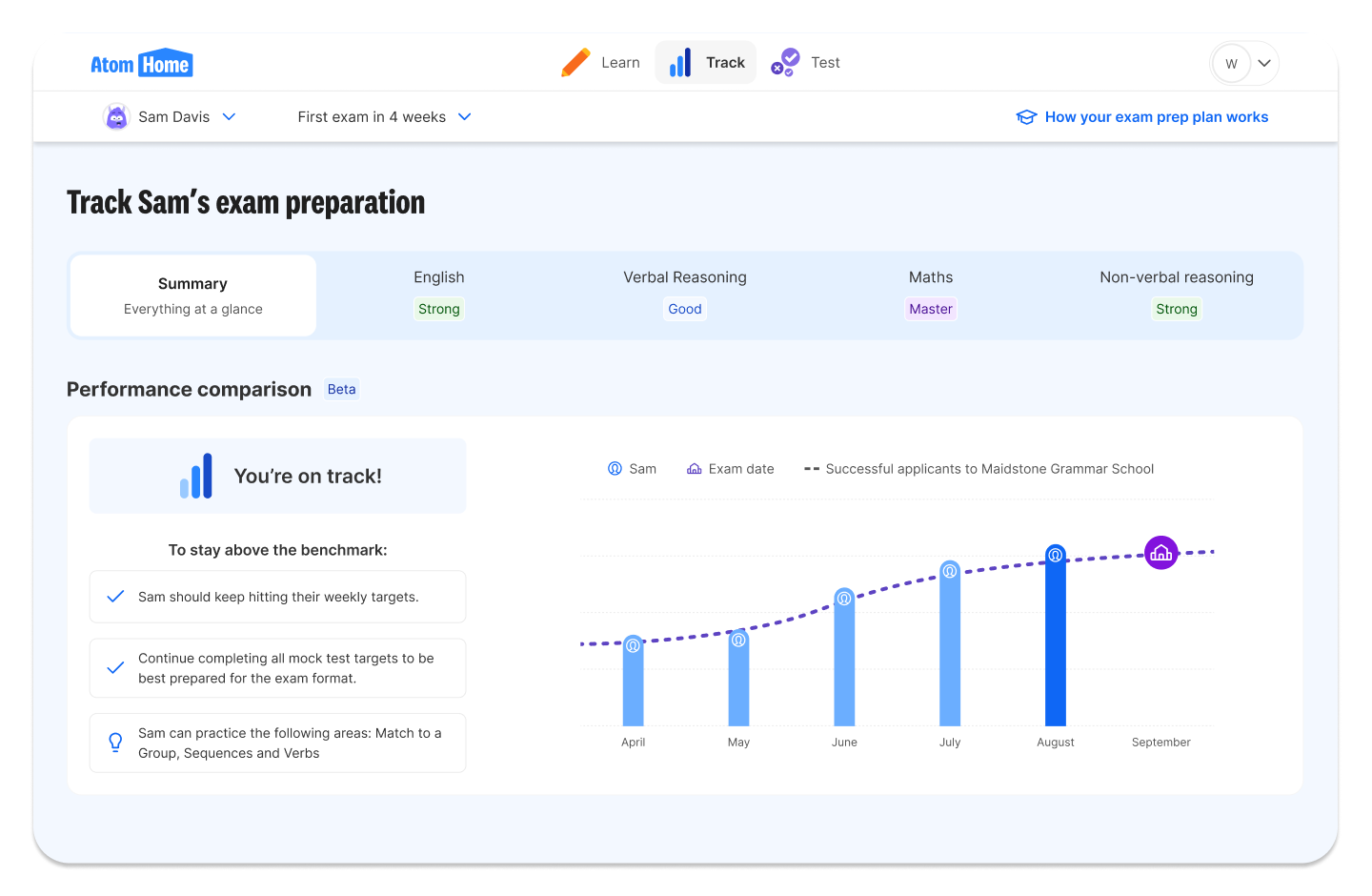
Atom's progress tracking gives you a clear, simple picture of how your child is doing in each topic and the direction they're moving in. You can see where they're on track, where they might need more practice, and spot progress as it happens.
That makes it easier to give meaningful encouragement, keep motivation steady, and focus on what matters most: consistent improvement, not just one-off results.
No items found.
Take control of your child’s 11+ preparation.
Not sure if your child is on track for the grammar school 11+? You don’t need to guess what to cover or whether they’re ready. Atom shows you exactly what to practise each week and how they’re performing, so you can stay ahead of the process without the stress.