Are you considering a grammar school in Lincolnshire for your child? We’ve collated everything you need to know about admissions in 2025–2026. Keep reading to:
- Find out more about grammar schools in Lincolnshire
- Learn about the Lincolnshire Consortium of Grammar Schools 11 plus exam
- Discover which subjects your child will be tested on
- Plus, get exclusive resources to help your child prepare!
What is the Lincolnshire Consortium of Grammar Schools?
The Lincolnshire Consortium of Grammar Schools is a group of grammar schools in Lincolnshire which use the same 11 plus exam. There are 15 grammar schools in total:
Co-educational (mixed) grammar schools
- Bourne Grammar School
- King Edward VI Grammar School, Louth
- King Edward VI Academy, Spilsby
- Queen Elizabeth’s Grammar School, Alford
- Queen Elizabeth’s Grammar School, Horncastle
- Queen Elizabeth’s High School, Gainsborough
- Skegness Grammar School
Boys’ grammar schools
Girls’ grammar schools
- Boston High School for Girls
- Kesteven and Grantham Girls’ School
- Kesteven and Sleaford High School
- Spalding High School
Caistor Grammar School is not a member of the Lincolnshire Consortium. The school uses its own bespoke 11 plus test and has separate admissions dates.
Dates for your diary
- Friday 10th January 2025: Lincolnshire Grammar School 11+ registration opens
- Monday 31st March 2025: Lincolnshire Grammar Schools 11+ registration closes
- Saturday 13th September 2025: Lincolnshire Grammar Schools 11+ verbal reasoning paper
- Saturday 20th September 2025: Lincolnshire Grammar Schools 11+ non-verbal reasoning paper
- Mid-October 2025: Lincolnshire Grammar Schools 11+ results day
- Friday 31st October 2025: secondary school common application deadline
- Monday 2nd March 2026: national school offers day
Dates can vary, so always check with your target schools!
What is the Lincolnshire Consortium of Grammar Schools 11 plus?
The Lincolnshire Consortium of Grammar Schools 11 plus is an academic entrance test. It’s used by the 15 grammar schools in the Consortium. If you’re interested in more than one grammar school in Lincolnshire, your child will only have to take the exam once.
The exam takes place in September in Year 6. Children who were born between 1st September 2014 and 31st August 2015 will take the first paper on Saturday 13th September 2025 and the second paper will take place on Saturday 20th September 2025.
The test is designed to be challenging. Grammar schools use the 11 plus to select children working in the top ability range in their year group. Children who are working at least within the top 25% of their year group are normally well-suited for grammar school.
What's on the Lincolnshire 11 plus?
The Lincolnshire entrance test consists of two papers provided by GL Assessment. Most grammar schools in the UK use 11 plus papers provided by GL Assessment.
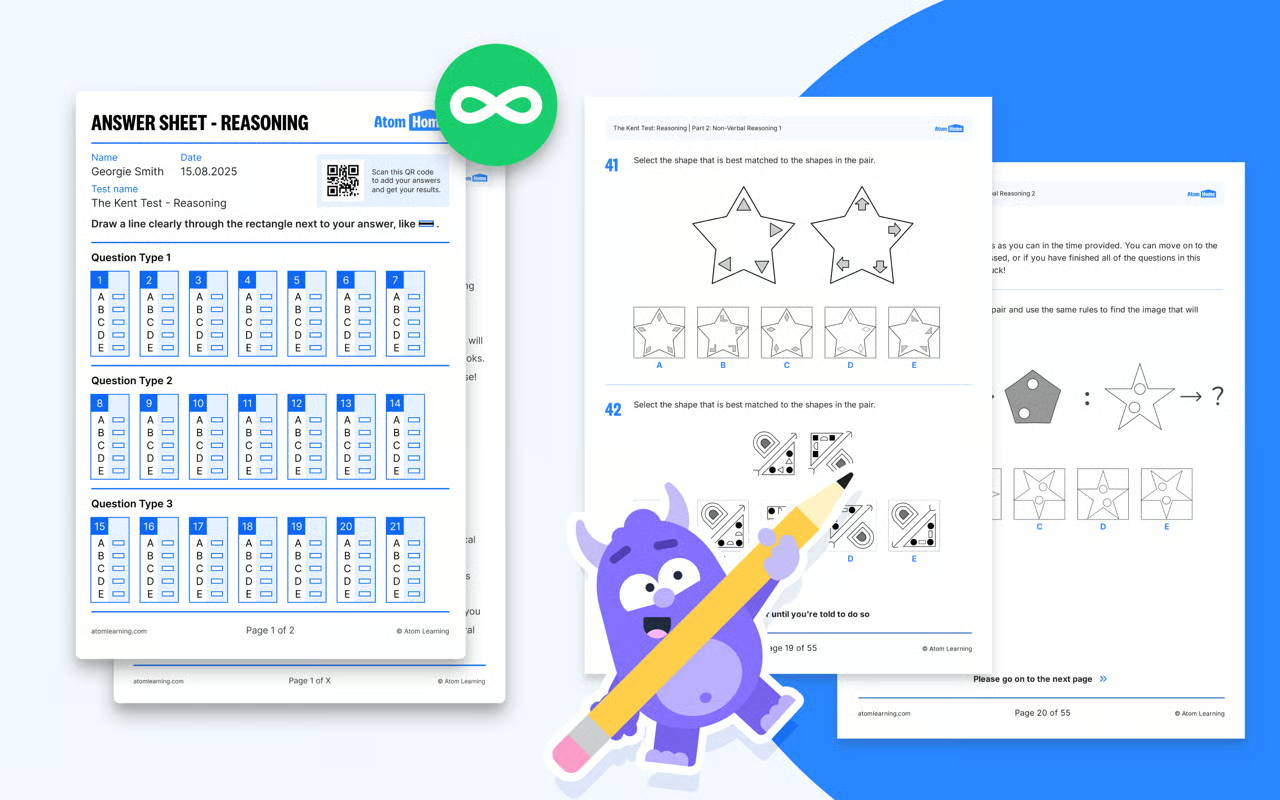
Both papers are multiple-choice. Your child will have separate pre-printed answer sheets, which they will use to mark the answer(s) they think are correct.
The two papers assess verbal reasoning and non-verbal and spatial reasoning. These subjects are not taught on the national curriculum, so your child might be unfamiliar with these types of questions. Grammar schools often use 11 plus verbal and non-verbal reasoning papers because they analyse children’s academic potential, rather than what they have already learned.
There is a short unmarked practice exercise at the start of each test to help your child understand how to answer the different types of questions.
Verbal reasoning
Verbal reasoning involves reasoning with written information, such as words, letters, numbers and symbols. Your child will need to understand how words are produced and used, and the relationships between them. They might also need to use logic to solve codes and work out the next item in a sequence.
Common types of verbal reasoning questions include:
- Vocabulary: identifying synonyms, antonyms, homonyms, odd ones out, and spotting connections
- Finding words: solving anagrams, jumbled words, jumbled sentences, and finding a missing word
- Building words: joining words, morphing words, transferring letters, and identifying missing letters
- Codes and sequences: solving codes and/or sequences using letters, numbers, and/or symbols
- Logic: statement logic, number logic, letter logic and deductions
The verbal reasoning paper lasts 50 minutes and consists of 80 questions. These are split into around 15 sections, with 5–6 questions of the same style in each section.
Non-verbal and spatial reasoning
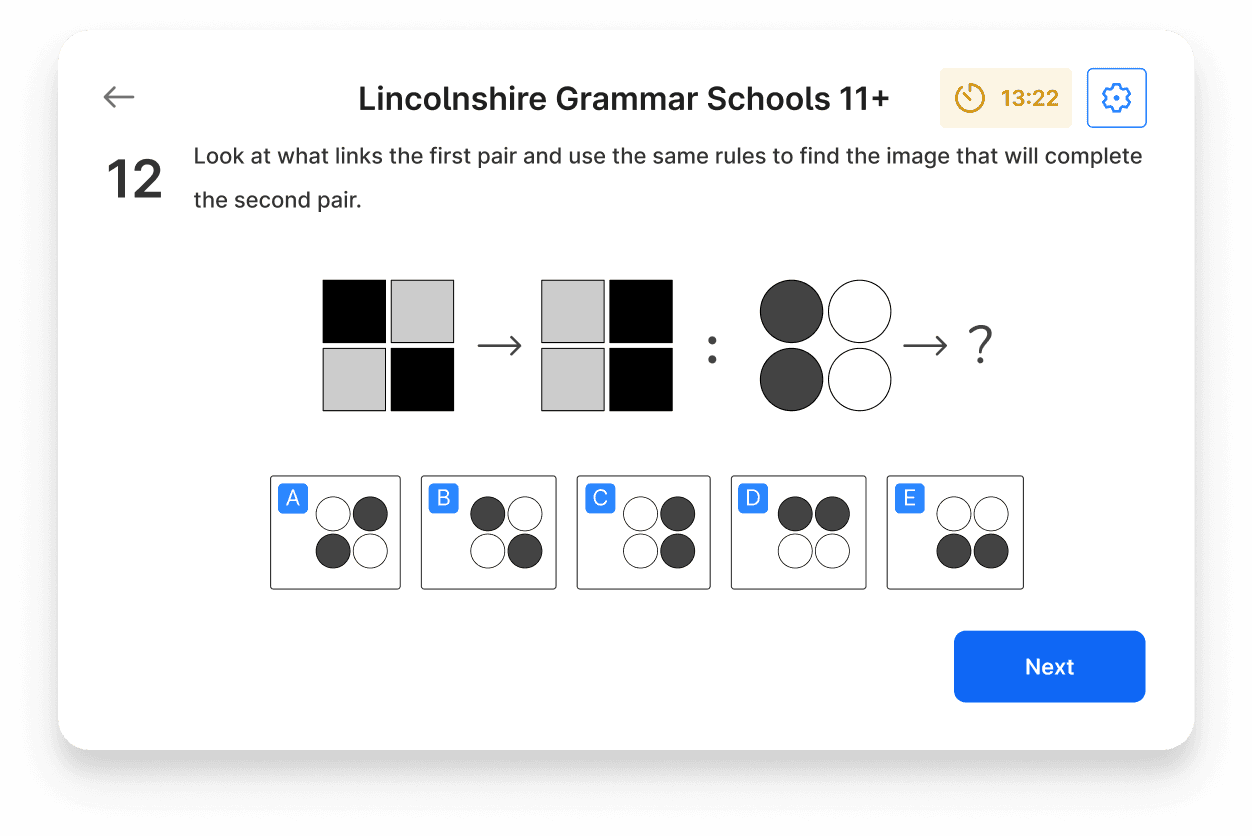
Non-verbal and spatial reasoning involves reasoning with visual and abstract information, such as shapes, diagrams and pictures. Your child might need to look at the relationships between shapes and sequences of shapes by spotting common features from a set of shapes and applying them to a new figure. Some questions might ask them to solve codes, where they will need to match features of a shape with particular letters.
Non-verbal reasoning usually involves interpreting shapes. Common question types include pairing shapes, solving sequences, solving matrices, finding a code, spotting the odd one out, and matching to a group/pair.
Spatial reasoning usually involves manipulating shapes. Common question types include finding parts within a shape, shape logic, rotations and reflections, and following folds
This paper consists of 70 questions. These are split into five sections – three non-verbal reasoning sections, and two spatial reasoning sections – with around 14 questions in each section.
Your child will work through each section at a time following instructions from their invigilator. Each section has a time limit of around 7 minutes (after the practice questions have been completed). They will not be able to move onto the next section until they are told to do so.