Dover Grammar School for Girls 11+ guide
Applying to Dover Grammar School for Girls for September 2028? This guide covers the Kent Test and the school's own Dover Test, the qualifying score, how the 140 Year 7 places are allocated and the key dates for September 2028 entry.
Dover Grammar School for Girls 11+ at a glance
The details below follow Dover Grammar School for Girls's most recently published arrangements, for September 2027 entry, as set out in Kent County Council's 2027/28 admission arrangements. The school confirms each cycle's figures in the spring — we'll update this page as soon as the 2028-entry arrangements are published.
- School type: girls' grammar school
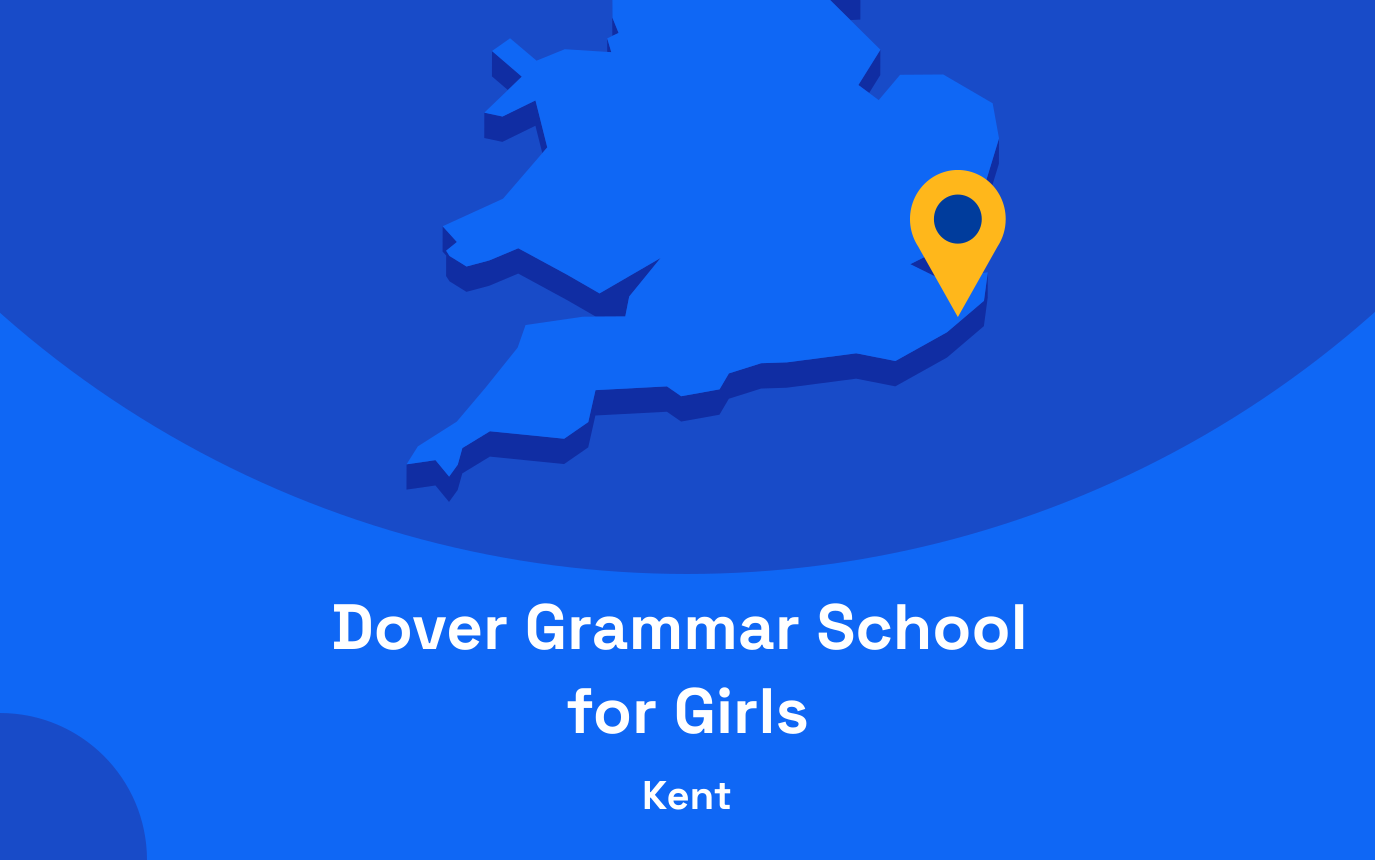
- Location: Dover, Kent
- Admissions contact: enquiries@dggs.kent.sch.uk
- Number of places in Year 7: 140 (2027-entry figure — Dover Grammar School for Girls confirms each year's admission number in its determined arrangements, published the spring before entry.)
- Qualifying score: Girls qualify by passing either the Kent Test or the school's own Dover Test. Kent County Council sets the qualifying score after each test. After the 2025 test (for September 2026 entry), children needed a total of 332 or more, with no single score below 108. Dover Grammar School for Girls hasn't published a pass standard for the Dover Test for 2028 entry. Qualifying girls are then offered places using the criteria below, not by score.
- 11+ test: Kent Test (two multiple-choice papers of about an hour each, plus a writing task that isn't marked; or the school's own Dover Test (an English paper and a maths paper))
- Catchment or priority area: no — distance is the last criterion
Source: Kent County Council Admissions Arrangements for 2027/28 (Dover Grammar School for Girls section). Last checked October 2026.
Key dates for September 2028 entry
Kent County Council runs the Kent Test and sets its dates in the county's co-ordinated admissions scheme, and Dover Grammar School for Girls sets the dates for its Dover Test. Neither has published 2028-entry dates yet, so the windows below follow the 2027-entry timetable. For the Kent Test, registration ran from Monday 1 June 2026 to Wednesday 1 July 2026, the test took place on Thursday 10 September 2026 for children at Kent primary schools (the weekend of 12 and 13 September 2026 for everyone else) and results were due on Thursday 15 October 2026. The Dover Test normally takes place on a Saturday in September; the school hasn't published Dover Test registration or results dates for 2028 entry, and we don't have a previous cycle's Dover Test dates on file. We'll update this page as soon as the 2028-entry dates are published.
About Dover Grammar School for Girls
Dover Grammar School for Girls is a selective state school for girls aged 11–18 with a mixed sixth form. It is rated ‘outstanding’ by Ofsted and consistently achieves high academic results. The school promotes early discussions about university choices through its Project ROAR (Russell Group or Alternative Ready).
The school offers an impressive range of extracurricular opportunities. Clubs include computer science, dissection, debate, British Sign Language, a student-led magazine, biodiverse gardening, and a variety of sports.
How to apply to Dover Grammar School for Girls
Dover Grammar School for Girls is selective, so your child needs to sit the 11+ test to be considered for a place.
You register your child for the Kent Test with Kent County Council during its registration window. Late registrations go to Kent County Council by email at kent.admissions@kent.gov.uk. The Dover Test needs a separate registration, on the school's online application form.
Once you have your child's result, you apply by naming Dover Grammar School for Girls on your common application form, which goes to your home local authority. Application deadline: Sunday 31 October 2027. This is the national closing date. Kent County Council has in the past moved the deadline to the following Monday when 31 October falls on a weekend — it did so for 2027 entry, when the date moved to Monday 2 November. The council confirms its own closing date in its co-ordinated admissions scheme, usually published the year before. Treat 31 October as the date to work to, and check the council's scheme before you submit.
Reaching the qualifying score makes your child eligible, but it doesn't guarantee a place. If more qualifying children apply than there are places, the school uses its oversubscription criteria, set out further down this page.
What will my child be tested on?
The Kent Test is run by Kent County Council and used by the grammar schools across Kent, so your child only sits it once to be considered for any of them. Kent County Council says the tests in English, maths and reasoning are devised by GL Assessment.
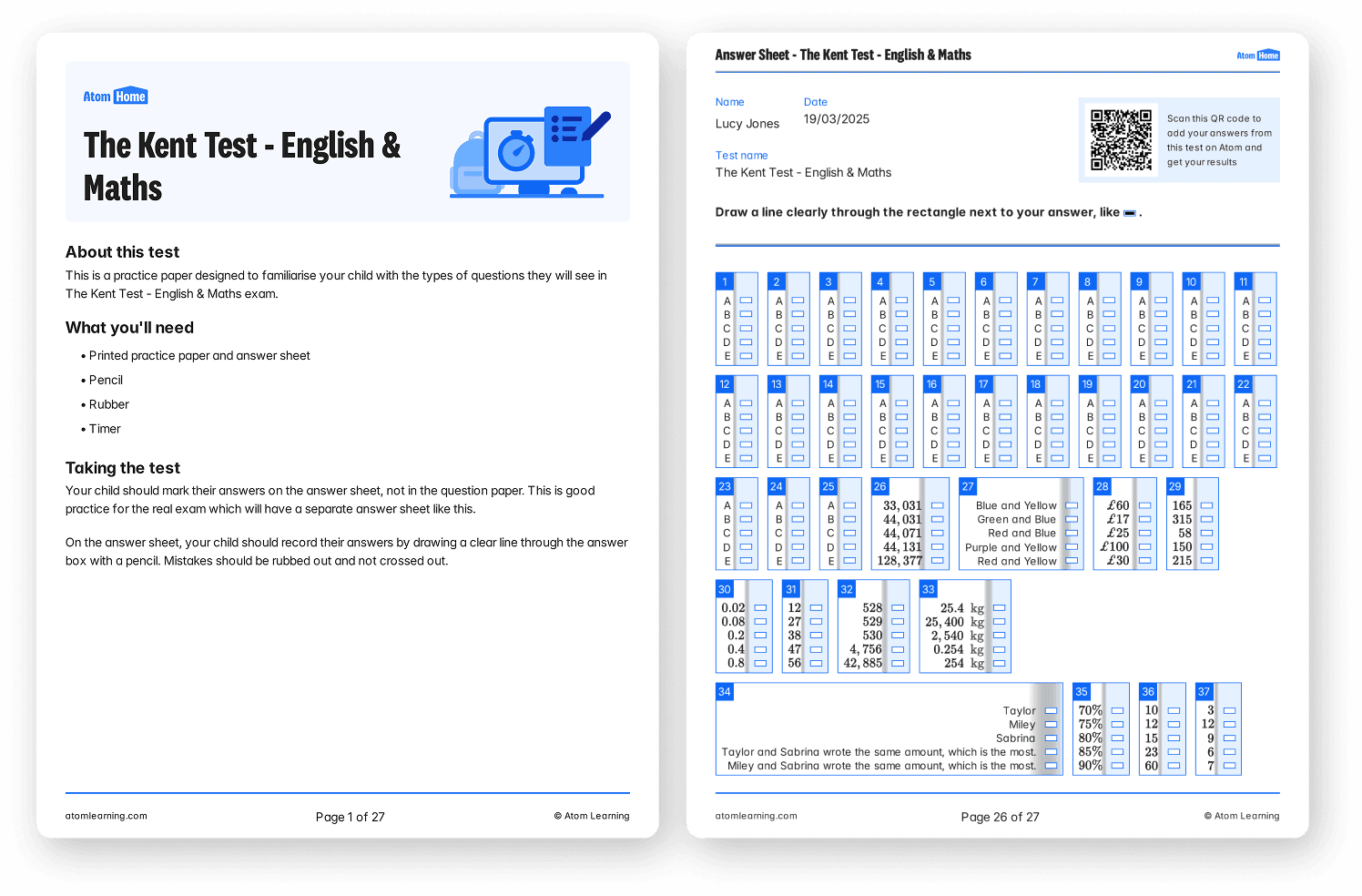
There are two multiple-choice papers, and answers go on a separate answer sheet. The first is an English and maths paper lasting an hour. Each section starts with a 5-minute practice exercise, followed by a 25-minute test. The English section is a comprehension exercise plus questions on literacy skills. The second is a reasoning paper of about an hour, including practice, with verbal and non-verbal reasoning sections of roughly the same length.
Your child also completes a writing task. It lasts 40 minutes, including 10 minutes of planning. It isn't marked, but a local headteacher panel may read it as part of the headteacher assessment stage. Results give three standardised scores, for English, maths and reasoning, plus a total. Each score ranges from 69 to 141.
Dover Grammar School for Girls also accepts its own Dover Test, so girls can qualify through either test. The school says the Dover Test is run by Quest Assessments, a provider of 11+ assessments, and the school has confirmed that your child sits an English paper and a maths paper. Paper lengths and question formats are published in the familiarisation material released before the test. Quest Assessments' Dover Test page adds that it is a paper test and isn't adaptive. All questions are multiple choice, usually with five options (A to E). Answers go on a separate answer sheet rather than being written out: your daughter draws a clear horizontal line through the box next to her chosen answer.
The Dover Test normally takes place on a Saturday in September, and you register for it on the school's online application form. Quest Assessments doesn't respond to individual enquiries from parents, so questions about the Dover Test go to the school at enquiries@dggs.kent.sch.uk. This is a different test from the Dover Boys Test used by Dover Grammar School for Boys.
The official familiarisation materials for the Dover Test are on the Quest Assessments parent guidance page. Read our guide to the Quest Admissions exam for what the test looks like and how it's marked.
The table below shows what each paper covers.
How are places allocated at Dover Grammar School for Girls?
If more children reach the qualifying standard than there are 140 Year 7 places, Dover Grammar School for Girls offers places in the order below. This order comes from the school's admissions policy for 2027/28. The school sets its 2028-entry policy separately, and we'll update this table if anything changes.
Does Dover Grammar School for Girls have a catchment area?
Dover Grammar School for Girls doesn't have a catchment area. Once the priority groups above have been offered places, the remaining places go to qualifying girls who live nearest the school, measured in a straight line from home to school.
If two or more girls are otherwise equal for the last place, names are given a number and drawn at random, supervised by someone independent of the school.
If you don't live close to the school, it's worth thinking about how your child will get there every day. How long will the journey take? What transport options are available? Will they be travelling independently or with support?
A longer or more complex journey can affect your child's daily routine, including how much time they have for homework, rest and after-school activities. It's a good idea to think about how manageable the school run will be and whether it will work for your family day to day.
How can I help my child prepare for the Dover Test?
Quest Assessments publishes official familiarisation materials for the test, and that is where families should start. Atom is not an authorised source for this test and has no access to its content. The guidance below is about building the skills the test draws on.
The curriculum doesn't change
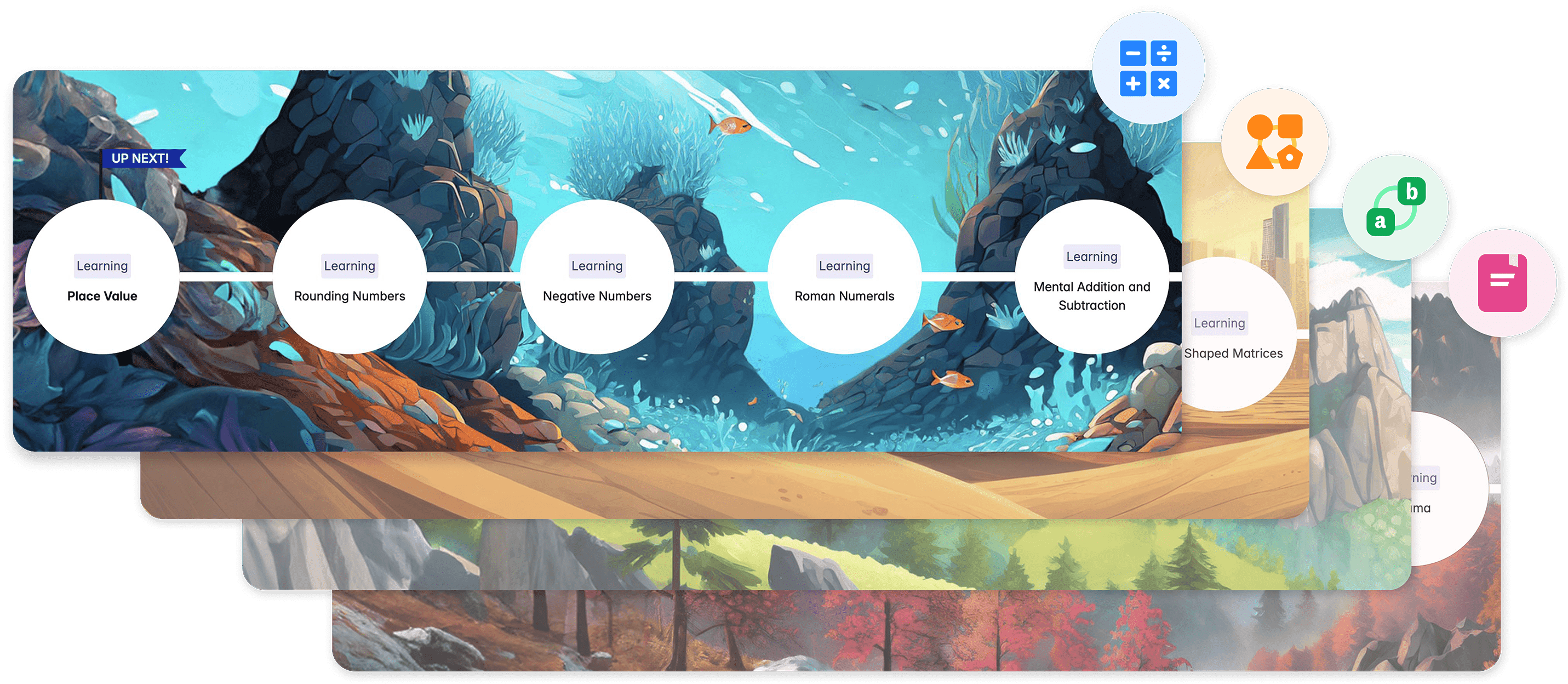
The test draws on the Key Stage 2 curriculum, which is the same material every 11+ test is built from. Atom Home covers that curriculum with over 100,000 teacher-written practice questions across English, maths, verbal reasoning and non-verbal reasoning, so the work a child does is useful whichever test they end up sitting.

Find the gaps early
Atom's progress insights show which topics and question types a child finds hardest, so revision goes where it's actually needed rather than across everything equally.
Practise the conditions, not the questions
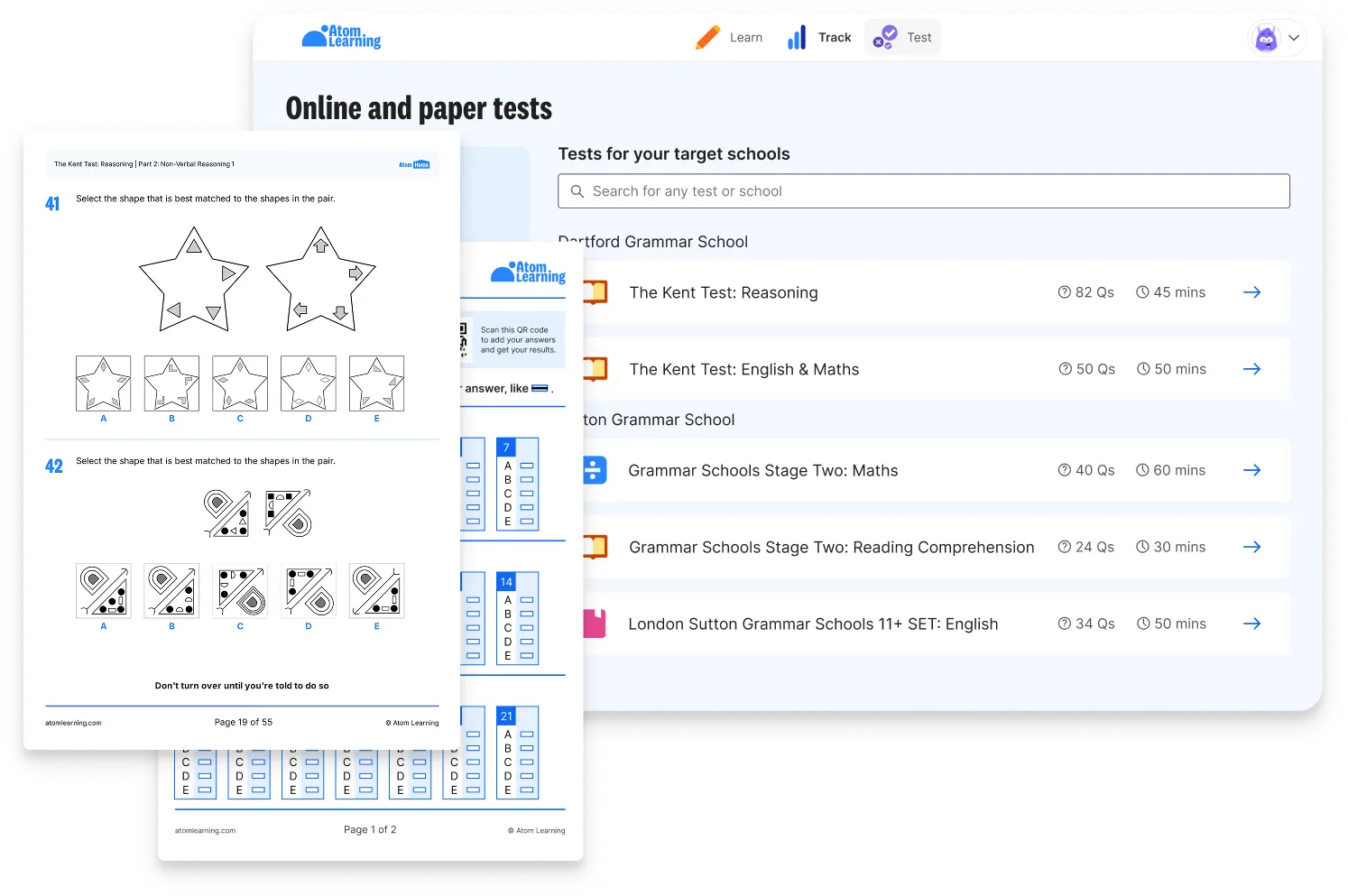
Atom's mock tests are built to give children practice working to time, reading an answer sheet and holding their nerve for a full paper. Each one returns a Standardised Age Score and a breakdown of where accuracy dropped under timed conditions.

Take control of your child’s 11+ preparation.

Not sure if your child is on track for the grammar school 11+? You don’t need to guess what to cover or whether they’re ready. Atom shows you exactly what to practise each week and how they’re performing, so you can stay ahead of the process without the stress.
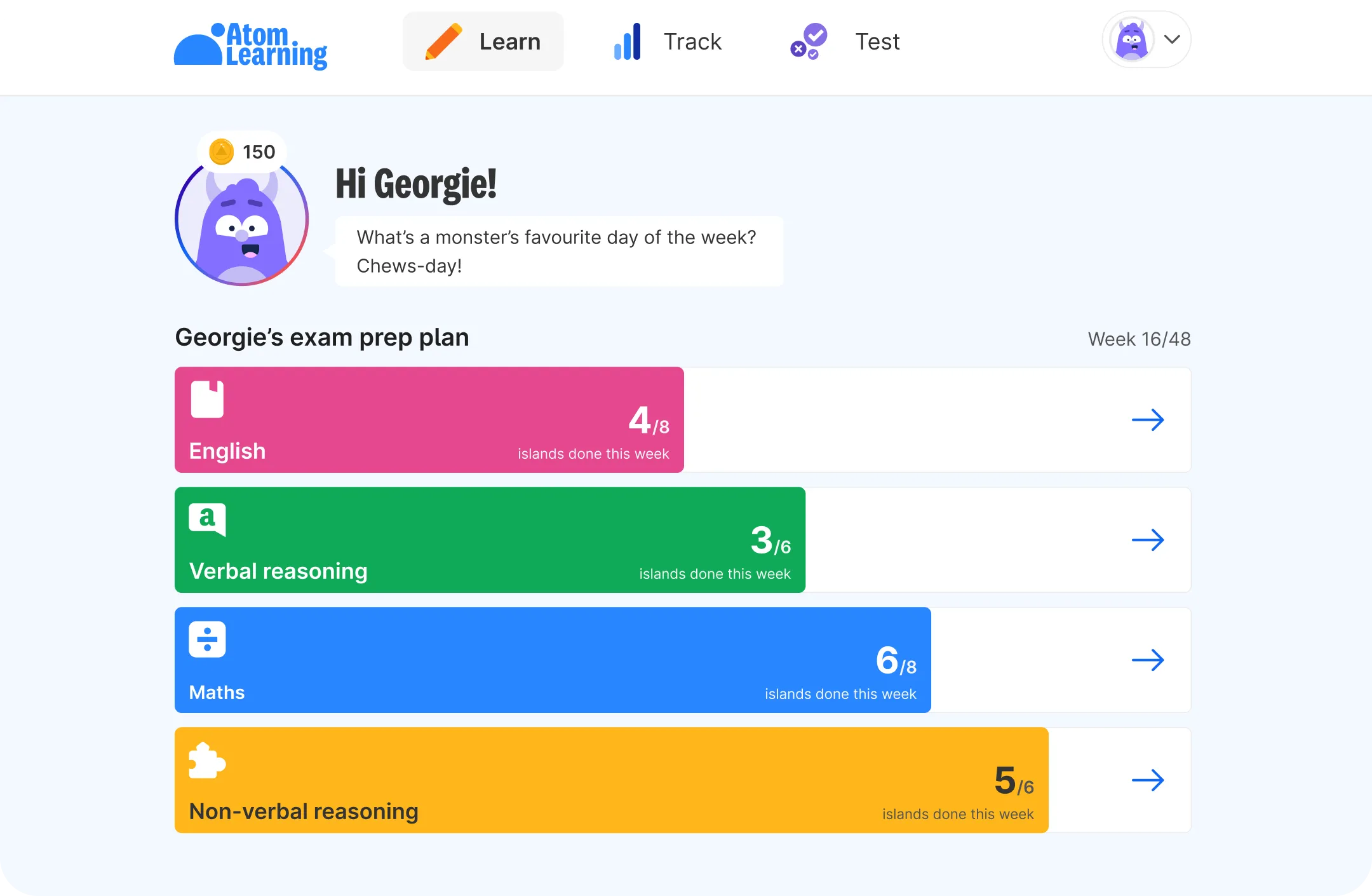
- Follow personalised weekly exam plans that show them what to learn next.
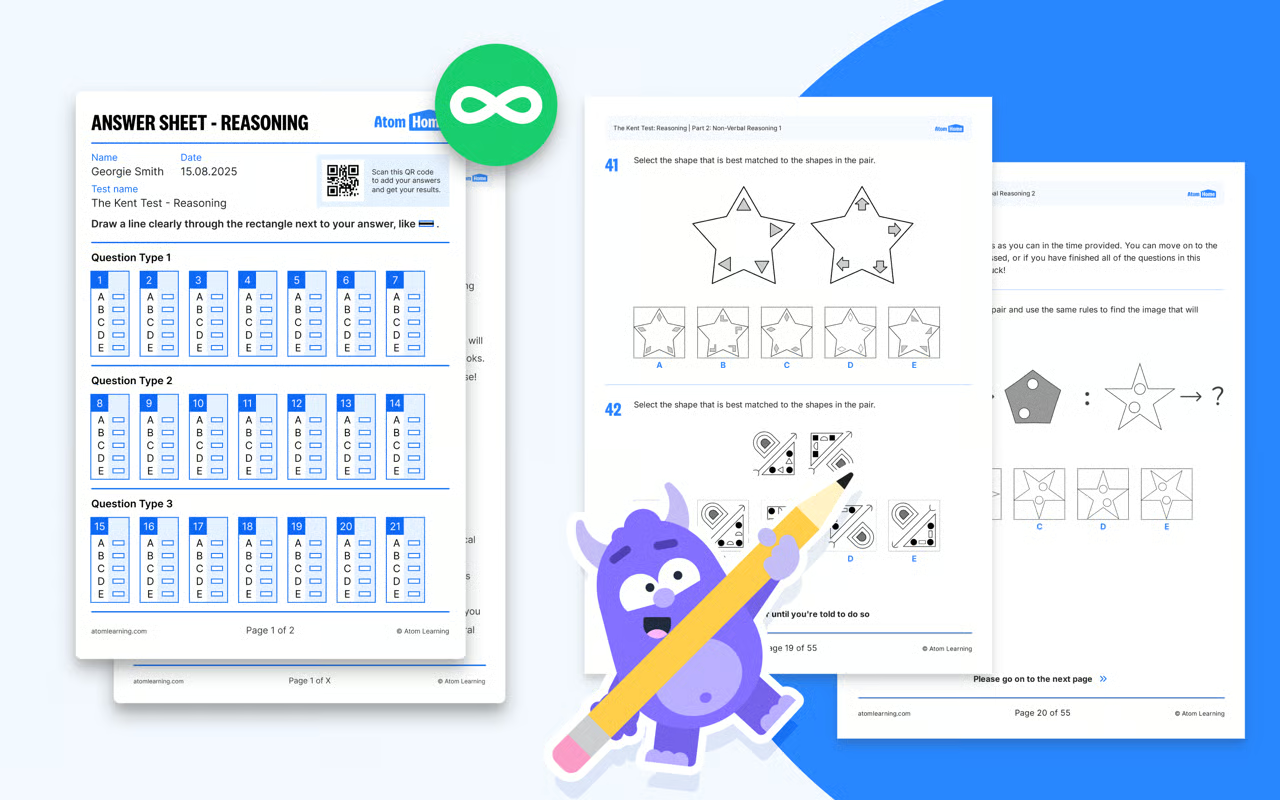
- Download realistic 11+ practice papers and upload a photo for instant, stress-free marking.
- Track progress and see how they compare to others applying to the same schools.
Start your free trial and help your child feel fully prepared for the 11+.